The Bullroarer Atlas

LOEB1929-030 - ethnographic attestation

Quinault

United States - Washington coast - North America - Northwest Coast

Play / practical

A Hopi bull-roarer, a short rectangular board painted with a red diamond between black crossed diagonals, one end notched and the other drilled...
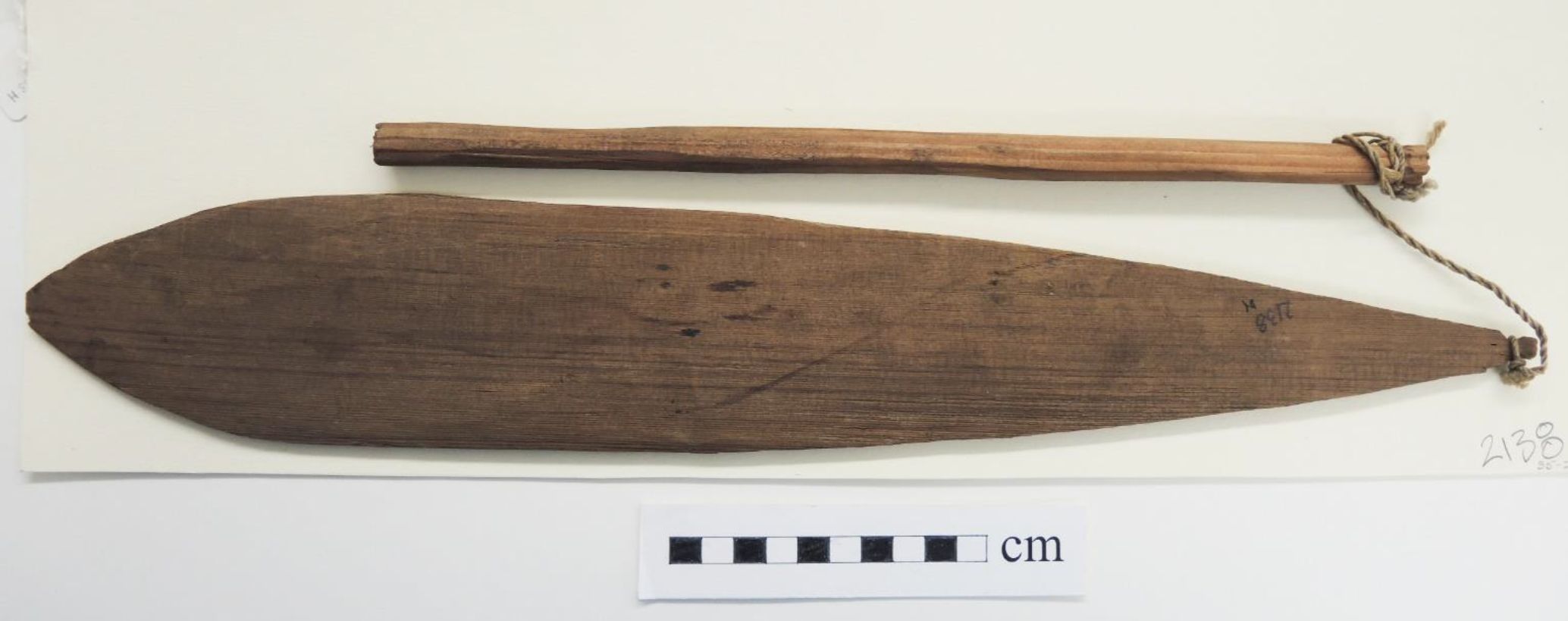
Representative image. A Hopi bull-roarer, a short rectangular board painted with a red diamond between black crossed diagonals, one end notched and the other drilled for a cotton cord ending in a small wooden toggle; no photograph of a Quinault instrument from the Washington coast has been found, so this Southwest piece is shown for the general North American form. Kulturhistorisk museum, Universitetet i Oslo (Etnografisk) (UEM13727) CC BY-SA Image source

Source term: bullroarer

Edwin Loeb's 1929 survey of initiation rites singled out the Kwakiutl as the only Northwest Coast people to use the bullroarer ceremonially, whirling it in secret during the winter dance as the voice of the spirit come to carry off the novice, sounded four times. Among the neighboring Quinault of the Washington coast the same instrument was present, but only as a child's toy; in the secret-society rites the sounding of spirits was done with rattles instead. The distinction comes from a table Loeb credited to his Berkeley colleague Ronald Olson, who marked the Quinault entry under bullroarer as "Rattles, X (as toy)." Loeb adds that among the Quinault the novice was cut and bones were thrust through the flesh of the arms.

The Kwakiutl are the only tribe of the Northwest which makes ceremonial use of the bullroarer. … The Quinault also have the instrument, but only as a toy.

Loeb 1929:274
Function
Loeb's table notes a bullroarer among the Quinault only as a toy, with rattles as the ceremonial sounder.
Map confidence
medium - representative on-land anchor at Quinault (regional coordinate fell just offshore of the rendered coastline); not an exact findspot
Source location
p. 274

View source Open this point on the interactive map