No. KOCH1992-001
Gadebusch Schwirrplättchen (decorated bone plate)
Germany · Mecklenburg · Gadebusch · Central Europe
Function not recorded
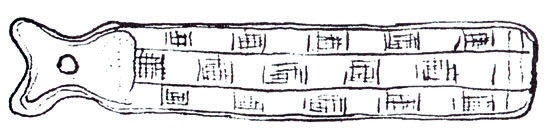
Schwirrplättchen
Source term: Schwirrplättchen (Koch 1992)
Schwirrplättchen — German, 'little whirring plate', the music-archaeological term for small bone bullroarer plates.
The bone plate from Gadebusch is dressed for the part: rectangular with rounded corners, a fish-tail worked at the pierced end, its surface covered in lines and checkerboard patterns. Robert Beltz's great Mecklenburg inventory of 1910 filed it modestly — a 'decorated bone implement with a hole for hanging'. Eight decades later the music archaeologist Klaus-Peter Koch called it what he judged it to be: a Schwirrplättchen, a bullroarer plate, kin to the whirred bone of the Mesolithic camps at Pritzerbe and the reindeer-hunter blades Rust spun in his Stellmoor experiments. Only its age stays unsettled: Bronze Age by Koch's reading, early Iron Age by Beltz's own shelf.
Das bronzezeitliche Schwirrplättchen aus Gadebusch besaß eine rechteckige Form mit abgerundeten Ecken und an dem gelochten Ende die Ausarbeitung eines 'Fischschwanzes'.
The Bronze Age bullroarer plate from Gadebusch had a rectangular form with rounded corners and, at the pierced end, the working-out of a 'fish-tail'.
Klaus-Peter Koch (1992), p. 120
Particulars
- Object
- Decorated bone plate, slightly curved, rectangular with rounded corners, a 'fish-tail' worked at the pierced end, the surface ornamented with lines and checkerboard-like patterns.
- Function
- Identified as a bullroarer plate (Schwirrplättchen) by the music archaeologist Klaus-Peter Koch; no findspot use-context is recorded.
Source
Klaus-Peter Koch, 'Musikarchäologische Quellen aus dem östlichen Deutschland: Zwischenbericht,' Jahresschrift für mitteldeutsche Vorgeschichte 75 (1992), pp. 101–136, at p. 120; Robert Beltz, Die vorgeschichtlichen Altertümer des Grossherzogtums Mecklenburg-Schwerin (1910), p. 294, Taf. 47 no. 38