WINDL1996-001 - archaeological find
Schletz cattle-scapula plate
Weinviertel - Lower Austria, Asparn an der Zaya-Schletz - Central Europe
Function not recorded Candidate only
Source term: Schwirrknochen / Schwirrblatt
Schwirrknochen: German 'whirring bone'; Schwirrblatt, 'whirring blade' - the archaeological German terms for a bullroarer.
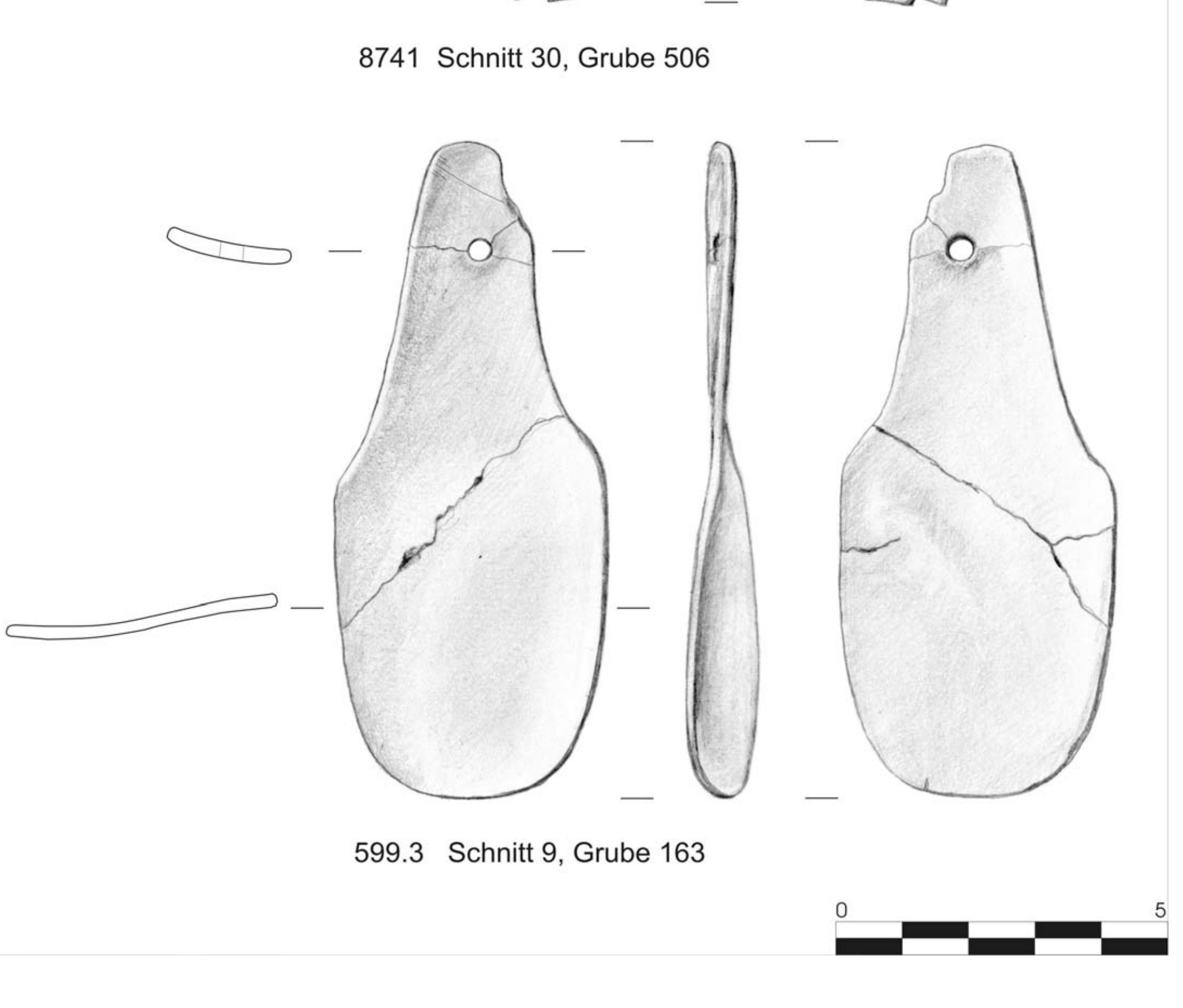
Someone in the last generations of the Linear Pottery culture cut a plate out of a cow's shoulder blade, ten centimetres long, no thicker than three millimetres, and drilled a single hole through the narrow stem at its top. It was thrown into a rubbish pit at Schletz, the fortified village in Lower Austria better known for the dead in its ditch, and dug up again in 1987. Helmut Windl thought it a whirling bone and cast a copy, which hummed when he swung it; a generation later Beate Maria Pomberger made her own and measured the note, down at the bottom edge of hearing. Both experiments show what the shape can do, not what it did - the thing is broad and curved like a small scoop, and the archaeologist who catalogued it lists pendant, whirling bone, spoon and scoop side by side.
- Object
- Flat plate cut and scraped from a cattle scapula, 10 cm long, 4.1 cm at maximum width and 2-2.9 mm thick; the lower half is elongated-oval and broadened like a scoop while the upper half narrows into a stem perforated at its end. Fnr. 599.3, excavated 1987. Fehlmann's Taf. 28 draws front, back, side and section at 1:1. The surface is poorly preserved, with no polish and no diagnostic manufacture or use-wear recorded.
- Function
- Not recorded.
- Source
- Daniela Fehlmann, Die Knochen-, Zahn- und Geweihartefakte der linearbandkeramischen Siedlung Asparn/Zaya-Schletz (NÖ), University of Vienna diploma thesis (2008), DOI 10.25365/thesis.1949, printed pp. 28 and 166-167 with n. 840 and Taf. 28: object number, locus, measurements, description, the record of Windl's Schwirrknochen interpretation and resin-cast…
- Source location
Page references
Fehlmann 2008, printed pp. 28 and 166-167 with n. 840, Taf. 28; Pomberger 2018, p. 8; Windl 1996, p. 27, Taf. 10; Fnr. 599.3, Schnitt 9, Grube 163
- Source confidence
- medium Settlement anchor for the fortified Linearbandkeramik site at Asparn an der Zaya-Schletz, Lower Austria, as carried in the evidence packet; not a coordinate for Schnitt 9 or Grube 163.