RAMSL2003-001 - archaeological find
Pottenbrunn twisted bone blade
Traisen valley near St. Pölten, Lower Austria (Niederösterreich) - Central Europe
Function not recorded Candidate only
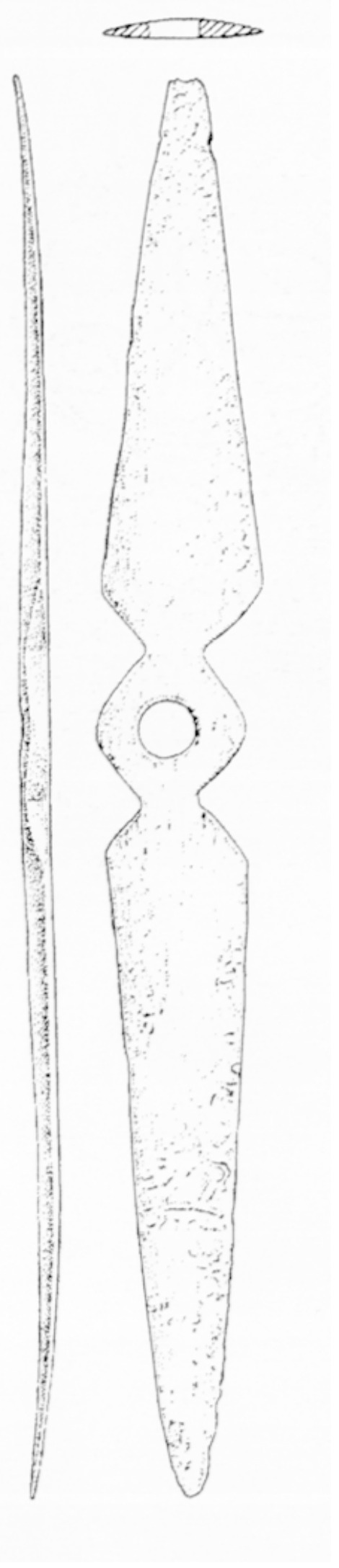
Source term: Schwirrholz / rhombe (Wamser 1983, as reported by Ramsl 2003)
Schwirrholz: German 'whirring wood', the standard German word for a bullroarer.
Late in the fourth or third century BC a man was buried at Pottenbrunn, in the Traisen valley of Lower Austria, with more weapons than most of his contemporaries were given and a spearhead grand enough to have been carried as a standard. He also took with him things no warrior needed: an iron tool that is blade, toothed edge and saw at once - the kit, it seems, of someone who cut into bodies, perhaps into skulls - and this thin bone blade, twisted like a propeller and pierced through its waist. Whirled on a cord it would be a bullroarer; hung and spun, it would be kin to the iynx, the magic wheel of Greek ritual. Whoever he was, the dead man seems to have known medicine, or rather pharmacy, and perhaps magic.
De forme hélicoïdale, percé d'un un [sic] trou plus ou moins central, l'artefact en os (Fig. 7.2) semble unique en contexte laténien.
Helical in form, pierced by a more or less central hole, the bone artefact (Fig. 7.2) seems unique in a La Tène context.
Peter C. Ramsl, "La nécropole laténienne de Pottenbrunn" (2003), p. 252.
- Object
- Long, thin, flat bone blade twisted into a helix like a propeller, lenticular in section; the two arms taper to points either side of a waisted, diamond-shaped centre pierced by a single round hole. Found with an iron multi-purpose instrument combining a pointed blade, a finely toothed edge and a one-sided saw.
- Function
- Not recorded.
- Source
- citing L. Wamser, 'Herrenhöfe, Burgen und Großgrabhügel der Hallstatt- und Frühlatènezeit in Mainfranken: neue Befunde', Das Archäologische Jahr in Bayern 1983, pp. 72-76, at p. 75
- Source location
Page references
Ramsl 2003 pp. 251-252, Fig. 7.2; p. 256; Wamser 1983 p. 75
- Source confidence
- low
- Location note
- Pottenbrunn village anchor, St. Pölten; the cemetery lies just south-west of the village on an alluvial terrace on the right bank of the Traisen (Ramsl 2003 p. 247). Not a grave coordinate.
Regions: Europe