No. NAAIN-013
Naskapi birch blade in crayon
Canada · Labrador · Davis Inlet · North America · Subarctic
Play / practical
Source term: bull-roarer
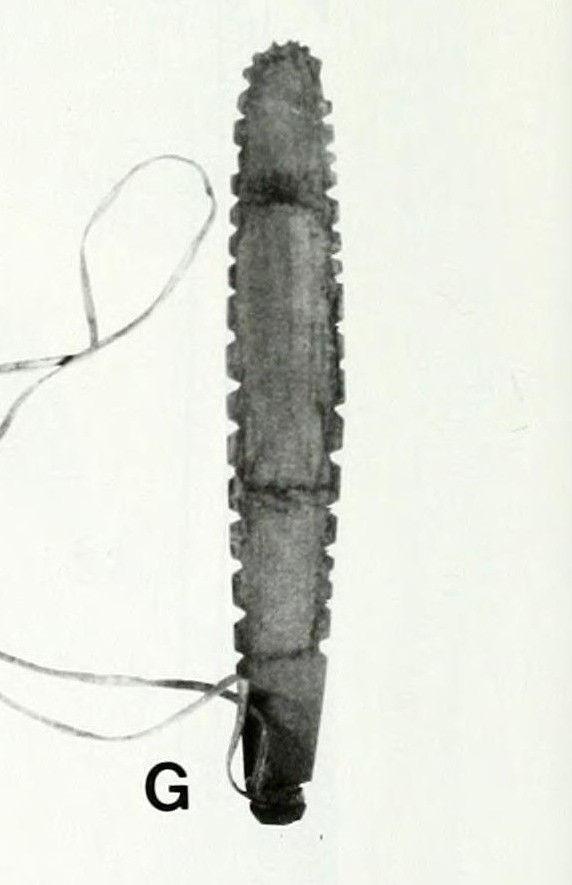
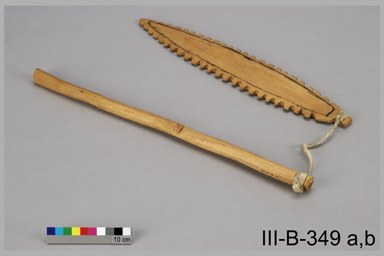
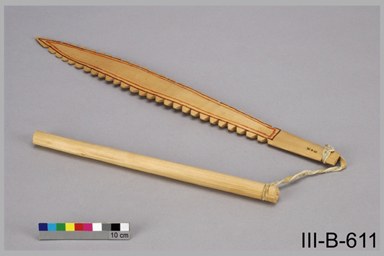
Notched all round and scribbled over in purple and red crayon, this birchwood oval was a Naskapi child's bull-roarer from Davis Inlet on the Labrador coast. William Duncan Strong collected it, one of four, on the Rawson-MacMillan Subarctic Expedition of 1927-28; it is now in the Field Museum. By then such toys were whirled and spun for the amusement of children and adults, but they had once belonged to what Frank Speck called "minor magical playing devices": the same set as the caribou-astragalus buzzer, originally a magical device, spun to make the wind rise.
The collection contains four bull-roarers, flat oval pieces of birchwood notched on all sides, to the ends of which are attached lengths of caribou skin, sinew, or twine. Two specimens have been crudely decorated with purple and red crayon. Strong (1928c, vol. 1) noted that the instrument was a child's toy and had no other function. It was sometimes tied to a stick.
VanStone 1985, Material Culture of the Davis Inlet and Barren Ground Naskapi (Fieldiana Anthropology n.s. 7), p. 35
Particulars
- Object
- Wooden bullroarer, Field Museum 176799.
- Function
- Grouped with games and toys; no further use recorded.
Source
James W. VanStone, Material Culture of the Davis Inlet and Barren Ground Naskapi, Fieldiana Anthropology n.s. 7 (1985), pp. 35, 47, 53–54, fig. 92G, specimen 176799