No. PNG145
Nakanai
Papua New Guinea · West New Britain · Oceania · Sahul
Play / practical
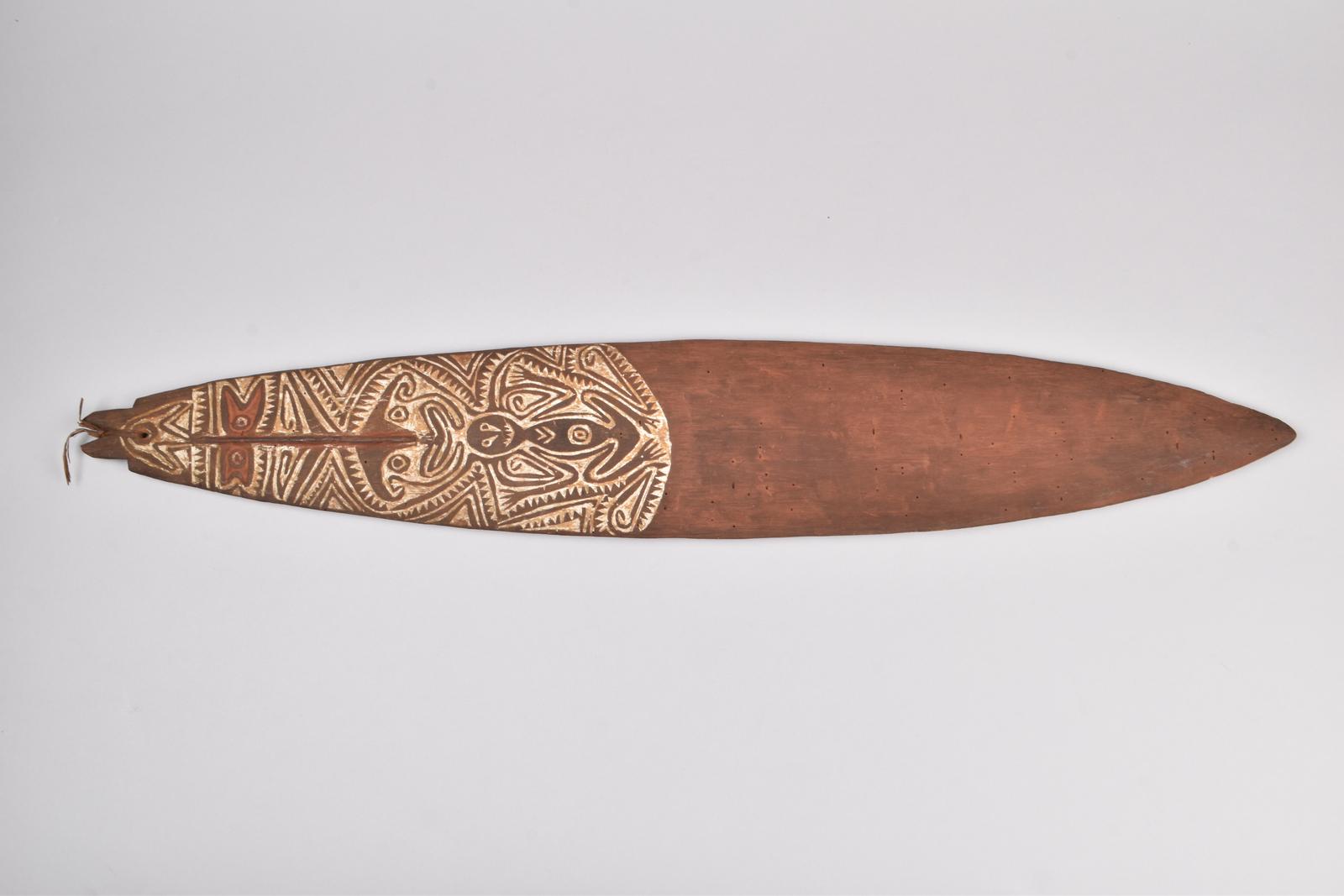
siko
Source term: siko (e-)
a bullroarer, glossed as a children's toy
Etymology. Written with the noun-marker prefix e- (e-siko).
Here the bullroarer is a toy. On New Britain's north coast the Nakanai call it siko and leave it to children, because the voice that truly commands fear comes from elsewhere: the valuku, clan-spirit masks that parade the villages each dry season, chasing and striking any woman or child who fails to flee. Where many peoples hid the sacred in a whirling blade, the Nakanai hid it behind a mask, and let the whirring wood dwindle to a plaything.
Particulars
- Function
- A children's toy.
Source
K. A. Gourlay, Sound-Producing Instruments in Traditional Society: A Study of Esoteric Instruments and Their Role in Male-Female Relations (New Guinea Research Bulletin 60; Canberra and Port Moresby, 1975), Table 1, entry 145; Ann Chowning and Ward H. Goodenough, Dictionary of Lakalai (Nakanai), s.v. siko, and English-Lakalai section, p. 261