No. PNG152
Tolai
Papua New Guinea · East New Britain · Oceania · Sahul
Play / practical
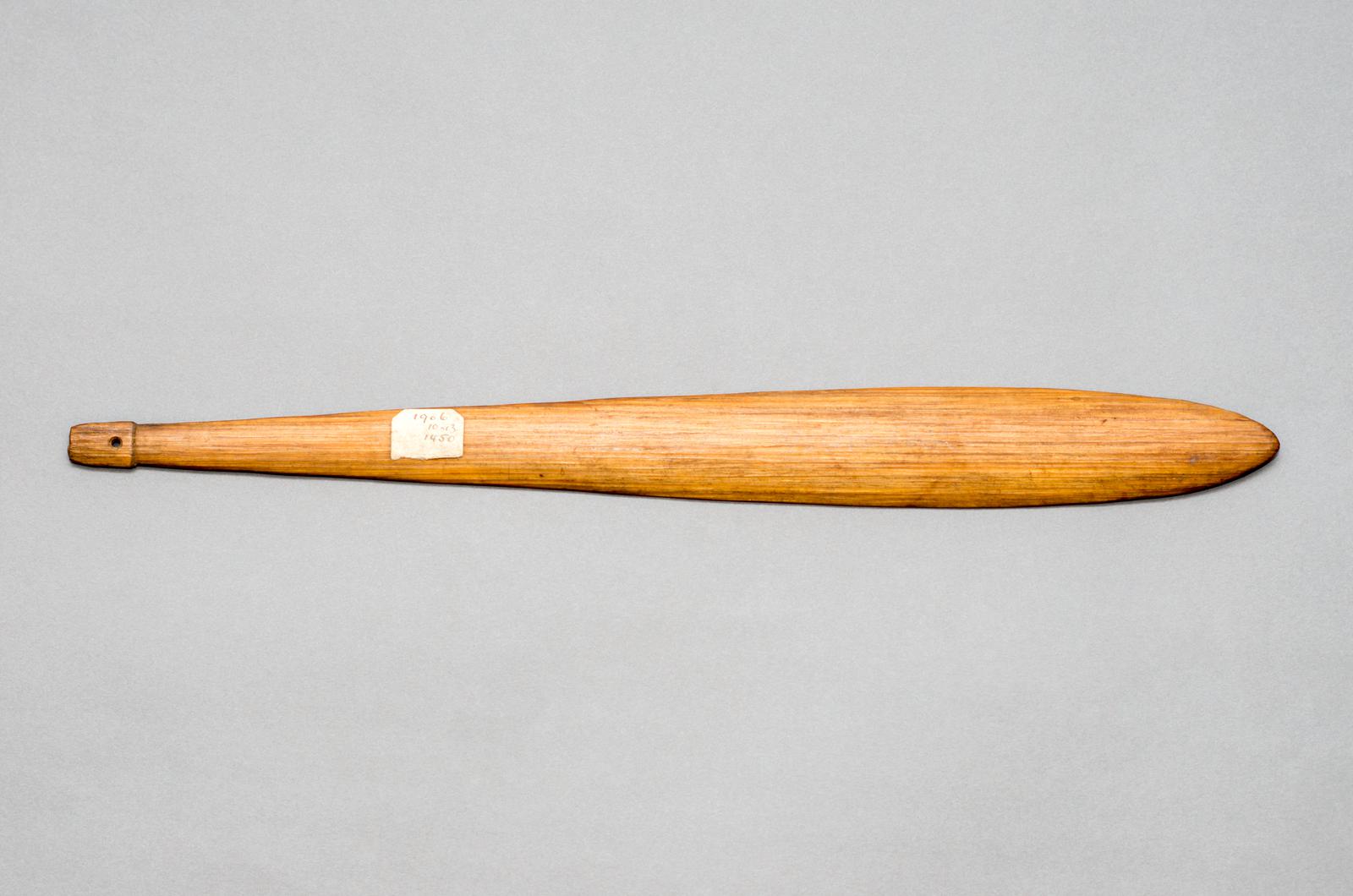
Across much of Melanesia the bullroarer is a guarded voice of spirits, kept from women and children on pain of punishment. Among the Tolai of New Britain's Gazelle Peninsula it was the reverse: a child's toy, whirled for the noise, carrying no secret — and, as the trader-ethnographer Richard Parkinson noted in 1907, not even a name in the Kuanua tongue. The dread that elsewhere rides the roarer belonged here instead to the masked tubuan and duk-duk, ancestral spirit-figures of the men's secret society who appeared at initiations and funerals to enforce Tolai law.
Particulars
- Object
- Both the bullroarer and the slit-gong are in use here.
- Function
- Whirled by children as a plaything.
Source
K. A. Gourlay, Sound-Producing Instruments in Traditional Society: A Study of Esoteric Instruments and Their Role in Male-Female Relations (New Guinea Research Bulletin 60; Canberra and Port Moresby, 1975), Table 1, entry 152; Richard Parkinson, Dreissig Jahre in der Südsee (Stuttgart, 1907), p. 138