No. HOUGH1914-001
Blue River painted whizzer
United States · Bear Creek Cave · Blue River · upper Gila, Arizona · North America · Southwest
Sacred / spirit
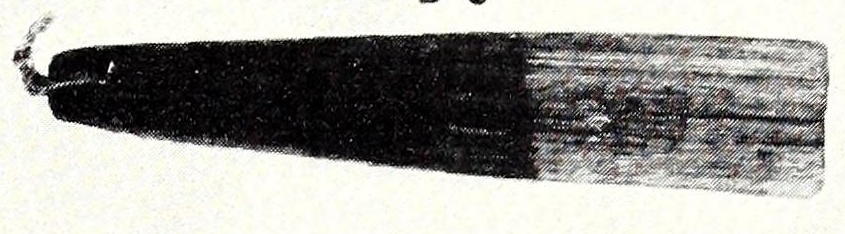
Source term: whizzer (museum) / bull-roarer (Hough)
In a dry shrine cave above the Blue River, on the Arizona edge of the upper Gila, Mogollon people left offerings that open ground would long since have rotted away: prayer-sticks, painted rods, and - grouped on Walter Hough's plate 26 - bull-roarers cut from thin strips of wood and pith and painted red, green, and black. Hough judged them no different in shape from the ones Hopi and Zuni priests still whirl for wind, thunder, and rain, and counted them among the cave's paho, its prayer-offerings. One reached the Smithsonian catalogued simply as a "Whizzer." The cave was a sacred place for a wide territory, used over a long span; dry and left undisturbed, it kept its perishable wooden voices for centuries.
Figures 9, 11, 25, and 26 represent bull-roarers, not differing in shape from those used at present by the Hopi and Zuni.
Hough 1914:129 (USNM Bulletin 87)
Particulars
- Object
- Painted wooden bull-roarer from a dry shrine cave: a flat sounding blade painted red, with a separate cord-grip handle painted green and black — the two pieces of one whizzer.
- Function
- A bull-roarer paho, or prayer-offering, left in a votive shrine cave.
Sources
- Walter Hough, "Culture of the Ancient Pueblos of the Upper Gila River Region, New Mexico and Arizona," United States National Museum Bulletin 87 (1914), p. 129 and Plate 26 (figs. 9, 11, 25, 26) View
- Smithsonian National Museum of Natural History, USNM A232234-0, "Whizzer," Blue River, Arizona; Second Museum-Gates Expedition, 1905