No. WHITE1962-001North America
Zia Pueblo háomomo bullroarer
United States · Zia Pueblo · Sandoval County · New Mexico · North America · Southwest
Sacred / spirit
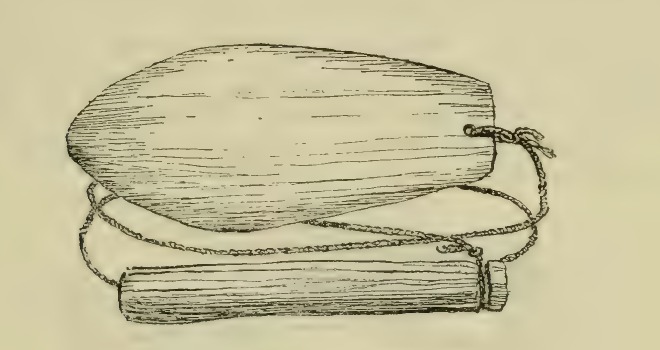
háomomo
Source term: bull roarer
háomomo: Zia Pueblo name for the bullroarer.
At Zia Pueblo the háomomo made thunder by hand. Its seven-inch wooden blade was thick through the middle and pared thin at the edges, tied by three feet of stout cord to a wooden handle; whirled hard, it imitated the sound of thunder. It was no village toy. The Fire, Kapina and Giant societies each kept one, perhaps the Flint society too, and the Snake society could borrow the Kapinas'. The Fire society made its members twice. At the first admission the shamans circled the sand painting against the usual ceremonial direction, thrust flaming juniper sticks into their mouths and rubbed the novice with the charred wood. That earned the right to work the summer and winter weather ceremonies and the two solar rites. The power to cure came only four or eight years later, before a new sand painting of the lion, bear, eagle, snakes and other animals from which healing is drawn. Fire, members said, is a spiritual being: they ate it to get its power. In 1957 six of the society's ten members were women.
Bull roarer (háomomo) is a piece of wood about 7 inches long ... It is whirled vigorously ... 'it imitates the sound of thunder.'
White 1962:315
Particulars
- Object
- Broad wooden blade about 7 inches long and half an inch thick in the middle but thin at the edges, joined by a stout cord about 3 feet long to a wooden handle; complete rig drawn in fig. 50.
- Function
- Whirled vigorously to make a noise that imitated thunder; owned by the Fire, Kapina, Giant, and possibly Flint societies, with the Snake society able to use the Kapinas' instrument.
Source
Leslie A. White, The Pueblo of Sia, New Mexico, Bureau of American Ethnology Bulletin 184 (1962), pp. 149–154 (Fire society) and p. 315, fig. 50 (háomomo)