No. FOWLER1971-001
A shriek inside the women's circle
United States · Colorado Plateau and eastern Great Basin (Utah, northern Arizona, southern Nevada) · North America
Sacred / spirit
na-ni-muit (Na-mi-mu-it); nanimutanimpi
Source term: musical instrument; bullroarer
na-ni-muit (Na-mi-mu-it): Powell's Numic name for the whirled instrument. we-wi-wi: to whirl the na-ni-muit. nanimutanimpi: the same instrument as named in Carroll's account.
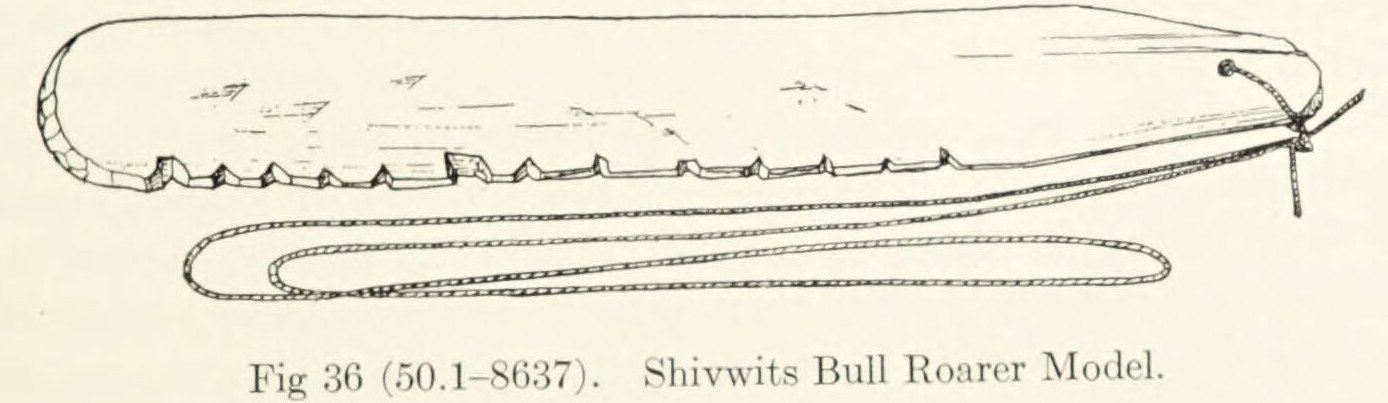
The women formed a circle and danced slowly, shuffling. Inside it the men stood on their toes, heels turned out and bodies bent forward, then leapt high into the air, yelling and whirling an instrument that gave out a curious shriek. This was a dance of the Numa, the Utes and Paiutes of the canyon and desert country, in the years between 1868 and 1880. The instrument was the na-ni-muit, a small tablet with notched edges, tied by a string to a stick two or three feet long and swung through the air to whirr. To swing it was we-wi-wi.
whirling a musical instrument [probably a Na-mi-mu-it] which they hold in their hands and which gives out a curious shriek
J. W. Powell, MS 798, p. 12, in Fowler and Fowler, Anthropology of the Numa (1971), pp. 64–65, as quoted by Carroll (2005), p. 200.
Particulars
- Object
- A small notch-edged wooden tablet tied by a string to a stick two or three feet long; elsewhere described as a flat piece of juniper on an end string.
- Function
- Whirled by men leaping and yelling inside a circle of women dancing a slow shuffle.
Sources
- Don D. Fowler and Catherine S. Fowler (eds.), Anthropology of the Numa: John Wesley Powell's Manuscripts on the Numic Peoples of Western North America, 1868–1880 (Smithsonian, 1971), pp. 64–65 View
- Alex K. Carroll, 'Dance, Great Basin', in American Indian Religious Traditions: An Encyclopedia (ABC-CLIO, 2005), p. 200