No. STEWART1942-005
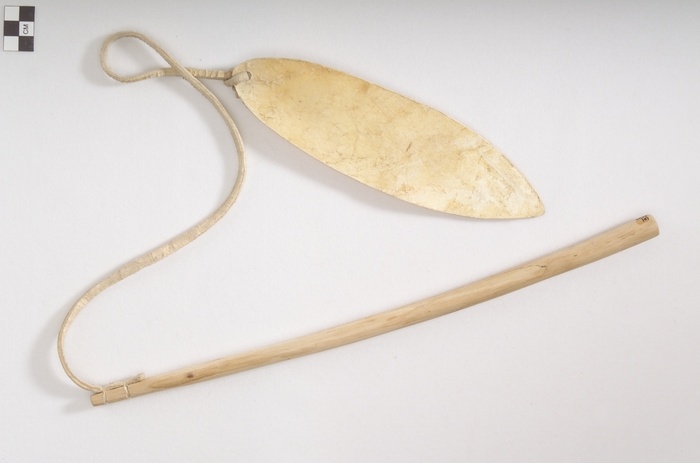
Taviwatsiu Ute rawhide bullroarer
United States · Front Range near Denver, Colorado (band removed to the Uintah Reservation, 1880) · North America · Great Basin
Sacred / spirit
nia'monöpö
Source term: Bull-roarer: of rawhide
nia'monöpö: the Taviwatsiu term for the bull-roarer in Stewart's comparative vocabulary (shared with the Timpanogots); no literal gloss is given.
Denver was theirs once: the White River Ute still named it as the former center of Taviwatsiu country when Stewart came to the Uintah Reservation to ask. Their bull-roarer blade was rawhide, not wood, whirled on a handled string — a child's toy, but in summer-born hands a tool to raise wind and clear clouds, and an item of a shaman's kit. Jane Tonem-Pickett, who told him most of it, had been living at Grand Junction when the Meeker fight of 1879 broke over the band; within a year her people were removed across the mountains to Utah.
Used effectively only by people born in summer.
Stewart 1942:291, element 2802
Particulars
- Object
- Whirrer of rawhide swung on a string with a wooden handle; a wooden blade was denied.
- Function
- A toy; also whirled to make wind blow and clear away clouds, effective only for people born in summer, and kept among a shaman's paraphernalia.
Source
Omer C. Stewart, Culture Element Distributions: XVIII, Ute-Southern Paiute, Anthropological Records 6(4) (1942), pp. 237-238, 291, 315 and 352