From the Barotse plain to the Namibian border, a whirled board can quiet a cold child, run with masked spirits on an Ovimbundu hunt, or speak for a Kwanyama bird that swallows the boys at circumcision. In the south-west, the Humbi and Handa said the bullroarer itself had swallowed a boy who did not come home, and mothers danced childbirth for those who did.
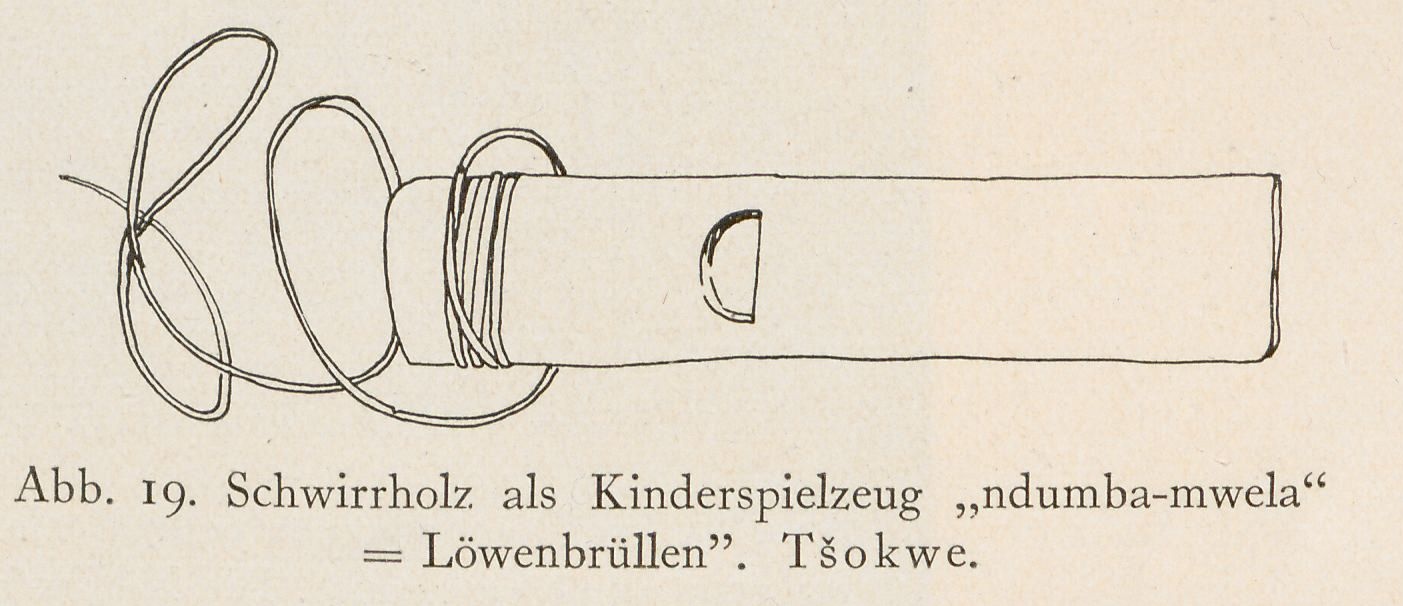
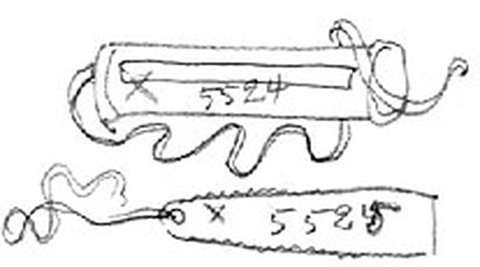
Chokwe (Tsokwe)Chokwe ndumbamwela, a children’s toy bullroarer, as illustrated by Baumann in 1932.NgangelaNgangela kasolo and kahulihuli, Angola, 1933.
On a winter evening on the Barotse plain of the upper Zambezi, a small child cries with cold. An older brother makes a lion roar, and the mother says: listen to the thing crying over there. The child falls quiet. Far to the south-west, on the Angola–Namibia border, Kwanyama boys and their mothers hear a hum as the voice of a giant bird that swallows the boys at circumcision. In the Angolan highlands, Ovimbundu novices race across the country to hunt, with masked spirit-men beside them and a whirled board sounding above their cries. 6, 12, 8
Lozi, Kwangwa and Mbunda boys on the upper Zambezi in western Zambia all knew the game called “making the lion roar.” When winter came with the flood and the nights turned cold, small children cried. An older brother rubbed charcoal over an overturned wooden bowl, or swung a small pierced board faster and faster on its cord. Then the mother told the baby, utwa se si lila lila ka fa, listen to the thing crying over there, and the little one went quiet. Some of these Mbunda had come to the river from Angola. 6
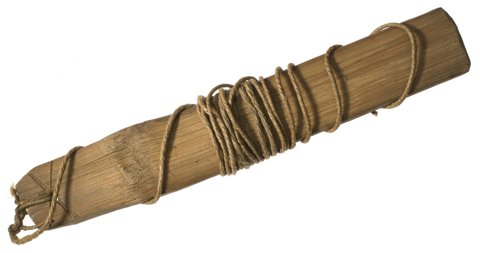
In north-eastern Angola, a Chokwe man showed Hermann Baumann an oval board on bark cord while they talked about children’s games. He swung it around his head and called it ndumbamwela, lion-roaring. 4
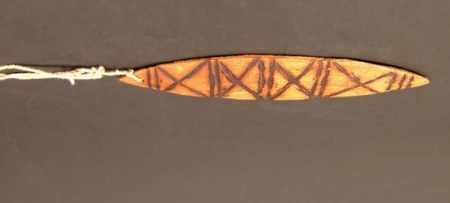
The same lion growls in the Mukanda lodges of north-western Zambia, as the Luvale ndumbamwelela, the Ndembu ndumba mwila and the Luchazi ndumba mwelela. There it announces the coming school, frightens novices and their mothers from behind the lodge, and sounds among the songs of recovery. 1, 2, 3
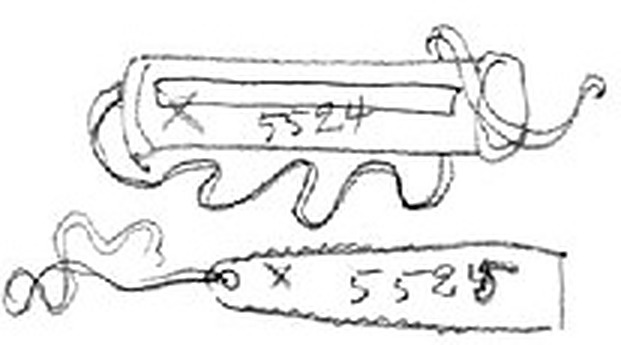
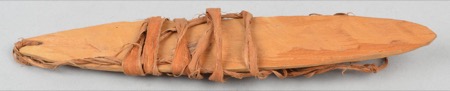
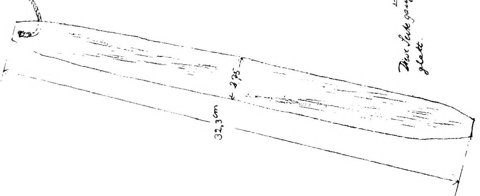
The Ngangela of Angola gave names to two contrasting shapes. Kasolo is a broad rectangle with its cord wound tight at one end; kahulihuli narrows into a long taper with a loose cord at its tip. Théodore Delachaux drew the pair, which came from Angola in 1933. 9
In the central Angolan highlands, Ovimbundu boys vanished into an initiation camp in the bush that no woman could approach, sworn on pain of death never to reveal what was done there. They were seen only when, as part of their training, they raced across the countryside to hunt a wild animal and carry it back to camp. They came covered in white ash. Costumed, masked men ran with them, and a thin oval of wood whirled on a string sounded above their cries as the voices of the spirits. At Elende in the same highlands, children swung the same kind of board, the embungumbungu, as a plaything. 8, 7
On the Angola–Namibia border, Kwanyama boys and their mothers took the bullroarer’s hum for the voice of edila, a giant bird that swallowed the circumcision candidates. A boy who survived had passed out through its anus; a boy who died under the knife had stayed in its stomach. The men who staged the rite wore bird masks, and as each boy was cut they sounded their bullroarers to drown his cries. 12
The same voice marked the death of a king. On the fourth day of mourning for a circumcised king, a player stood hidden in a crowd of initiated men and sounded the instrument. The sounding, osinghuma, announced that there was no longer a king and that this mourning was like no other. 12
Among the Humbi and Handa cattle-herders of south-western Angola, the lumpoku sounded in the boys’ ekwendje circumcision camps. Its rising and falling roar frightened the uninitiated, who took it for the voice of an all-powerful Being; among the Humbi, its buzz was the voices of the ancestors. Nyaneka songs heard the ehulumphuku howling across the plains by the lagoon of Pundo. 14, 13
If the operation left a boy maimed, people said Ehulumphuku lyamima: the bullroarer has swallowed him. A Humbi mother sent her absent son a new basket for his homecoming. If he had died in the camp, a guard cut out its bottom and sent it back, and she understood without a word. For the boys who came home, the mothers danced and mimed childbirth. 13
On the upper Zambezi the winter comes with the flood, and the nights turn cold. When the small children cried with it, an older brother made the lion roar, either by rubbing a lump of charcoal over an upturned wooden bowl or by whirling a little pierced board on its cord, faster and faster. Then…
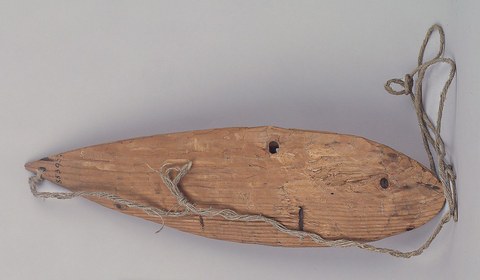
Representative — not this record’s object · A corded oval board from Oas, Namibia (Weltmuseum Wien)
Hermann Baumann asked after bullroarers among the Tsokwe for a long time and got nothing, until one day, while he was asking about children's games, a man turned up with one and demonstrated it as a toy. Baumann wondered afterward whether the lion in its name once meant more, echoing the roaring…
At Solochi Village in August 1983, two ndumbamwelela broke into the women’s Mukanda dance with a growl said to imitate a lion. The dancers stopped, cheered, and answered with shrill cries: the sound announced that the boys’ initiation camp was about to begin. How the roar was made remained one of…
Representative — not this record’s object · A bullroarer collected at Blantyre, Malawi.
Behind the Ndembu Mukanda lodge at Wukengi, a junior guardian whirled ndumba mwila, a fish-shaped bullroarer carved from red mukula wood. Its growl terrified the novices and their mothers. The old explanation was worse: a monster had come to swallow the boys.
Representative — not this record’s object · A carved Leele bullroarer from the Kasai (Tervuren)
Luchazi boys went into the mukanda lodge to be circumcised and schooled in seclusion. When every boy's wound had healed came kulonda ntsimba, 'the climbing of the genet cat': the initiates were nimble as genets again, and the first stage of their schooling was over. The rite had its kukuwa songs,…
Representative — not this record’s object · An Angolan bullroarer of 1937, from across the Luchazi border.
The Ovimbundu boys vanished into an initiation camp in the bush that no woman could approach, sworn on pain of death never to reveal what was done there. Only once in all that time were they seen: when, as part of their training, they raced across the countryside to hunt, kill and carry a wild…
Representative — not this record’s object · A San !goin!goin blade drawn for Bleek and Lloyd’s Bushman Folklore (1911)
Booklet pp.5–13: Luvale school, age and schooling; track 1 Solochi 8 August 1983, p.7; Sakutemba songs and meals pp.8–10; kukuwa and jingunda pp.10–11; purification and return pp.12–13.
Field Museum Anthropological Series 21(2), p.332; Elende plaything represented by Field Museum 208743. The toy context does not exclude Boulton’s independently witnessed initiation hunt.
Chapter 6, p.73: witnessed Ovimbundu boys’ initiation-hunt sortie with masked spirit-men and a whirled oval wooden blade; Boulton did not enter the camp.