No. BARNETT1937-006
Siuslaw bull-roarer
United States · Siuslaw River, Lane County, Oregon · North America · Northwest Coast
Play / practical
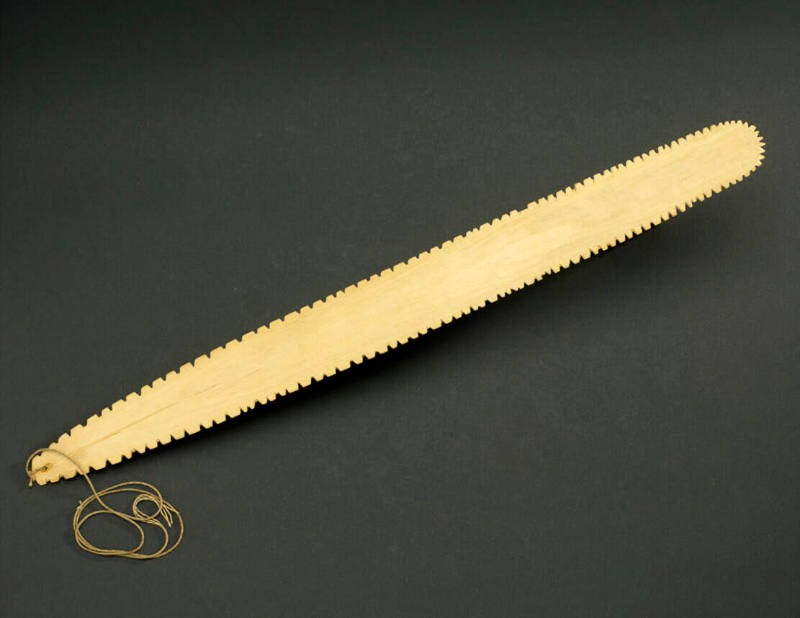
Source term: bull-roarer (boy's plaything)
The Siuslaw are the last people up this coast to own a bullroarer — a boy's plaything, undescribed — and their neighbours immediately north said flatly that they had none. Not for want of whirling. The Alsea kept a top season: one appointed month a year when the whole village, grown people and children together, spun tops cut from cedar knots "because the cedar knots had the property of whirling well," or rolled from spruce, alder and fir bark between the palms. Nobody bet on them. The Alsea whirled a great deal. What they did not whirl was a roarer.
Thus fun was had with a spinning top.
Leo J. Frachtenberg, Alsea Texts and Myths, BAE Bulletin 67 (1920), p. 211.
Particulars
- Object
- Not described; recorded only as a bull-roarer.
- Function
- A boy's plaything, at the northern limit of the instrument on this coast.
Source
Homer G. Barnett, 'Culture Element Distributions: VII, Oregon Coast,' University of California Anthropological Records 1:3 (Berkeley, 1937), p. 174, element 746 ('Bull-roarer (boy's plaything)'); Leo J. Frachtenberg, Alsea Texts and Myths, BAE Bulletin 67 (1920), pp. 209-211