No. TUOHY1979-001
Kachina Cave serrated scapula
United States · Smith Creek Canyon, northern Snake Range, White Pine County, Nevada (eastern Great Basin) · North America
Function not recorded
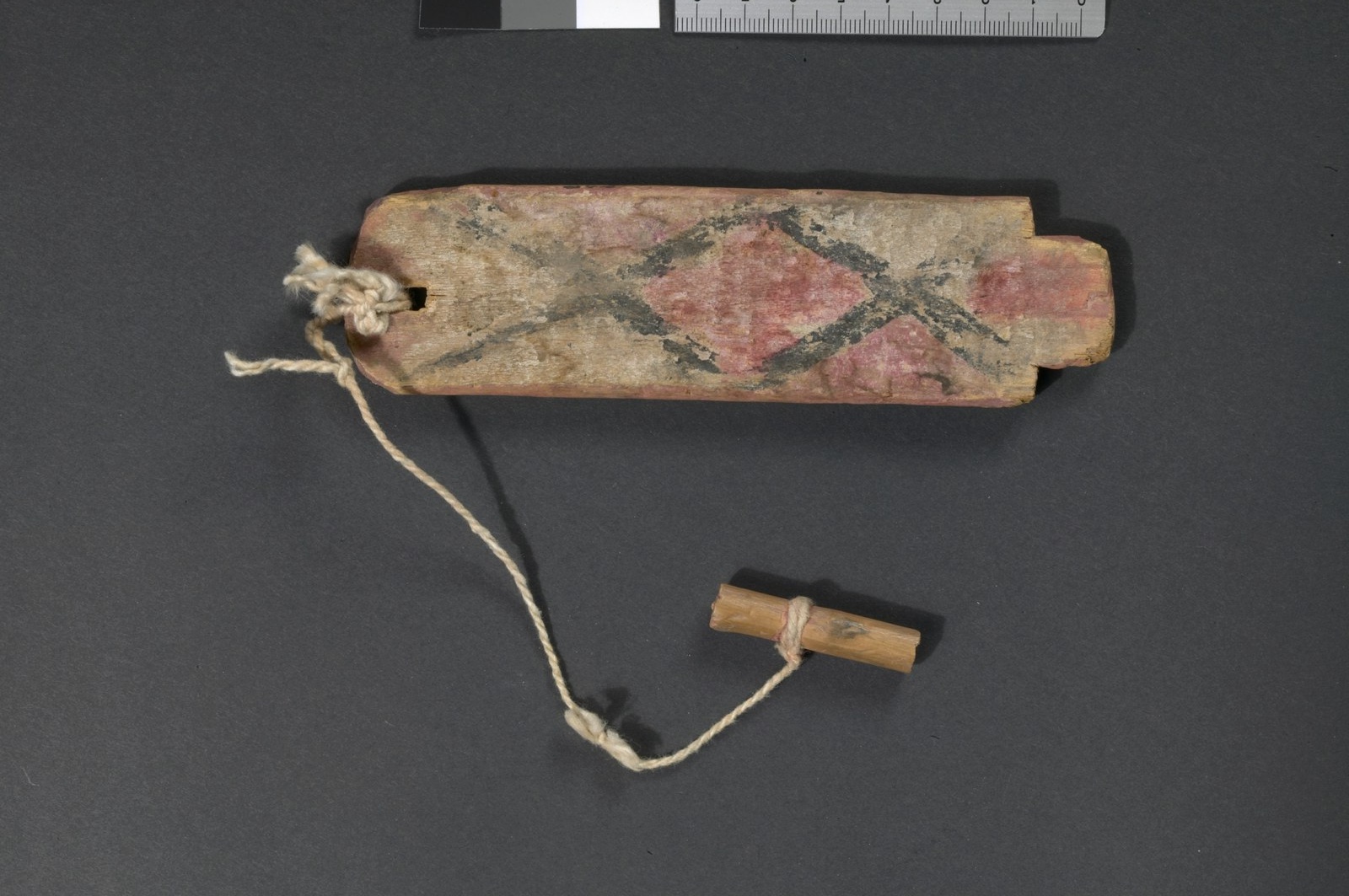
Source term: bull roarer
Kachina Cave opens off Smith Creek Canyon on the eastern flank of the Snake Range, and the Archaic layers in it gave up a shoulder blade with one edge cut into teeth. Donald Tuohy, who dug the site, called it a bull roarer - once when he described it, again on the page where he listed what the Archaic people had left, and he says it might have served as one. Then he stops. No measurements, no count of the holes or where they sit on the blade, no note of whether the teeth are worn smooth or still sharp, nothing to compare it with, and he never spins it. The name is doing all the work. A toothed scapula is also the shape of a notched rasp, of a harvesting sickle, of a hide scraper, and a few hundred metres down the same canyon, at Amy's Shelter, another author in the same volume prints a notched scapula and calls it nothing at all. What would separate them is the perforation, and the perforation is the one thing Tuohy never describes.
...and a serrated bone scapula possibly a bull roarer
Tuohy, "Kachina Cave" (1979), printed p. 72.
Particulars
- Object
- A bone scapula with its edge cut into teeth, from the Archaic strata. The excavation report gives no dimensions and no material identification; the word 'perforated' appears on the description page, but no perforation is counted, sized or located.
- Function
- Not recorded. The excavator proposes no use beyond the identification itself.
Source
Donald R. Tuohy, "Kachina Cave," in Tuohy and Rendall (eds.), The Archaeology of Smith Creek Canyon, Eastern Nevada; Nevada State Museum Anthropological Papers No. 17 (December 1979), chapter pp. 1-89. Bone-artifact section pp. 61-64; Archaic-assemblage summary p. 72