No. NGUINEA-007
Uramot Baining salek bullroarers (Bateson, New Britain)
Papua New Guinea · East New Britain · Gazelle Peninsula · Latramat-Kainagunen · Oceania · Bismarck Archipelago
Restricted
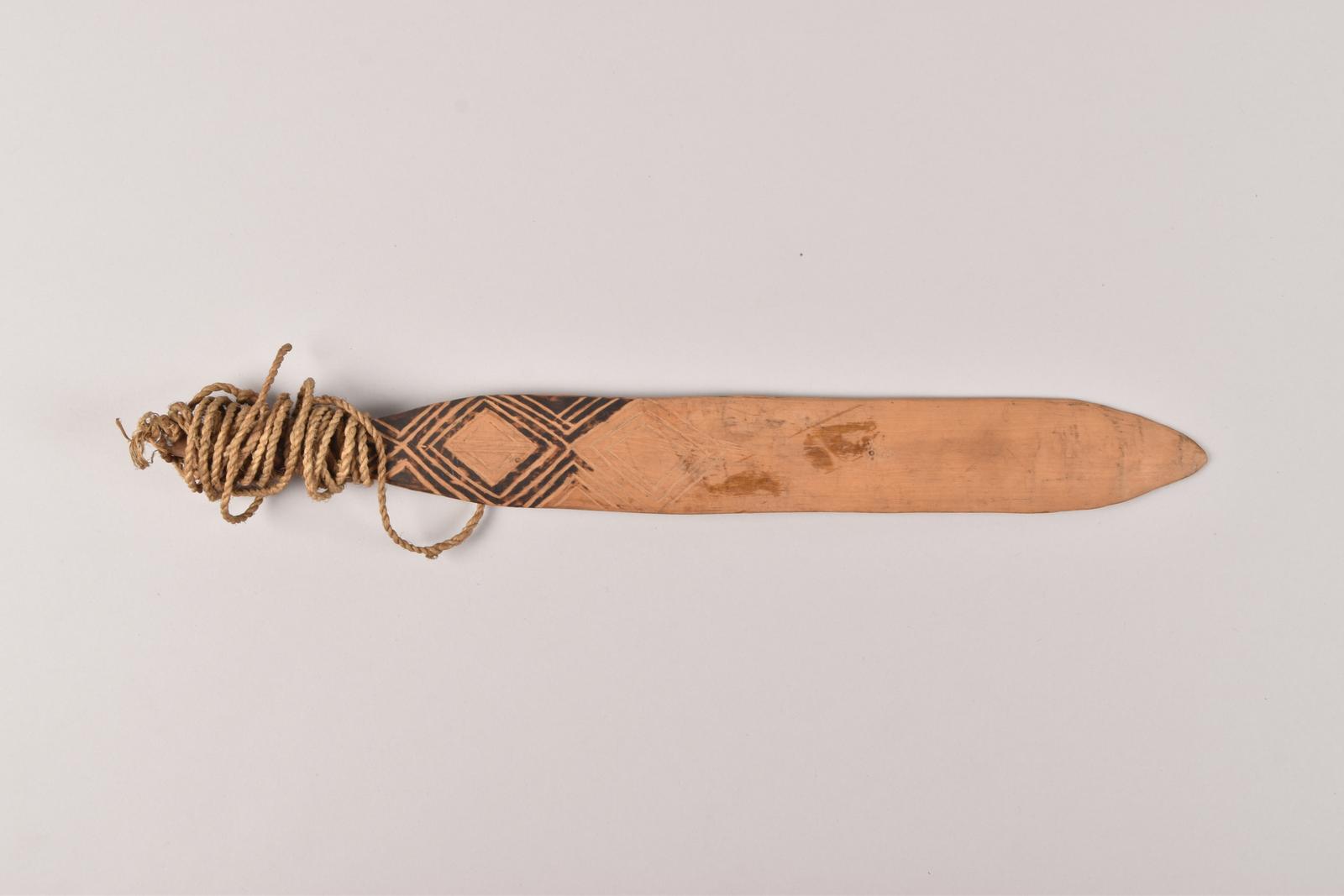
SALEK
Source term: Bullroarer
The Uramot Baining did not swing these from the hand. Each salek went on the end of a long stick, held loosely in both hands, and it sounded at Momdas, the initiation in which fathers lead their blindfolded sons between two rows of men until the instruments howl. The whirring is the voice of Rigenmucha, the supreme being. At the end of the rite the roarers sound again to bring out the masks, and the new initiates dance with snakes wound round their bodies. Gregory Bateson collected these two narrow splints of black palm wood, each with a truncated, angled tip and a squared, pierced end, at Latramat-Kainagunen on the Gazelle Peninsula; one still carries a knotted loop of fine twine.
One of 2 small bull-roarers. Used in MOMDAS (initiation ceremony). Swung on a long stick which is held loosely in two hands.
Cambridge MAA, accession note for 1930.453 A-B (coll. G. Bateson)
Particulars
- Object
- Pair of small black-palm bullroarers, MAA 1930.453 A-B; accession notes say they were used in MOMDAS initiation and swung on a long stick.
- Function
- Used in the MOMDAS initiation ceremony; swung on a long stick held loosely in two hands.
Source
Cambridge MAA objects 1930.453 A and 1930.453 B, Bullroarer, cultural affiliation Uramot Baining, place Latramat; Kainagunen, Gazelle Peninsula; local term SALEK; original accession notes: one of two small bull-roarers used in MOMDAS initiation ceremony