No. STEWART1941-006
Toe-dokado wimo'to of the Carson Sink
United States · Carson Sink, Carson Lake and the lower Carson River, western Nevada · North America · Great Basin
Weather / fertility magic
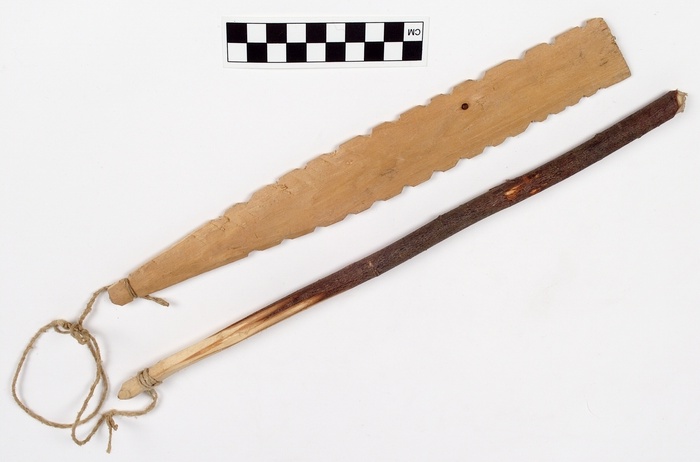
wimo'to
Source term: bull-roarer (wimo'to)
Wimo'to / wimoto: the Northern Paiute bullroarer term; the modern dictionary entry for it is recorded in the Fallon dialect, which is this band's speech.
The tule eaters held the Carson Sink, and their roarer worked both sides of the line the eastern bands drew: it was a toy, and it was swung to bring the wind. Their country is also where the only mechanical description in the Northern Paiute lexicon comes from - a flat slat, the string tied at one end, twirled above the head - recorded from Wuzzie George in the Fallon dialect long after Stewart's visit. Neighbouring bands have been quoted on that description for want of one of their own. It was always this band's.
Particulars
- Object
- A wooden whirrer: a flattened board about six inches long and two to three wide, serrated on both edges, tied to its string at one end and twirled over the head.
- Function
- Swung both as a children's toy and to make the wind blow.
Source
Omer C. Stewart, 'Culture Element Distributions: XIV, Northern Paiute,' Anthropological Records 4:3 (1941), pp. 363, 401 and 403; Sven Liljeblad, Catherine S. Fowler and Glenda Powell, Northern Paiute-Bannock Dictionary (University of Utah Press, 2012), p. 670, s.v. wimoto