No. VOGELSANG2011-001
Oruwanje incised shale blade
Kaokoland · northern Namibia · Southern Africa
Function not recorded
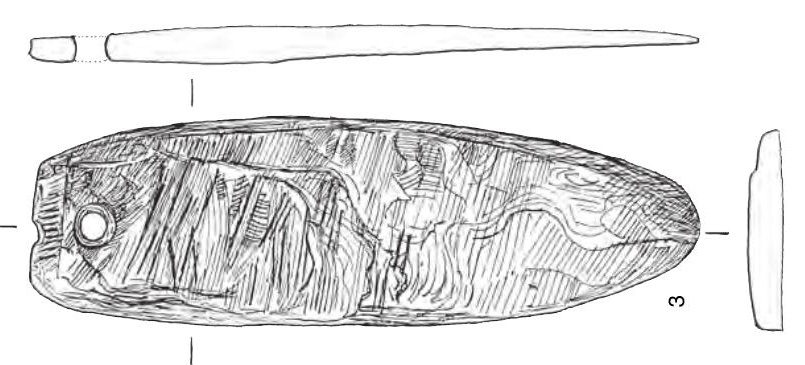
Source term: shale pendant
A slip of polished shale, 86 mm long and only 5 mm thick, tapers from a squared, pierced end to a rounded tip. The hole is large for so small a blade, 3 mm across, and worn; the face is scored with fine incisions. A companion from the same layer cracked while it was being drilled and was never strung. Blades like these belong to northern Namibia's first potters, probably hunter-gatherers who had taken up the craft; no bones of herd animals have yet been found in the area. This one was left about 2,000 years ago in a west-facing rockshelter above a broad basin, in mopane woodland much like today's, a short walk from a waterhole. Its exact twin is a bone blade from Matjes River on the southern Cape, 88 by 27 by 5 millimetres with the same 3 mm hole, long filed as a pendant. That one is worn along the sides of its hole, where a spinning cord pulls, not at the top, where a hanging one does, and a copy roars readily. The nearest bullroarers in living memory belong to the Uukwaluudhi of Owamboland, some 150 km east and many centuries later, whose old rain-callers whirled flat slips of wood, six inches by two, as the voices of the Big Birds.
Particulars
- Object
- Incised shale blade, 86 × 26 × 5 mm, with polished edges and a worn 3 mm terminal perforation.
- Function
- Not recorded.
Sources
- Ralf Vogelsang and Barbara Eichhorn, Under the Mopane Tree: Holocene Settlement in Northern Namibia, Africa Praehistorica24(2011), pp51–55,61–65,70–71, fig31 View
- Märit Salokoski, How Kings Are Made – How Kingship Changes (University of Helsinki, 2006), pp. 229–231 View · archived
- Kumbani, J., Bradfield, J., Rusch, N. and Wurz, S. 2019. A functional investigation of southern Cape Later Stone Age artefacts that resemble bullroarers. Journal of Archaeological Science: Reports 24: 693–711. View