No. JSTEWARD1943-002
Bannock wupu'nonoyuwin, Fort Hall
United States · Fort Hall, Snake River plain, southeastern Idaho · North America · Great Basin
Weather / fertility magic
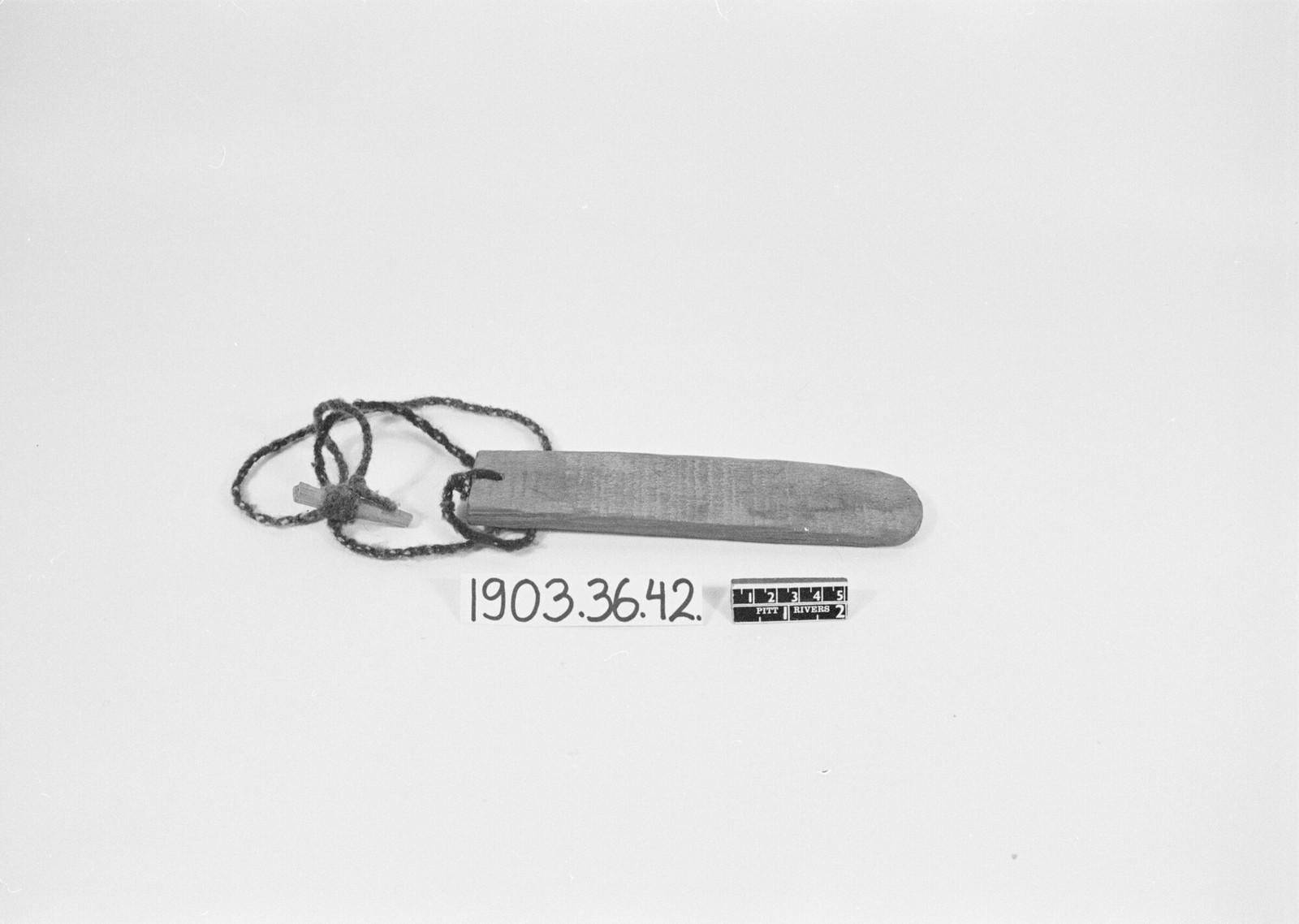
wupu'nonoyuwin
Source term: bull-roarer (wupu'nonoyuwin)
The Bannock wintered with the Shoshoni at Fort Hall, travelled with them and married them, and kept their own language through all of it. For all the differences that closeness left standing between the two peoples, the bullroarer was not one of them. Both swung a wooden blade on a wooden handle, both for children and for warm wind, and both named it with the same construction — a booming root under a prefix meaning 'by means of a long swung thing'. What the Bannock kept that their neighbours did not was the far side of the weather rule, and it attached to a second whirring instrument, the buzzer: where a summer-born person swinging the roarer calls the warm wind, a winter-born person whirring the buzzer in winter brings the storms.
Particulars
- Object
- Wooden whirrer fitted with a wooden handle.
- Function
- A children's toy; also whirled to bring warm wind.
Source
Julian H. Steward, 'Culture Element Distributions: XXIII, Northern and Gosiute Shoshoni,' Anthropological Records 8:3 (1943), pp. 264, 333, 383 and 384