No. BECK2008-001
Yuŋyúŋ, named for its whirr
Mexico · Puebla, Necaxa River valley (Patla, Chicontla, Cacahuatlán) · North America
Function not recorded
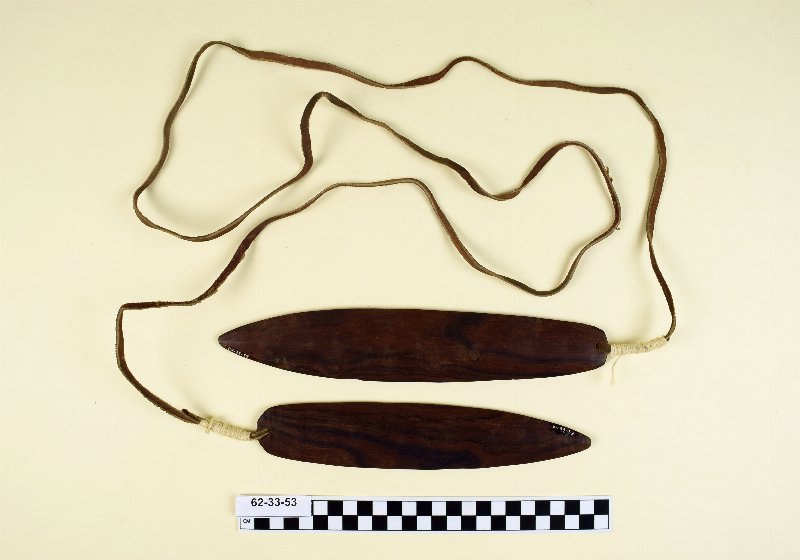
yuŋyúŋ
Source term: bullroarer
yuŋyúŋ: the bullroarer. yuŋyuŋ (no fixed stress): the ideophone for its whirring.
Swing a small board in circles at the end of a string and, in Upper Necaxa Totonac, it goes yuŋyuŋ. The language is rich in such sound-words, ideophones that paint a noise or a motion in the air, and this one became the instrument's own name: yuŋyúŋ, the bullroarer, set apart from its whirr only by a fixed stress on the final syllable. It is one of very few Totonac words born from an ideophone, spoken in the Necaxa River valley, high in the mountains of northern Puebla.
the whirring sound created by swinging a small board in circles at the end of a string
David Beck, 'Ideophones, Adverbs, and Predicate Qualification in Upper Necaxa Totonac', IJAL 74 (2008), p. 20.
Particulars
- Object
- A small board swung in circles at the end of a string.
- Function
- Not recorded.
Source
David Beck, 'Ideophones, Adverbs, and Predicate Qualification in Upper Necaxa Totonac', International Journal of American Linguistics 74(1) (2008): 1–46, p. 20