No. EXH2026-037
Bahía de los Ángeles cave find
Mexico · Bahia de Los Angeles, Baja California · North America
Function not recorded
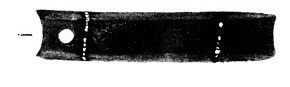
Source term: Bull-roarer (?)
From a burial cave at Bahía de los Ángeles came a remarkable slat of polished dark wood: 23.5 centimetres long, concave on both faces, pierced at one end, and inlaid with black-filled grooves and fragments of Olivella shell. One of the seven people buried there was a shaman, laid in the cave with his paraphernalia: tubular stone pipes, a cape of human hair, cane whistles, and this slat. The cave's contents belong to the Borjeño, who held this coast when the Spanish arrived.
This artifact has been tentatively called a "bull-roarer" because no other purpose can be conjectured.
Massey & Osborne, A Burial Cave in Baja California (Anthropological Records 16:8, 1961), p. 344
Particulars
- Object
- Polished slat of very hard dark wood, 23.5 cm long, from a burial cave; USNM 139565.
- Function
- Not recorded.
Source
William C. Massey and Carolyn M. Osborne, 'A Burial Cave in Baja California: The Palmer Collection, 1887,' Anthropological Records 16:8 (University of California Press, 1961), pp. 339, 341, 344 and 351