No. EXH2026-030
Kiliwa
Mexico · Baja California (Arroyo Leon area) · North America
Sacred / spirit
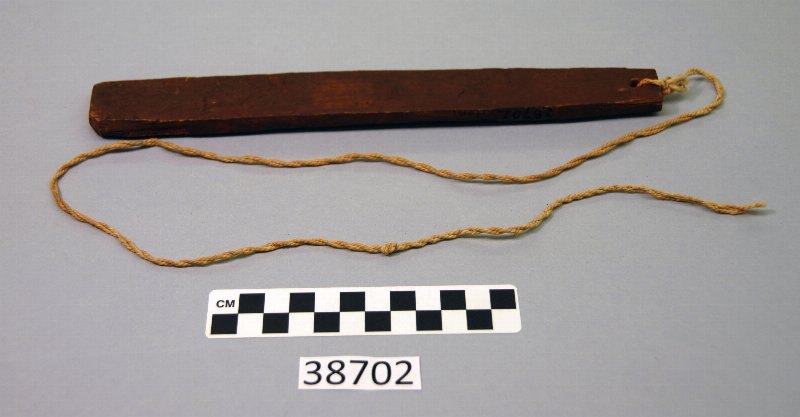
Source term: Schwirrholz (bullroarer)
Among the Kiliwa of northern Baja California the bull-roarer belonged to the shaman, who used it in the ñiwey, the ghost-calling ceremony in which one of the feared dead would take possession of him and, through him, tell where it had hidden something in life. Anyone, in an emergency, might also whirl a bull-roarer to placate a ghost. This was recorded by Peveril Meigs, whose field trips among the Kiliwa in 1928, 1929, and 1936 produced the standard account of the people, and the practice was later reported by Massey and Osborne. They also noted an archaeological example: a conventionally shaped wooden bull-roarer, lenticular in cross-section and about 21.5 centimeters long, recovered from the surface of a cave in the San Julio Basin east of Comondú. A second, highly polished piece of hard dark wood, probably ironwood and 23.5 centimeters long, may have served the same purpose.
They have also been reported for the Kiliwa of northern Baja California, where they were used by shamans in the ñiwey ceremony, and for placating ghosts by anyone in an emergency.
Massey & Osborne, A Burial Cave in Baja California: the Palmer Collection, 1887 (Anthropological Records 16:8, 1961)
Particulars
- Object
- Bullroarer used in religious ceremonies.
- Function
- Played a role in religious ceremonies.
Source
Peveril Meigs III, The Kiliwa Indians of Lower California (Ibero-Americana 15, Berkeley, 1939), p. 45; William C. Massey & Carolyn M. Osborne, 'A Burial Cave in Baja California: The Palmer Collection, 1887,' Anthropological Records 16:8 (1961), p. 344