Atlas Essay —
Drinking the Serpent
The Lower Pecos, Texas · Spiro, Oklahoma · southern California · the Nile, Egypt · the Punjab
About fifteen hundred years ago, in a rock shelter above the canyons where the Pecos River runs into the Rio Grande in south-west Texas, someone swallowed a venomous snake whole, fang and all. More than four thousand years before that, people in the same canyons were pressing ground peyote into little cakes. Up the Arkansas River, in Oklahoma, the shell cups of the Spiro mound held jimsonweed, one of them under an engraved serpent. In southern California the jimsonweed was handed to boys by a man called by the snake’s own name. On the Nile, the sick drank water that had run over a stone god gripping snakes in his fists.
People have been taking the serpent into their bodies for thousands of years, and the ground keeps the proof. They swallowed it, drank from its cup, drank the water that ran over its image and pricked it into their skin, always beside the strongest medicine they had. The venom sacrament is old, and it is everywhere.
In brief
- A human coprolite from Conejo Shelter in the Lower Pecos of Texas, dated 1460–1528 cal BP, holds “the bones, scales and a fang of a snake in the Viperidae family”: a venomous snake, swallowed whole (Sonderman, Dozier & Smith 2019). The same canyons hold the oldest peyote in the Americas, worked into effigies about 4000 BCE.
- Seven of 31 Mississippian and Caddo vessels from Arkansas, and 14 of 18 shell cups from Spiro in Oklahoma, held atropine from Datura. One positive bottle carries the Great Serpent; the one whole positive cup carries the two-headed serpent (King et al. 2018).
- Among the Luiseño, Cahuilla and Cupeño of southern California, the jimsonweed drink of boys’ initiation was guarded by the paha, a word meaning the red racer snake, while the bullroarer warned the uninitiated away (Strong 1929). At Pinwheel Cave, a painted Datura flower looks down on a packet of chewed Datura quids.
- On the Metternich Stela and the healing statue of Djedhor, Egyptian priests carved Horus gripping snakes and cut basins to catch water poured over him: a victim “could then drink this water.”
- A woman buried at Deir el-Medina, the tomb-builders’ village at Luxor, carried snakes tattooed on her shoulders and arms, and Egyptian spells had images drawn on the hand and “licked off.” In the Rigveda the long-haired ascetic “drank of the poison with his cup, together with Rudra.”

A viper, swallowed whole
The Lower Pecos canyonlands lie on the Texas–Mexico border, where the Pecos and the Devils River cut deep limestone gorges on their way into the Rio Grande. The rock shelters there are dry enough to keep what people left behind: sandals, baskets, fibre, and their dung. Conejo Shelter, in Val Verde County, was dug before the Amistad dam flooded the canyons. In 2019 Elanor Sonderman, Crystal Dozier and Morgan Smith published what one coprolite from it contained. Most of it was ordinary desert fare: agave and sotol fibre, prickly pear, and a small rodent eaten whole. The rest was a viper: “the bones, scales and a fang of a snake in the Viperidae family.” Radiocarbon dates from this coprolite and a second from the same layer put the meal at 1460–1528 cal BP, around 420–490 CE.
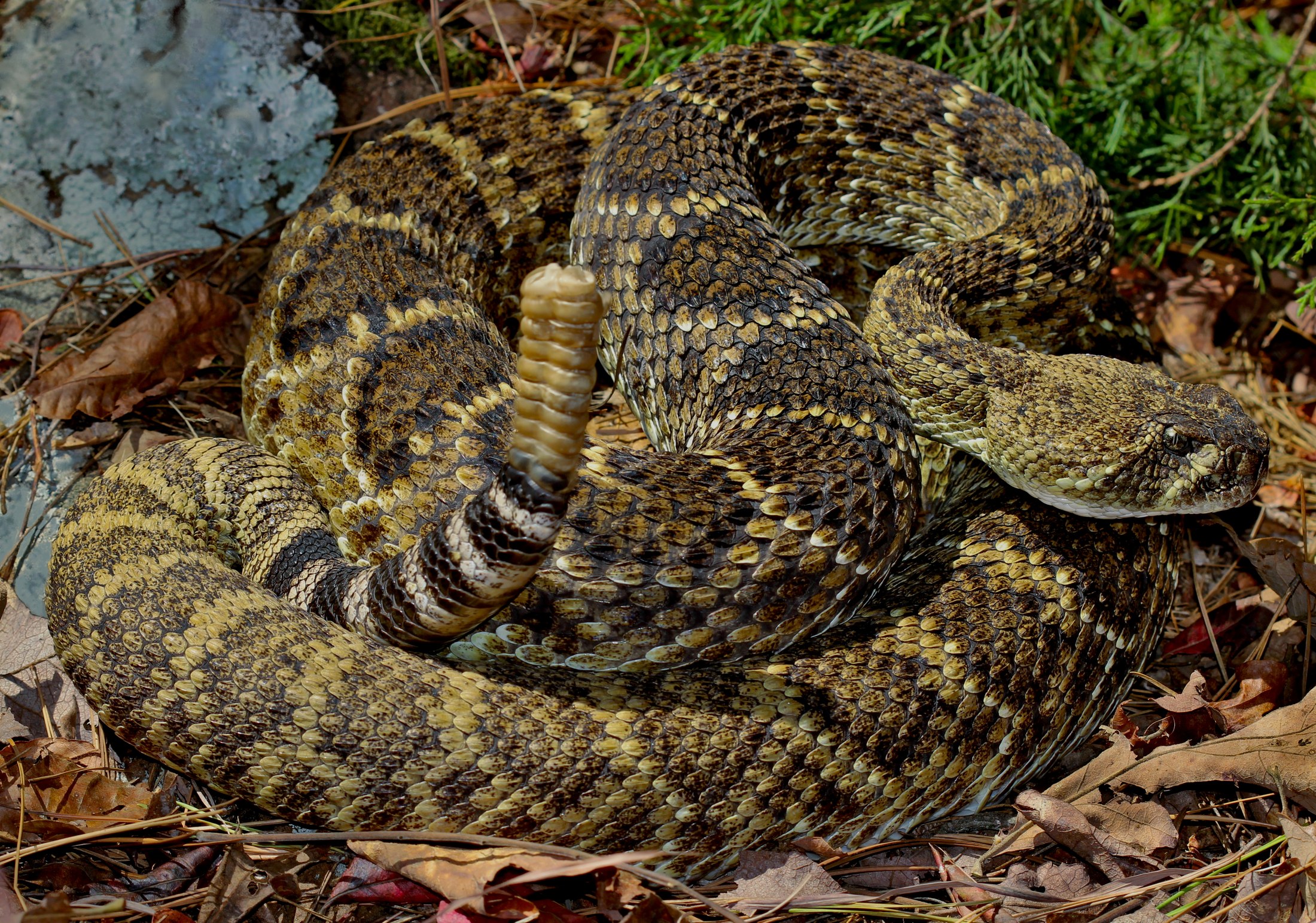
The snake went down as it was, fang included. “The person,” Smith said, “ate the snake as-is, the whole thing.” And again: “It appears he or she consumed an entire snake, most likely a western diamondback rattlesnake.” The authors called it what it is, “the first direct archaeological evidence of venomous snake consumption known to the researchers,” and the title of their paper names the act: “potential ritualistic viperous snake consumption.”
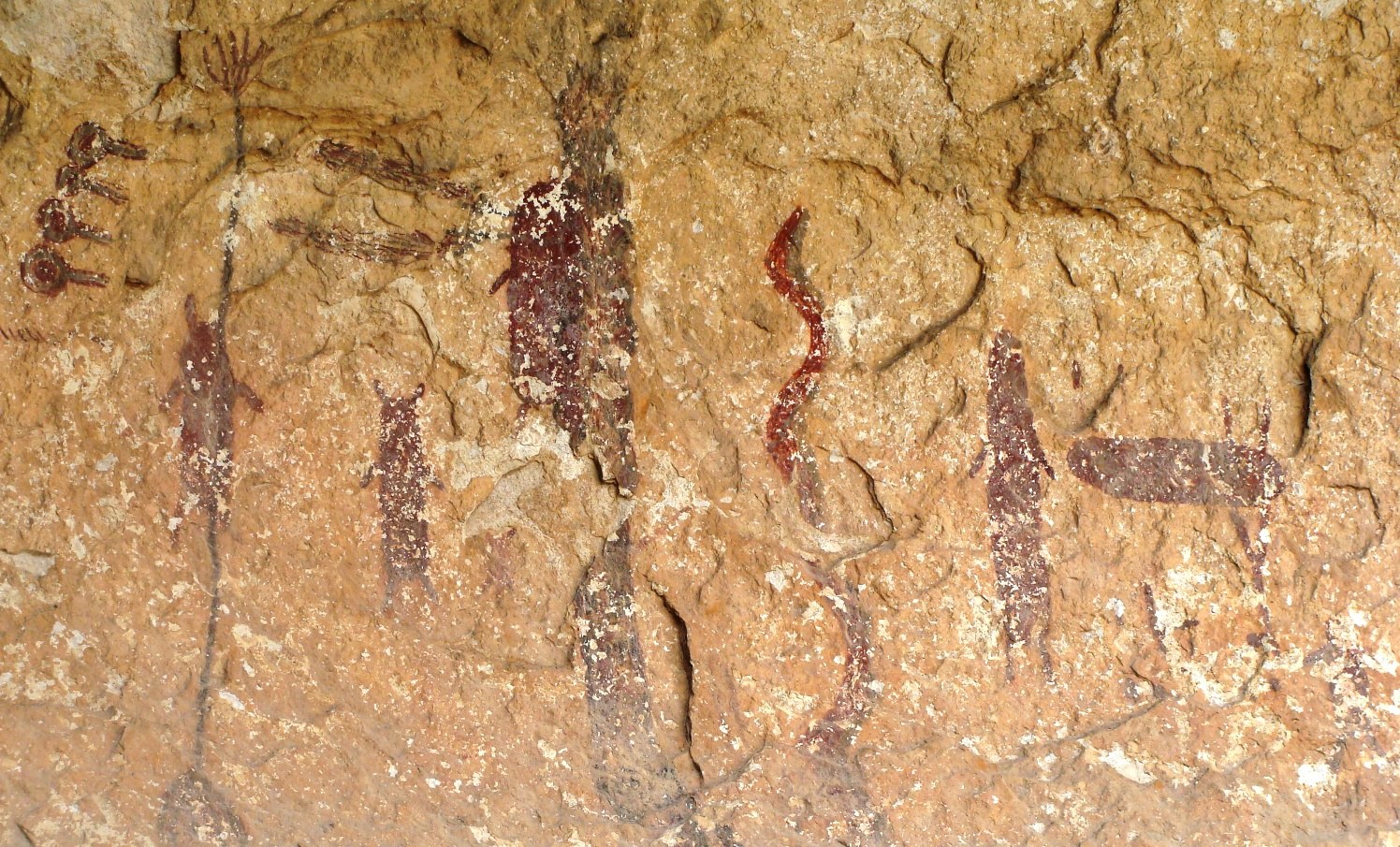
The canyons around Conejo Shelter are painted. The Pecos River style murals, among the largest painted rock art in North America, run along the shelter walls for hundreds of feet, red, black and yellow figures with staffs, wings and antlers, and among them the serpent. Sonderman pointed to it in the same breath as the coprolite: “the rock art in the Lower Pecos region also exhibits snake iconography.” Carolyn Boyd, who has spent a career on these walls, reads them as the scripture of a plant religion; in the words of the Pinwheel Cave team, her “extensive analyses have shown that Lower Pecos rock art iconography likely relates to mythological narratives concerning Peyote and Datura.”
The peyote is there too, and it is very old. Peyote, the small spineless cactus of the Chihuahuan Desert whose buttons carry mescaline, has come out of only two archaeological sites. One is Shumla Caves, in the same Lower Pecos country. In 2006 Martin Terry and his colleagues dated three specimens from Shumla to a mean of 5195 ± 20 radiocarbon years, about 4000 BCE, and looked at what they were.
“The Shumla Caves’ specimens are composed of an aggregate of ground peyote mixed with other plant material, i.e., they appear to be manufactured peyote effigies, and are definitely not intact peyote buttons.”
Terry et al., Journal of Archaeological Science 33 (2006), pp. 1017–1021
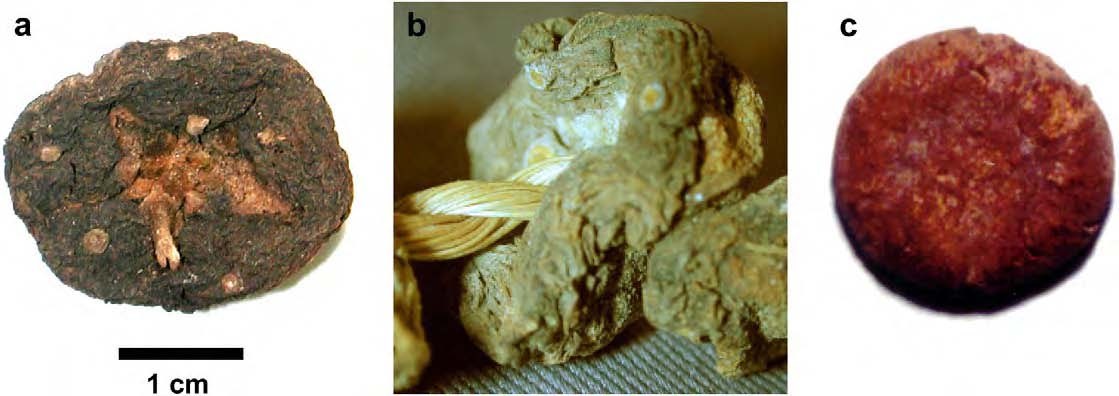
They still held 2 percent mescaline. Someone ground the cactus, mixed it and shaped it into the likeness of a button: a prepared dose, made to be carried and kept. At the second site, a burial cave near Cuatro Ciénegas in Coahuila, a button was found “strung on a cord with (originally) eight other buttons” and laid with the dead, about 835 radiocarbon years ago. So the Lower Pecos holds the whole set within a day’s walk: the oldest prepared vision medicine on the continent, walls painted with the serpent among the plant’s mythology, and a person who swallowed a viper whole.
The serpent’s cup
Spiro sits on the Arkansas River in far eastern Oklahoma, near the Arkansas line. Its Craig Mound, built between 1250 and 1450 CE, was the great treasure house of the Mississippian world, the mound-building civilisation of the eastern United States, packed with engraved cups cut from the shells of whelks brought up from the Gulf of Mexico. For a long time everyone assumed those cups held the Black Drink, the bitter caffeine tea of yaupon holly that Southeastern peoples drank before council and war and vomited back up. In 2018 Adam King, Terry Powis and their colleagues scraped residues from vessels in the Gilcrease Museum in Tulsa and ran them for the alkaloids of Datura, the jimsonweed.
Fourteen of the eighteen Spiro shell cups and fragments came back positive for atropine, and seven of thirty-one Mississippian and Caddo pottery vessels from Arkansas. The drink in the cups was the most dangerous vision plant of North America, and the vessels tell you whose drink it was. One positive pottery bottle is engraved with the two great powers of the world below.
“One vessel that tested positive for Datura is a medium-sized bottle incised with images representing the Underwater Panther and the Great Serpent … both of these images represent avatars of the Lord of Death in the Beneath World.”
King et al., Advances in Archaeological Practice 6:4 (2018), pp. 312–327
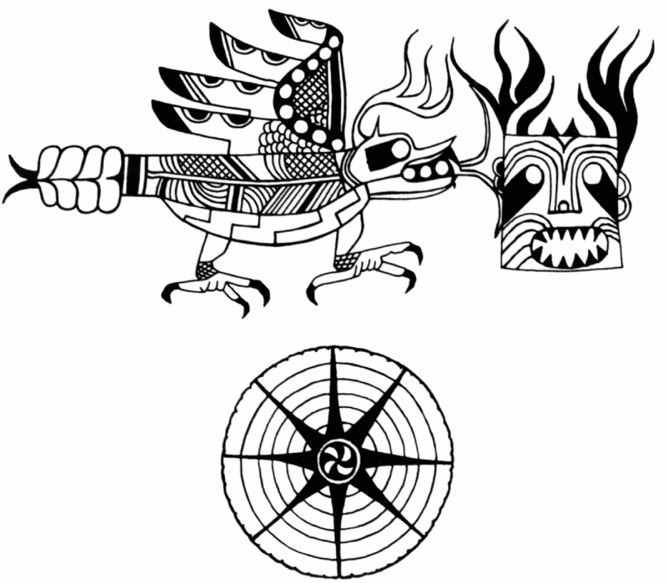
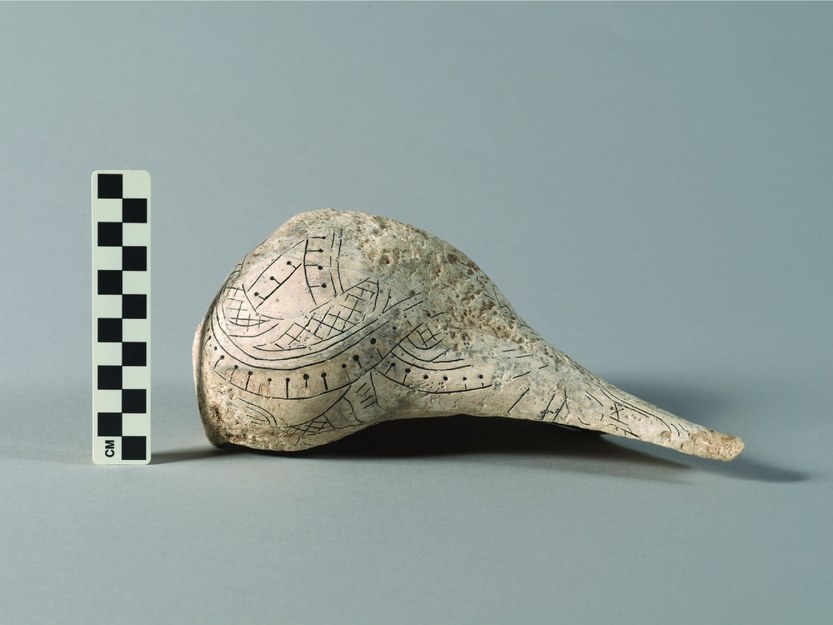
The one whole Spiro cup that tested positive is engraved in the Braden style, and its design is the serpent again: it “exhibits the amphisbaena theme, which is a creature with snakelike characteristics associated with the Beneath World.” Other positive pots are effigies of frogs and a turtle, creatures of the watery world below. The authors drew the line themselves.
The Great Serpent of the Southeast is the lord of the waters under the earth, horned, winged, the keeper of the dead and of the most potent medicine. The people of Spiro drank the jimsonweed out of his cup. “Now we must be open to the idea,” the authors write, “that these vessels were used in the consumption of more than one kind of ritual beverage.” The Black Drink was a purge; the Datura was a journey to the serpent’s country, and it was served in a vessel carrying his image.
The red racer pours the drink
Spanish missionaries in southern California called the jimsonweed toloache, and the peoples of the coast and the mountains behind Los Angeles and San Diego made it the centre of their religion. For the Luiseño of the San Luis Rey River, A. L. Kroeber wrote in his preface to Constance DuBois’s study of 1908, “the principal initiation of boys is the toloache ceremony, in which the central figure is the drinking of a stupefying decoction of jimsonweed.” The boys knelt at night before the tamyush, the sacred stone bowl painted red, white and black, while the officer called the paha went among the people whispering, “Keep quiet all of you.” Then they drank.
“The chief superintends the drinking, and as the candidates kneel in turn before the big tamyush to drink out of it, he holds the head of each with the palm of his hand under the forehead, and raises it when they have drunk a sufficient quantity of the liquid, watching to see that they do not drink too much.”
Constance Goddard DuBois, “The Religion of the Luiseño Indians” (1908), p. 79
The god of that religion, Chungichnish, sent the serpent after anyone who broke his law. Where other faiths threatened hell, DuBois wrote, “the worshipper of Chungichnish invoked the avengers of the hill, the stinging weeds, the rattlesnake and the bear.” After the drink the boys were shown a sand painting as large as a wagon wheel, a map of the world in quarters, the fourth quarter “empty except for the figure of a rattlesnake” and three sacred baskets (p. 90). In the rite for a dead initiate the painting has a gap to the north, “and the rattlesnake is painted near the gap” (pp. 92–93).
The man who served the drink was the snake. Among the Luiseño, the Cupeño and the Cahuilla the ceremonial officer who managed the rite was called paha, and William Duncan Strong, working among the Luiseño, Cahuilla and Cupeño in the 1920s, recorded what the word means: “The word paha appears to be of Luiseño origin, meaning a snake called the Red Racer” (1929, p. 62 n. 137). The red racer is the coachwhip, the long fast whipsnake of the southern deserts.
“The Luiseño call the ceremonial assistant associated with the jimsonweed cult, paha. This term is translated as red racer (Coluber flagellum), a reptile common in the area. They say that the coloration of the male snake is red and of the female black, and on this account the paha was painted red on one side of his body and black on the other thus representing both sexes … The same symbolism applies to the Cahuilla and Cupeño paha.”
William Duncan Strong, Aboriginal Society in Southern California (1929), p. 290
Among the Cahuilla, of the mountains and desert east of the Luiseño, the drinking had its own name, kiksawel, and the bullroarer kept the door. “The manet-dancer whirled the bullroarer as a warning to the uninitiated to stay away. The northern clans called it melawhic. Then the clan leader ground the jimsonweed “in a small ceremonial mortar called takic,” added water, poured it into a red pottery bowl, “and the paha gave each boy a swallow.” “The novitiates became unconscious and were left in the dance house all night” (Strong 1929, pp. 174–175). Strong’s informants said what the weed was: “The jimsonweed was a great human pul,” a shaman, “with whom they could talk.” The Luiseño swung their own whirling board at the death rites, and in the whirling dance of the Cupeño young people the snake swung the roarer himself: “before them were the two red and black painted pahas, swinging bull roarers” (Strong 1929, p. 258).
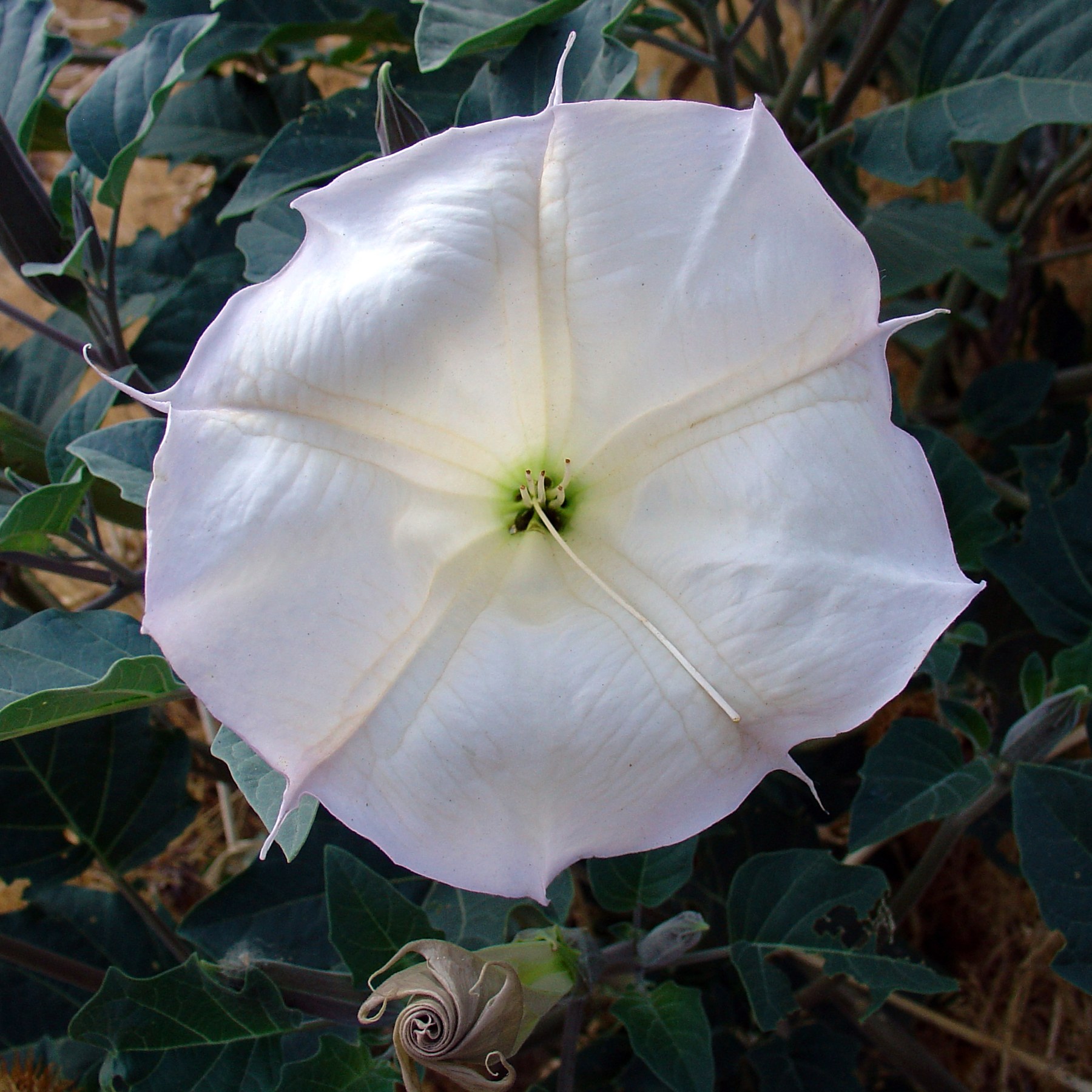
So the boy drank the most dangerous plant in his world from the hand of a man painted as the snake, under the roar of the bullroarer, and fell down as though dead. The ethnographers came late, when the rite was fading. The ground shows the drink was old. Pinwheel Cave lies in the Wind Wolves Preserve at the southern end of the San Joaquin Valley in Kern County, California, inland from the Chumash coast. Its ceiling is painted with a red pinwheel, and in the crevices of that ceiling David Robinson and his team found wads of chewed plant fibre. They were Datura wrightii, the jimsonweed, the earliest dated to 1530–1655 CE.
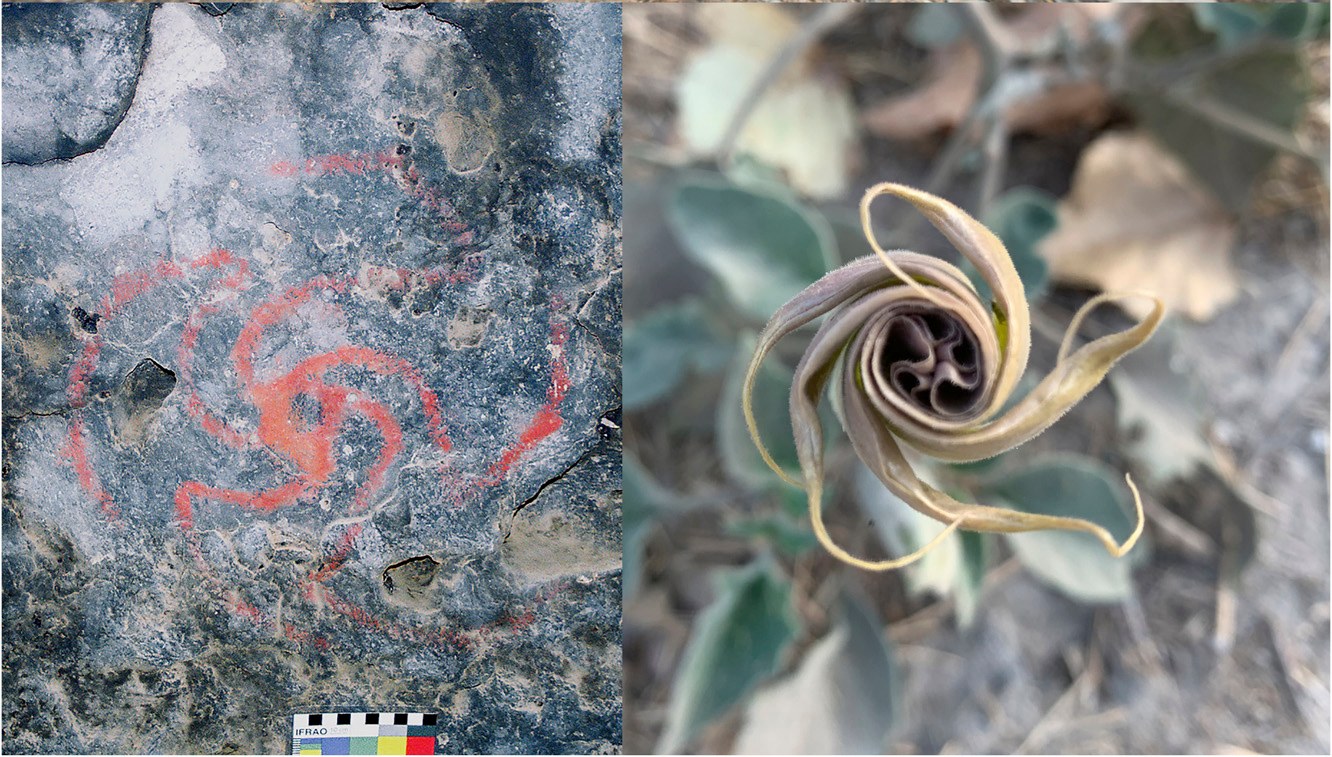
The painting is the plant. “As the Datura bud opens, the carolla unfurls into five arms, each curving back to create a pinwheeling appearance.” One crevice held a packet of ten quids, and the excavators drew the obvious conclusion: “the best explanation is that this packet represents the doses of a group, perhaps up to 10 individuals, matching what would be expected from a group initiation ceremony.” The Chumash knew Datura as a person, the grandmother Momoy. The paintings, the team wrote, “served epistemologically, preparing participants for the experience they were undertaking.”
Water off the serpent-killer
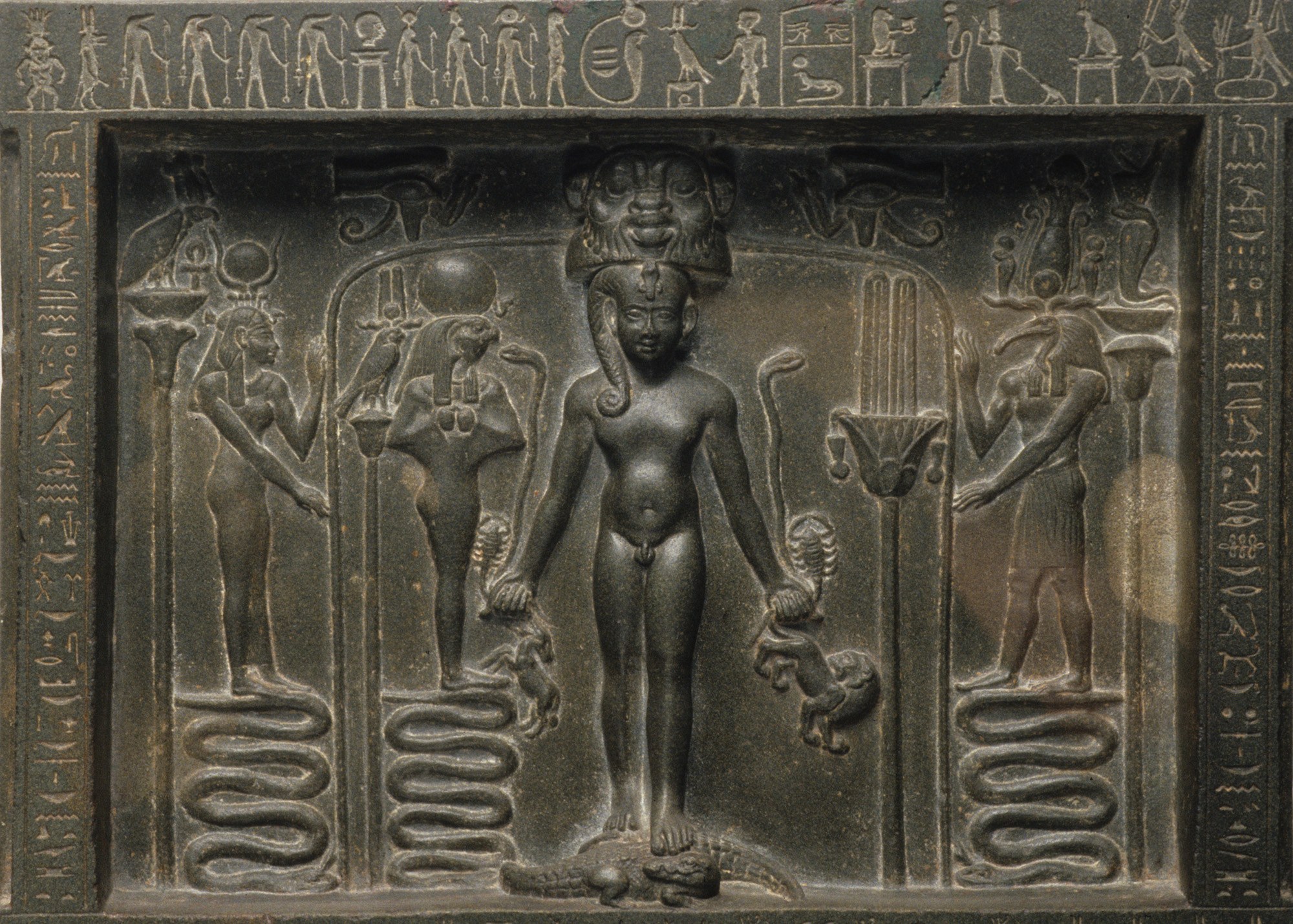
Egypt drank the serpent in a different way, and left the apparatus standing. In the last centuries of the pharaohs the priests made cippi, stelae of Horus the child standing on crocodiles and holding snakes, scorpions and lions in his fists, covered with spells against bites and stings. The greatest is the Metternich Stela in the Metropolitan Museum, carved under Nectanebo II between 360 and 343 BCE for the temple of the Mnevis bulls, most likely at Heliopolis, at the edge of modern Cairo. “Horus holds snakes and scorpions,” in the museum’s description, and “his feet rest on two crocodiles.” Below him, rows of hieroglyphs record “thirteen magic spells to protect against venomous bites and wounds.”
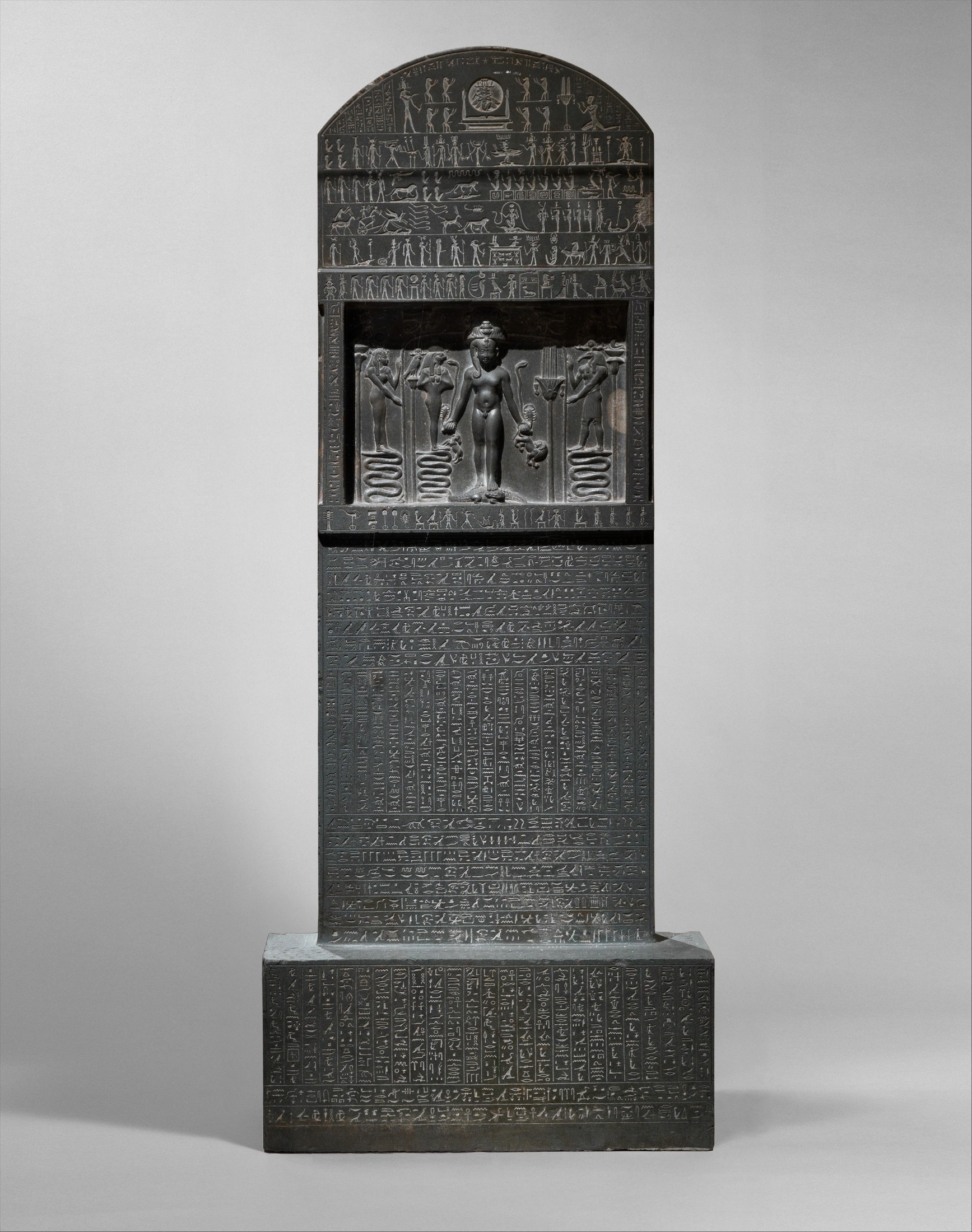
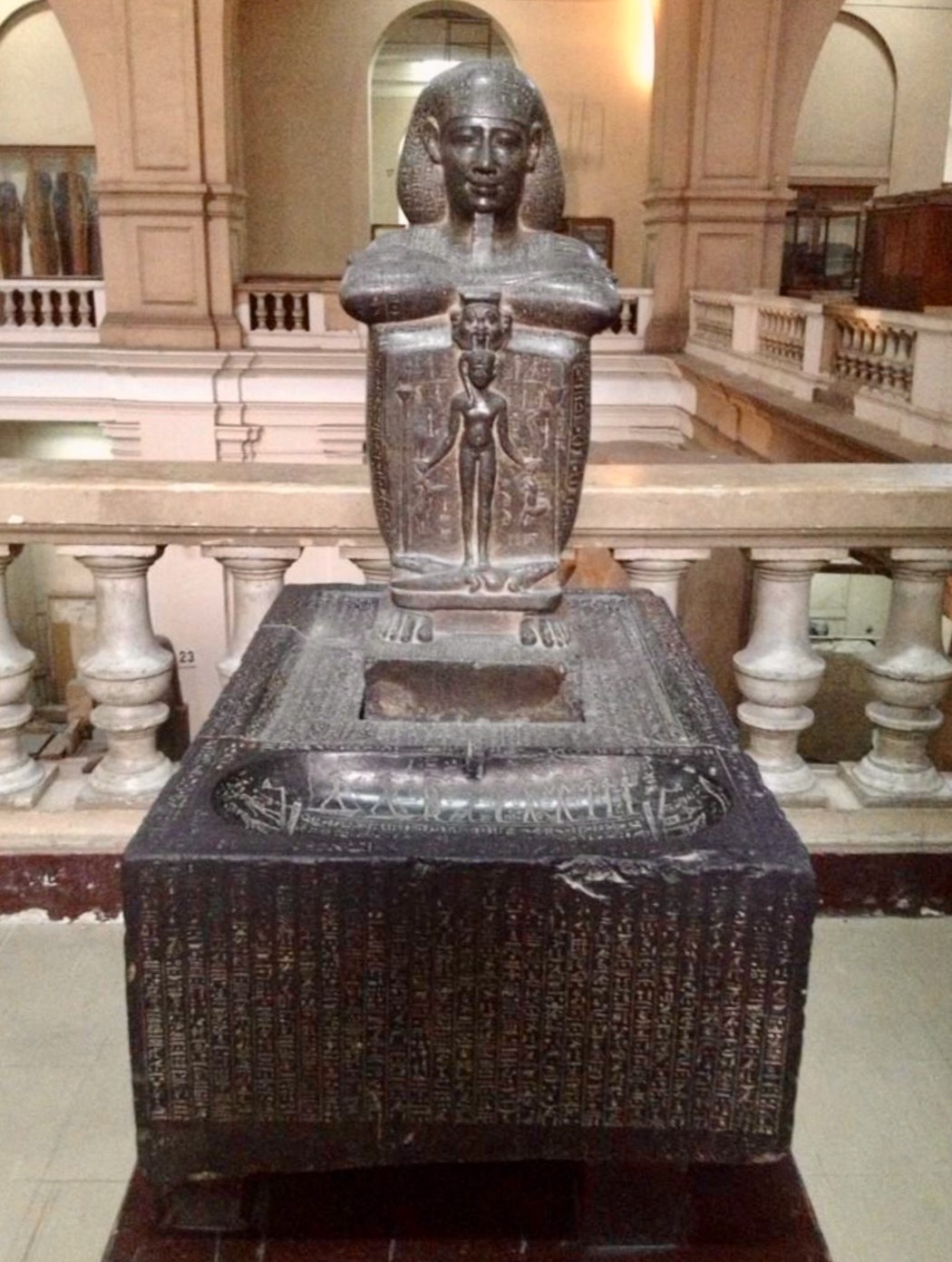
The words and pictures were not read. They were drunk.
“A victim could recite or drink water that had been poured over the magic words and images on the stela.”
The Metropolitan Museum of Art, Metternich Stela, 50.85
The museum’s guide spells out the plumbing: “Water could be poured over the stela and it would run over the images and words and magically absorb their healing powers. The victim could then drink this water that could cure him from the inside.” A generation later, at Athribis in the Nile Delta, the priest Djedhor had himself carved squatting with a Horus stela between his arms and feet, his whole body covered in spells “against the stings and bites of crocodiles, snakes and scorpions.” Its base is cut with “two offering basins that are united by a channel.” Water, or wine, went over the god gripping snakes, over the spells, down the priest’s body, into the basins, and into the bitten man. The cure for the serpent was the serpent’s own picture, dissolved and swallowed, the master of serpents taken in by the mouth.
Serpents under the skin
Some Egyptians carried the serpent into the body for good. Deir el-Medina is the village on the west bank at Luxor where the artisans who cut the royal tombs in the Valley of the Kings lived. Among the remains from a tomb there, TT290, Anne Austin and Cédric Gobeil found the mummified torso of a woman, from a burial group mostly of the Ramesside age, the thirteenth to eleventh centuries BCE. She was tattooed with at least thirty designs. On her throat are sacred signs. On her shoulders and arms are snakes.
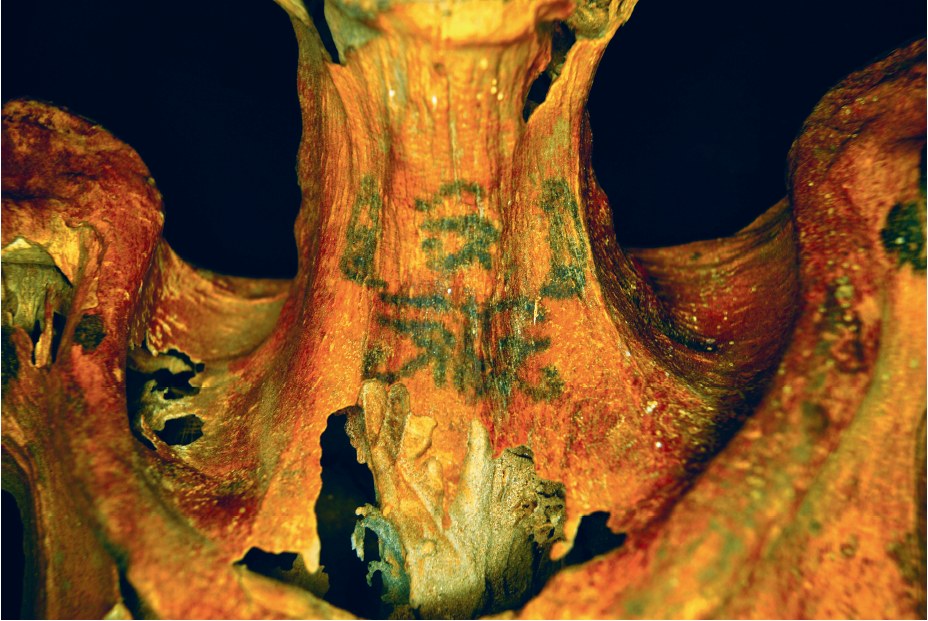
“Below each pair of wadjet-eyes on the shoulders is traced one wavy snake with its head facing forward … ivory apotropaic wands possess many figures of snakes.”
Anne Austin and Cédric Gobeil, BIFAO 116 (2016), §22
More snakes follow. Above each armpit a cobra, the uraeus of the pharaoh’s brow, hangs from a sun disc, and further down her arms are a cobra on a groundline and a snake with a basket (§28 and table 1). Austin and Gobeil read the tattoos as amulets pricked into the skin, “the act of fixing forever the image of an amulet,” a way “to attach permanently the magical power of an amulet on one person.” The throat was chosen “to give magical powers to her speech.” They concluded that she was “someone actively involved in healing and protecting people, in other words a magician.” In the same magic the patient took images in by the mouth: “Magical spells sometimes ask that images should be drawn on the patient’s hand and then licked off by him.”
The stela and the tattoo are one idea at two speeds. Pour water over the serpent-killer and drink it, and the power goes in once. Prick the serpent into the skin, and it stays. A magician who healed wore the snake on her own body and the sacred signs on her throat, where the spell comes out.
The poison in the cup
India wrote the drink into its oldest poetry. Hymn 10.136 of the Rigveda, composed in the Punjab in the second millennium BCE, is the song of the keśin, the long-haired ascetic, a wild holy man outside the sacrifice. It opens with what he carries.
“The long-haired one bears fire, the long-haired one poison, the long-haired one the two world-halves.”
Rigveda 10.136.1, trans. Jamison and Brereton (2014)
His companions, the wind-girt ascetics, ride the winds and tell the watching mortals that they see only their bodies (v. 3; The First Entheogen gives the line). And the hymn ends with the drink.
“Vāyu churned it for him; Kunannamā kept crushing it, when the long-haired one drank of the poison with his cup, together with Rudra.”
Rigveda 10.136.7, trans. Jamison and Brereton (2014)
The word is viṣa, poison, the word for venom, drunk viṣasya pātreṇa, “with the cup of poison,” in the company of Rudra, the wild archer of the mountains, the god of healing and of harm. The drink was churned, the ecstatic flew on the wind, and the mortals saw only his body. Later India told the same scene at the scale of the cosmos. In the Mahabharata the gods and demons churn the ocean for the drink of immortality, and the churning rope is a snake: “the gods and the Asuras made of Mandara a churning staff and Vasuki the cord.” Strained between them, the serpent breathes fire, “black vapours with flames issued from his mouth.” The last thing the churn throws up is poison.
“But with the churning still going on, the poison Kalakuta appeared at last. … And then Siva, being solicited by Brahman, swallowed that poison for the safety of the creation. The divine Maheswara held it in his throat, and it is said that from that time he is called Nilakantha (blue-throated).”
The Mahabharata, Adi Parva, section 18, trans. Kisari Mohan Ganguli
Rudra’s heir drinks the poison churned out of the serpent and keeps it in his throat, and he wears snakes for ornaments ever after. The hymn and the epic tell strikingly close scenes: the poison is churned, a god drinks it from a cup, and the drinker leaves his body behind on the wind.
Taking the serpent in
Put the finds side by side and the pattern does not need coaxing. In Texas a person swallowed a viper whole, fang and all, in canyons painted with serpents among the myths of peyote and Datura, where prepared vision medicine had been kept for four thousand years. At Spiro and across Arkansas the jimsonweed was drunk from cups and bottles engraved with the Great Serpent of the world below. In southern California a man named for the red racer gave each boy his swallow while the bullroarer roared, and the boy woke to a painted world with the rattlesnake in its empty quarter. On the Nile the sick drank water off the god who grips the snakes, and a healer wore the snakes in her skin. In the Punjab the ascetic drank the poison with Rudra and rode the wind.
Each is a door into the body. The mouth takes the serpent whole, or takes its drink from its cup. The throat holds the poison, or carries the spell. The skin takes the serpent’s image and keeps it. These are the same doors the living snake uses, the bite and the mouth, and the same ones the Bombay snake charmers used when they set a cobra to the tongue, as The First Entheogen tells. The drink in the serpent’s cup is the bite made bearable: the same encounter, carried in a vessel, poured by a man who is the snake. The Snake men of the Hopi dance with rattlesnakes in their mouths and close the rite by drinking their secret medicine (The Gift of Venom); the Kimberley brothers put a bullroarer in the snake’s mouth to make its venom (How the Snake Got Its Venom); the snakes that ride in the mouths of dancers live in Live Snakes in the Rite.
The archaeology carries the sacrament back past every text. The swallowed viper is older than Islam; the Shumla effigies are older than the pyramids; the Horus water was drunk two and a half thousand years ago, and the poison in the Rigveda’s cup was sung before that. The serpent was taken into the body on three continents, from the same kind of cup. That is what an ancient rite looks like when it has been carried a very long way: the venom first, then the drink that stands for it, then the water off its image, and always the serpent at the rim.
Key sources
- Elanor M. Sonderman, Crystal A. Dozier and Morgan F. Smith, “Analysis of a coprolite from Conejo Shelter, Texas: Potential ritualistic viperous snake consumption,” Journal of Archaeological Science: Reports 25 (2019): 85–93, doi:10.1016/j.jasrep.2019.03.032, abstract; and the Texas A&M University release on the find (2019), quoting Smith and Sonderman, as reprinted by Futurity.
- Martin Terry, Karen L. Steelman, Tom Guilderson, Phil Dering and Marvin W. Rowe, “Lower Pecos and Coahuila peyote: new radiocarbon dates,” Journal of Archaeological Science 33 (2006): 1017–1021, doi:10.1016/j.jas.2005.11.008, fig. 3.
- Adam King, Terry G. Powis, Kong F. Cheong, Bobi Deere, Robert B. Pickering, Eric Singleton and Nilesh W. Gaikwad, “Absorbed Residue Evidence for Prehistoric Datura Use in the American Southeast and Western Mexico,” Advances in Archaeological Practice 6:4 (2018): 312–327, doi:10.1017/aap.2018.30, figs. 2 and 5.
- Constance Goddard DuBois, “The Religion of the Luiseño Indians of Southern California,” University of California Publications in American Archaeology and Ethnology 8:3 (1908), with a preface by A. L. Kroeber, pp. 72 (Kroeber), 76–79 (Chungichnish and the toloache drinking), 90–93 (the sand paintings), Internet Archive.
- William Duncan Strong, Aboriginal Society in Southern California, University of California Publications in American Archaeology and Ethnology 26 (1929), pp. 62 n. 137 (paha, the red racer), 174–175 (the Cahuilla kiksawel), 258 (the Cupeño whirling dance), 290 (the Luiseño paha), UC Berkeley Library.
- David W. Robinson et al., “Datura quids at Pinwheel Cave, California, provide unambiguous confirmation of the ingestion of hallucinogens at a rock art site,” PNAS 117:49 (2020): 31026–31037, doi:10.1073/pnas.2014529117, fig. 1.
- The Metropolitan Museum of Art, “Magical Stela with Horus the Child” (the Metternich Stela), 50.85, catalogue entry and audio guide.
- Egyptian Museum, Cairo, “Statue of Djed-Hor Holding a Stela of Horus on Crocodiles,” collection entry.
- Anne Austin and Cédric Gobeil, “Embodying the Divine: A Tattooed Female Mummy from Deir el-Medina,” Bulletin de l’Institut français d’archéologie orientale 116 (2016): 23–46, doi:10.4000/bifao.296, §§17–22 and fig. 3.
- Rigveda 10.136, vv. 1, 3, 7, in Stephanie W. Jamison and Joel P. Brereton, The Rigveda: The Earliest Religious Poetry of India (Oxford, 2014), via the parallel text at Online Veda.
- The Mahabharata of Krishna-Dwaipayana Vyasa, trans. Kisari Mohan Ganguli, Book 1, Adi Parva, section 18 (the churning of the ocean), Project Gutenberg.