No. HAD1898-043
East Derbyshire bummer bullroarer
United Kingdom · East Derbyshire · England · Europe · British Isles
Play / practical
bummer / buzzer
bummer / buzzer: East Derbyshire sound-names for the bull-roarer.
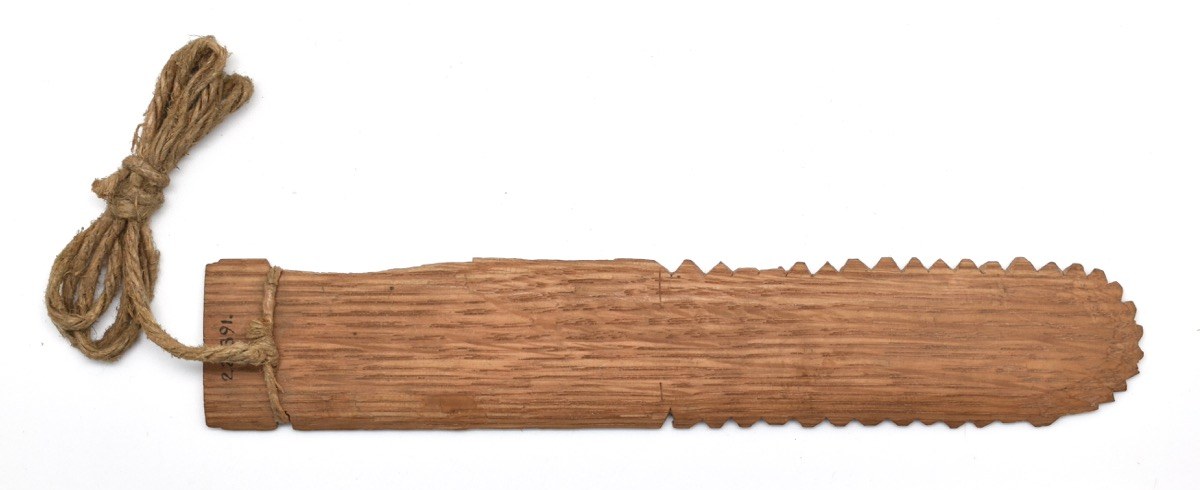
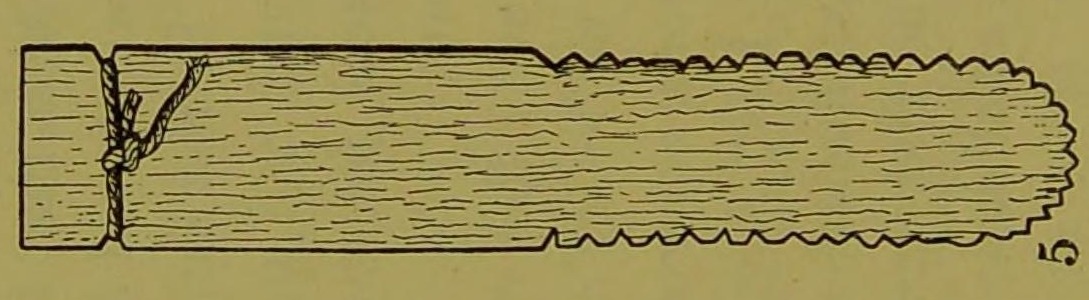
Nearly every English bullroarer Alfred Haddon handled had its string through a drilled hole; the one he got from East Derbyshire did not. Its cord is tied into a nick cut in each side near the squared end, and only the far half of the slat, down to its rounded tip, is toothed - a plano-convex board just over ten inches long. Boys there whirled it on that side-lashed cord, and the noise it made earned both of its local names: 'bummer' and 'buzzer.'
In East Derbyshire it is known as a 'bummer' or 'buzzer.' My Derbyshire specimen is plano-convex, the string end is square and the other rounded.
A. C. Haddon, The Study of Man (1898), pp. 278-280
Particulars
- Object
- Haddon's own East Derbyshire specimen: a plano-convex wooden slat, 257 x 47 mm, square at the string end and rounded at the free end; the single cord is tied into a nick cut in each side near one end, and only the opposite half and the free end are serrated.
- Function
- A boys' whirring toy, named for its sound.
Source
Haddon 1898, The Study of Man, Chapter X: The Bull-Roarer; Haddon's own collected Derbyshire specimen, described and figured first-hand