No. BAYLEY1912-001
Medieval European Holy-Spirit bullroarer emblem
France · Languedoc (medieval Albigensian Europe) · Mediterranean
Sacred / spirit
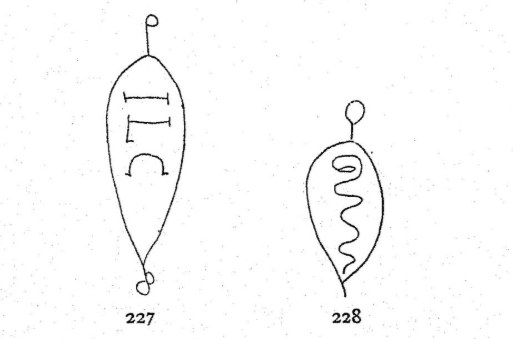
Source term: bullroarer / papermark emblem
Not an instrument at all, but a reading of paper. In The Lost Language of Symbolism (1912), the watermark scholar Harold Bayley took two medieval European papermarks — a blade ranging "from this laurel-leaf form to that of a diamond lozenge" — to be drawings of the bullroarer, and argued that "among the European mystics of the Middle Ages the bullroarer was apparently considered to be an emblem of the regenerating power of the Holy Spirit." He read the marks as charged with rebirth: the first, he wrote, carries "the regenerative number eight," the second "a roughly executed serpent, the symbol of regeneration." Bayley set this against the instrument's deep ancestry, noting that under the name Rhombus it had "figured prominently in the Mysteries of Ancient Greece," and tied the roaring sound to Dionysus, surnamed Bromius, "the roarer," and through him to Christ.
Ezekiel describes the voice of the Spirit as 'a great rushing,' and there is a similar reference in The Acts to 'a sound from Heaven as of a rushing mighty wind.'
Bayley, The Lost Language of Symbolism, Vol. I (1912), p. 86
Particulars
- Object
- Two medieval paper watermarks read by Bayley as bullroarers: a laurel-leaf / diamond-lozenge blade hung from a single cord; one carries the regenerative 'number eight', the other a roughly drawn serpent (symbol of regeneration).
Source
Harold Bayley, The Lost Language of Symbolism, Vol. I (1912), chapter on The Bullroarer, pp. 86-88, figs 227-228