No. SOLOVIEV2015-001Europe
Kildin Sámi navv’t beast-howler
Russia · Murmansk Oblast · Kola Peninsula · Europe · Arctic
Function not recorded
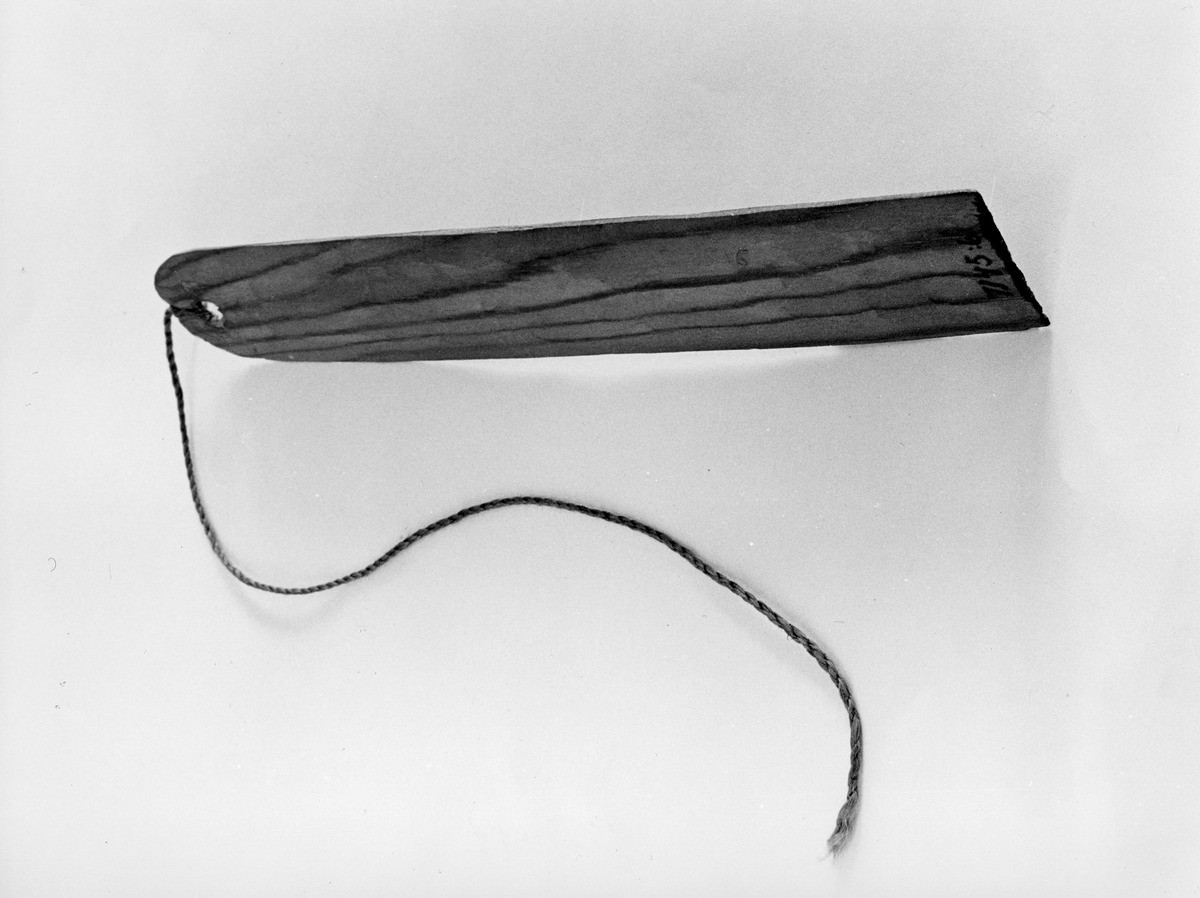
navv’t
Source term: vortex aerophone-howler
navv’t: “beast.”
The Kildin Sámi name navv’t means “beast,” and the sound earns it: a chip of wood, any chip to hand, threaded on a cord and spun so fast that it howls — to Soloviev’s ear, like a wolf. Behind that howl he hears the god Kavvrai, patron of the noaidi, who in the eastern Sámi telling made the wolf and the dog. Forgotten for a time, the howler came back with the Lovozero song-and-dance ensemble, whose leader V. D. Gurinov set out to recreate the old Sámi instruments: the navv’t howler, the khouff buzzer and the kellakh bells returned to accompany Sámi song.
наввьт / navv’t (кильд.-саам. – зверь)
navv’t (Kildin Sámi: “beast”)
Soloviev 2015:3
Particulars
- Object
- A chip of wood, any chip to hand, threaded on a cord, which spins at great speed when the cord is drawn taut and gives a howling sound. Recreated in the late Soviet period for the Lovozero song-and-dance ensemble.
- Function
- Recreated by the Lovozero Sámi song-and-dance ensemble, with the khouff buzzer and kellakh bells, and used to accompany singing; older use not recorded.
Source
I. V. Soloviev, “Saamskie muzykalnye instrumenty: k popytke osmysleniya semantiki zvenyashchego tembra,” Muzykal'nyj zhurnal Evropejskogo Severa 3 (2015), p. 3; O. N. Ivanishcheva and V. B. Bakula, Slovar' leksiki dukhovnoi kul'tury kol'skikh saami (Murmansk, 2013), p. 159, quoting L. S. Belyaeva, Saamskaya etnopedagogika (1991), p. 38, and A. A. Kiselev and T. A. Kiseleva, Sovetskie saamy (1987), p. 169; L. V. Khomich, Saamy (St Petersburg, 1999), ch. X
Nearby in the atlas
 Devil's Gate nephrite blades, two cord-wornc. 5750–4750 BC · Russia · Function not recorded
 Eliseevichi engraved ivory plaquesc. 19,000–13,000 BC · Russia · Function not recorded
 Kondon nephrite blesny / Lower Amur slat-lurec. 3350–3050 BC · Russia · Function not recorded
 Novgorod tanged whirring laths13th–14th centuries AD · Russia · Function not recorded
 Novopokrovka nephrite slat-luresc. 5000–3000 BC · Russia · Function not recorded
 Ust-Tartas engraved bone bladec. 3000–2000 BC · Russia · Function not recorded