No. NOVG2026-001
Novgorod tanged whirring laths
Russia · Novgorod the Great (Sophia and Trade sides) · Eastern Europe
Function not recorded Candidate only
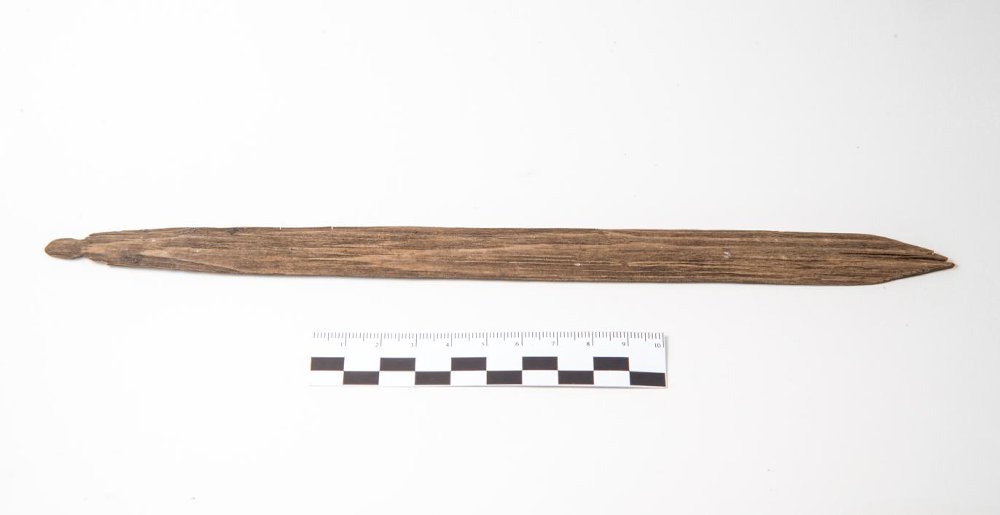
Source term: жужжалка
жужжалка: Russian 'buzzer', from жужжать 'to buzz' — the name Russian collections give loosely to any whirled sound toy, whether swung from an end cord or spun on a twisted double cord.
Waterlogged excavations at medieval Novgorod preserved two thin wooden whirrers from the thirteenth and fourteenth centuries. Each has a carved head or tang for attaching cord at one end and lacks the central holes typical of excavated twist-buzzers, making a swung bullroarer interpretation plausible but not proven.
Particulars
- Object
- Two thin wooden blades with carved terminal tangs, excavated from thirteenth- and fourteenth-century Novgorod contexts.
- Function
- Not recorded.
Source
Novgorod State Museum-Reserve, КП 44022/304 (инв. А-195/304; Troitsky excavation) and КП 44219/381 (инв. А-201/381; Nikitinsky excavation, 2003); State Catalogue of the Museum Fund of the Russian Federation, reg. 10418676 and 8729656