The Bullroarer Atlas

No. MOLODIN2020-001

Ust-Tartas engraved bone blade

Russia · Baraba forest-steppe · Novosibirsk region · Asia · Siberia

Function not recorded
Archaeological datec. 3000–2000 BCOdino Bronze Age burial context.
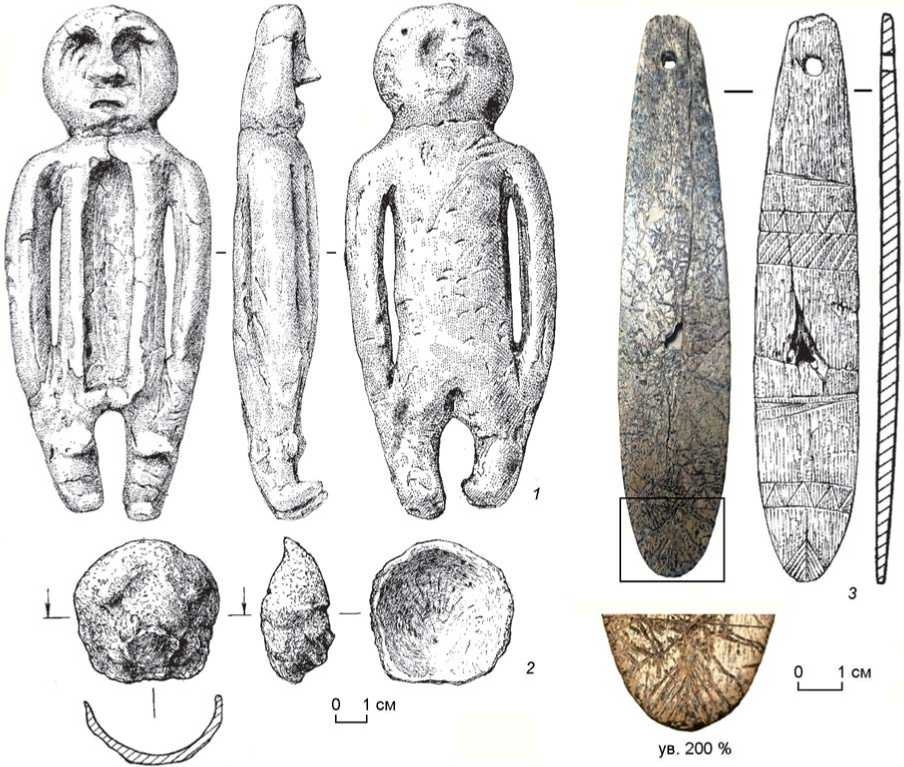
A source plate shows several views of a clay human figure and bone mask beside a photograph and drawing of a long engraved bone blade.
Plate I. Ust-Tartas-2 grave 65: engraved bone blade at right, clay figure at left, and bone mask below; complete fig. 3. Image source
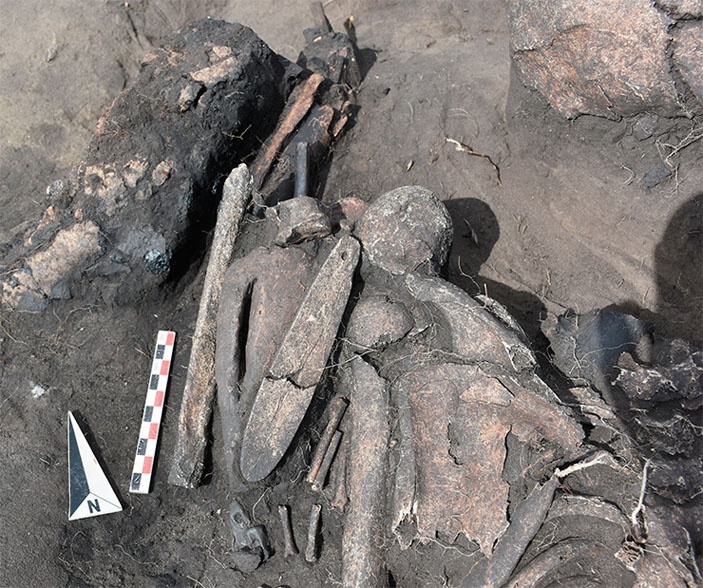
An excavation photograph shows a long bone blade in two pieces lying over a clay figure among dark grave deposits, beside a scale and north arrow.
Plate II. The broken engraved blade covering the clay figure in grave 65, during excavation. Image source
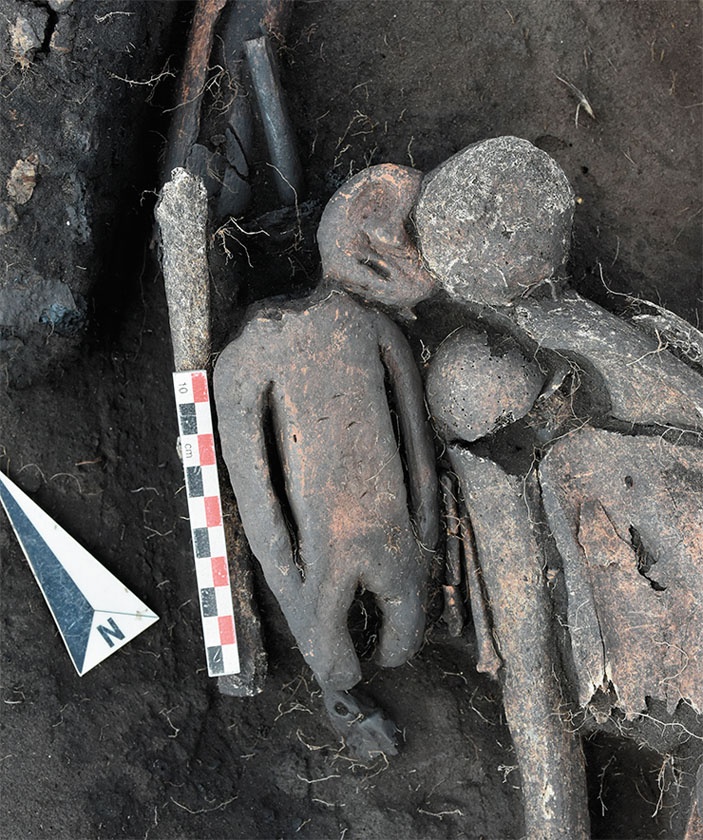
The clay figure lies in the grave with its round detached head beside its shoulder, next to human skeletal remains and an excavation scale.
Plate III. The uncovered clay figure in grave 65, with its detached head displaced beside it. Image source
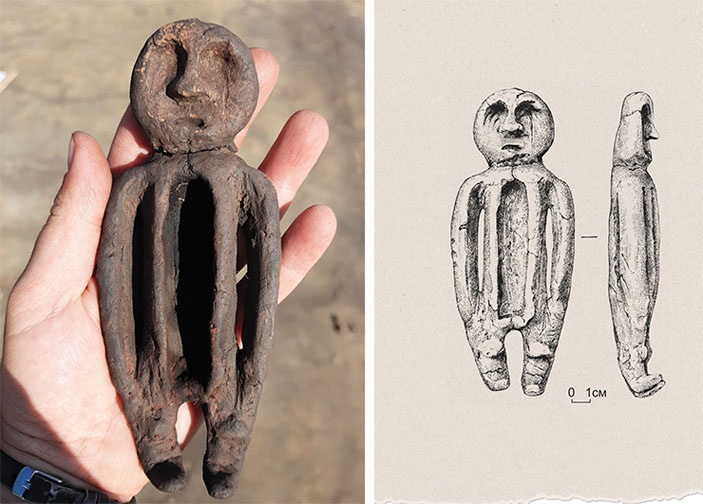
A clay human figure rests in a hand with its head repositioned above a hollow torso; drawings beside it show its face and profile.
Plate IV. The clay figure after excavation, with its head repositioned; photograph and drawing. Image source
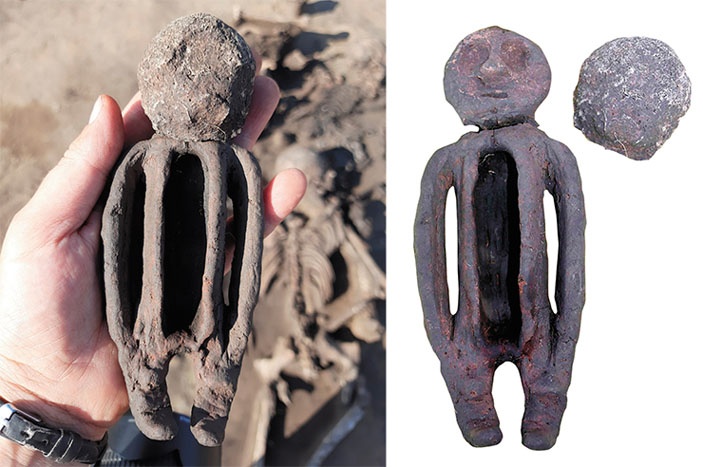
Side-by-side photographs show the clay figure with a round bone mask covering its face, then its uncovered face beside the detached mask.
Plate V. The clay figure with its bone mask fitted at left, and with the mask removed at right. Image source

Source term: костяная пластина

kostyanaya plastina: bone plate.

A thin bone blade, 13 cm long and only 3.5 mm thick, widens from a pierced narrow tip to a rounded end. Both faces are engraved in hair-fine lines: bands of hatched triangles, slanting strokes and a fan of cuts across the rounded end. It lay in two pieces over a small clay human figure in a Bronze Age grave of the Odino culture. The figure is hollow-bodied, its cheeks crossed by slanting lines like tattoos, and it wore a bear-like mask carved from a horse vertebra; its head had been broken off. It lay at the shoulder of a woman, face down over a man, both wrapped in birch bark and briefly burned in the grave. The bear was a favourite Odino image, on bronze buckles and a necklace of stone bears, and in another Odino grave, at Sopka, a vertebra mask again lay with an engraved bone plate. The excavator, Vyacheslav Molodin, saw the masked figure as a totemic ancestor, sent with the dead woman into the other world and then ‘killed’.

С обеих сторон пластина украшена гравированным орнаментом, нанесенным тончайшими линиями.

Both faces of the plate are decorated with engraved ornament applied in the finest lines.

V. I. Molodin et al., PAEAS 26 (2020), grave 65 account

Particulars

Object
Bone blade engraved on both faces, 130 × 25 × 3.5 mm, with a pierced narrow end and rounded broad end; recovered in two pieces beside a clay figure.
Function
Not recorded.

Sources

  1. V. I. Molodin et al., “Продолжение раскопок грунтовых могильников эпохи бронзы в Барабинской лесостепи,” PAEAS26(2020),501–509, fig3 View
  2. V. I. Molodin, “Глиняный «идол» урочища Таи,” Наука из первых рук5–6(90)(2020) View · archived

Part of The Bullroarer Atlas, companion to The Eve Theory of Consciousness.