No. SCHUMACHER1950-001
Batwa urübügübugu, bamboo for play
Rwanda · Highlands east of Lake Kivu (Kanage, Bushiru, Birunga margins); Schumacher's Eastern Batwa survey · East Africa
Play / practical
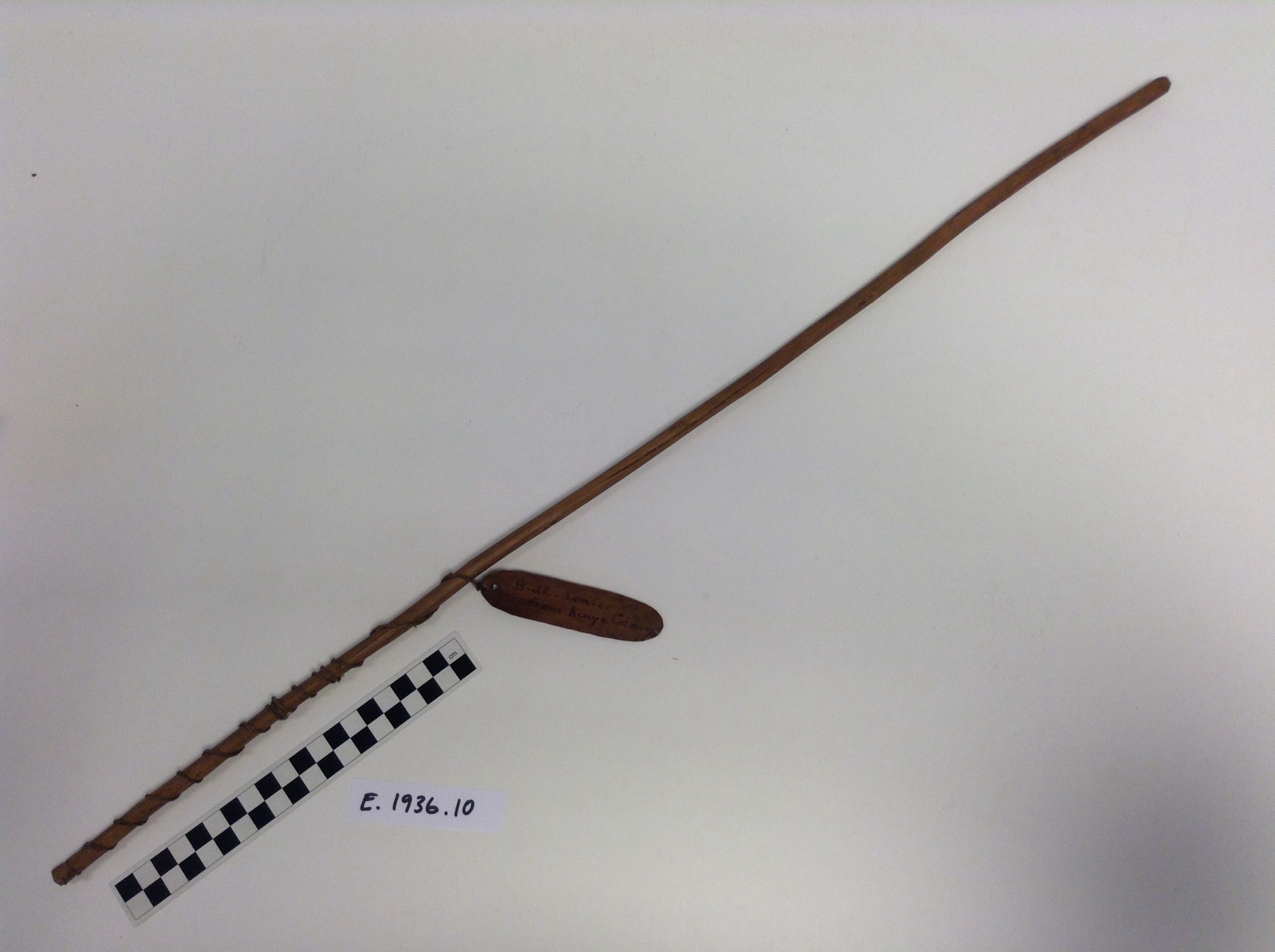
urübügübugu
Source term: Schwirrholz
urübügübugu: the Eastern Batwa name for the bullroarer, in Schumacher's spelling; no meaning is given. ’ndaro: the small branch huts in which the ancestors (bazimu) receive offerings.
A split of bamboo on a cord was all it took. Eastern Batwa children in the hills east of Lake Kivu whirled the urübügübugu for their own amusement; their elders knew it well and never brought it into a rite. Batwa worship lived elsewhere, in the ’ndaro: little domes of branches about a metre high where the ancestors received beer, meat and millet porridge. Nobody fenced them off. Children romped there and hens wandered in and out, so long as no one wrecked a shrine. The head of the family, building one, would say: “See, here is a house, grandfather — be content.”
Es besteht aus einem Bambusscheit und einer Schnur und dient den Kindern als Spielzeug.
It consists of a split of bamboo and a cord, and serves the children as a toy.
Peter Schumacher, Die Kivu-Pygmäen (1950), p. 317
Particulars
- Object
- A piece of split bamboo on a cord.
- Function
- A children's toy; Schumacher states that it was known but not used in any ritual act.
Source
Peter Schumacher, Die Kivu-Pygmäen (Twiden), Expedition zu den zentralafrikanischen Kivu-Pygmäen II (Brussels: Institut Royal Colonial Belge, 1950), p. 317