No. PEUR2026-012Europe
Balmori bull plaque
Spain · Llanes, Asturias · Europe · Iberia
Function not recorded Candidate only
Archaeological datec. 17,000–9500 BCMagdalenian to Azilian by attribution; the plaque itself is not dated.
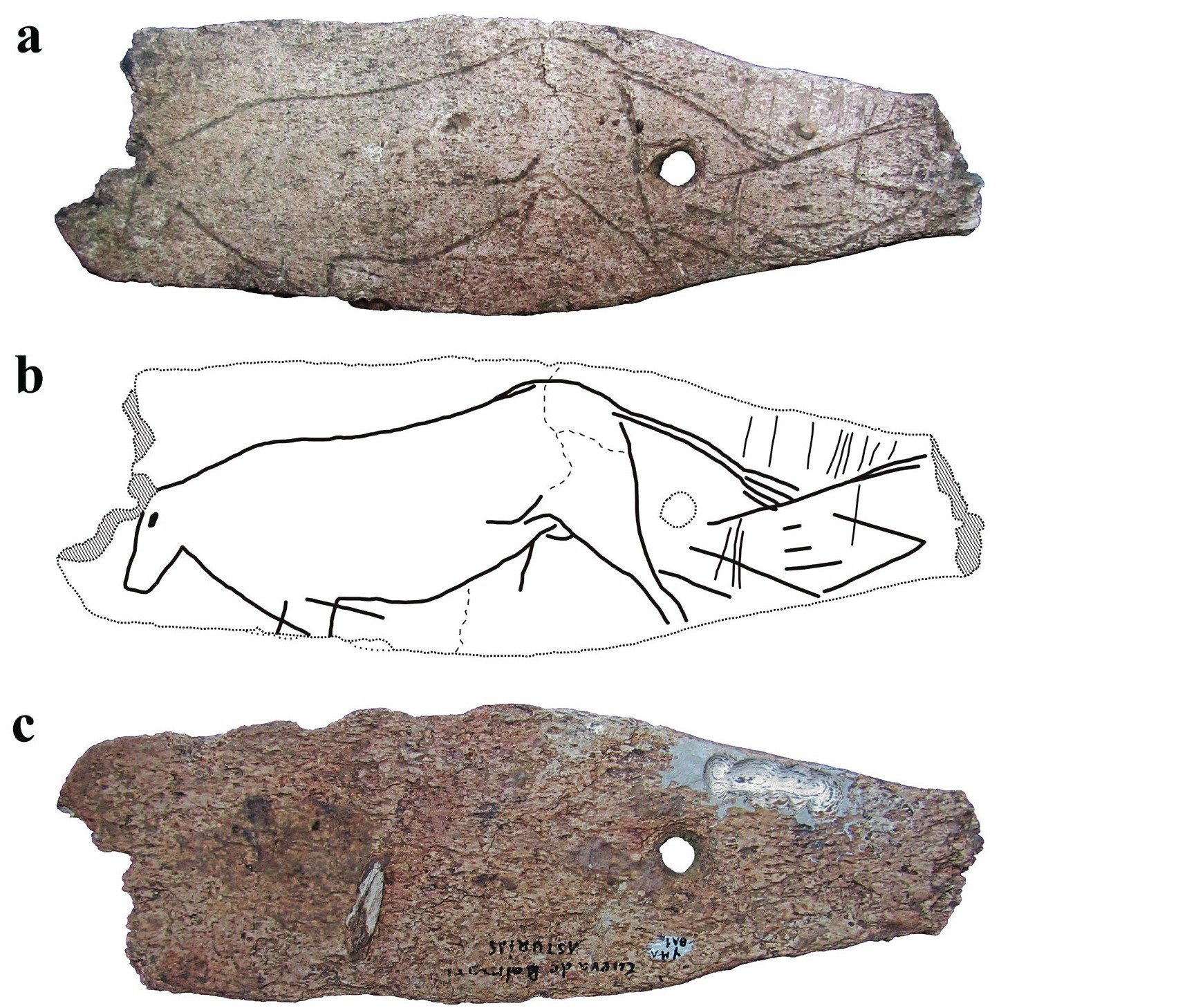
A great wild bull fills this flat bone plaque, its horns reaching toward one end and its sex carefully marked. It came out of Balmori cave, above the Asturian coast, in excavations of 1914 to 1917: nearly twenty centimetres of bone, broad and thin, with an old hole torn out at one end and a second bored through the body. Writing the prehistory of Asturias in 1977, Francisco Jordá Cerdá wondered whether it was a bramadera, a bullroarer.
Particulars
- Object
- Broad, completely flat bone plaque, 196.4 mm long as preserved, 54-60 mm wide through most of the body and 5.5-6.8 mm thick, engraved with a large bovine whose sex is marked; a broken-out hole survives at one end and a second hole is bored through the body.
- Function
- Not recorded. Jordá Cerdá raised the bullroarer reading as a question; the recent study treats it as a suspended plaque whose lower edge was first used to work soft materials.
Sources
- Francisco Jordá Cerdá, Historia de Asturias I: Prehistoria (1977), p. 134
- Iratxe Boneta, Corina Liesau and Adán Pérez-García, Kobie Paleoantropología 36 (2018): 21-30 View