No. BROWN1992-001North America
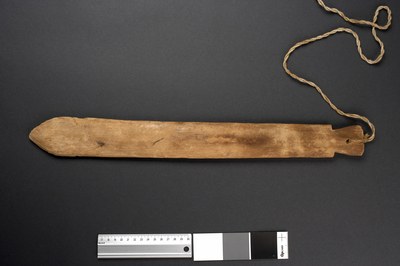
Navajo Reservoir rockshelter bullroarer
United States · New Mexico · Navajo Reservoir district (upper San Juan Basin) · North America
Function not recorded Candidate only
Source term: bullroarer
At LA 3398, a rockshelter tested during salvage archaeology in New Mexico's Navajo Reservoir district, excavators found a bullroarer lying in the dry upper deposit with Dinetah Gray pottery, stone tools, corn, and a yucca square knot — the material of a Navajo occupation classified to the Dinetah phase, provisionally dated to the sixteenth or seventeenth century. Frank Eddy, who excavated the site, later argued that the Dinetah phase could not always be told apart archaeologically, so the date stands as a working assignment rather than a settled one.
testing at this rockshelter produced results comparable to the survey, i.e., sparse artifacts but a complete lack of Gobernador Polychrome despite the presence of Dinetah Gray, lithics, corn, a yucca square knot, and a bullroarer (Eddy 1966:61-69)
Gary M. Brown and Patricia M. Hancock, "The Dinetah Phase in the La Plata Valley," in Reed and Reed (eds.), Cultural Diversity and Adaptation (BLM Cultural Resources Series 9, 1992), p. 70
Particulars
- Object
- One artifact identified as a bullroarer, recovered during salvage testing at LA 3398, a rockshelter in the Navajo Reservoir district of northwestern New Mexico. It was listed among Navajo-occupation material in the site's dry upper deposit, alongside Dinetah Gray pottery, lithics, corn, and a yucca square knot; a minor Ancestral Puebloan component lay separately in a wet zone beneath. No material, dimensions, or catalogue number for the piece have been published.
- Function
- Not recorded. The bullroarer appears only as one item on an inventory of Navajo-occupation artifacts from the rockshelter; no performer, rite, or occasion is described.
Sources
- Gary M. Brown and Patricia M. Hancock, “The Dinetah Phase in the La Plata Valley,” in Lori Stephens Reed and Paul F. Reed (eds.), Cultural Diversity and Adaptation: The Archaic, Anasazi, and Navajo Occupation of the Upper San Juan Basin, BLM Cultural Resources Series 9 (1992), p. 70 View · archived
- Frank W. Eddy, Prehistory in the Navajo Reservoir District, Northwestern New Mexico, Parts I and II, Museum of New Mexico Papers in Anthropology 15 (1966), pp. 61-69, via Brown and Hancock 1992, p. 70