BRODY1983-001 - archaeological depiction
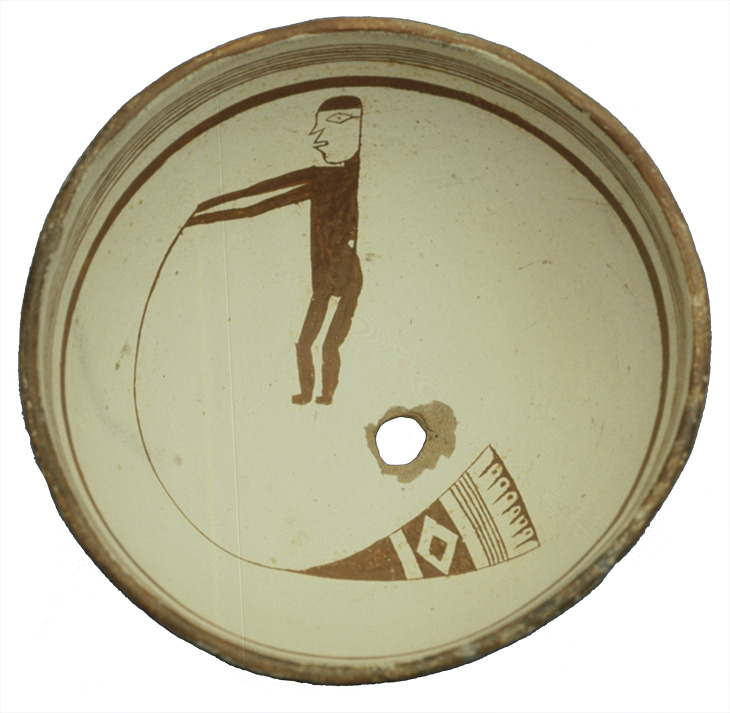
Mattocks bowl bullroarer scene
United States - Mimbres Valley - Grant County, New Mexico - North America
Function not recorded
Source term: bull-roarer
Inside a Mimbres bowl from the Mattocks site a small man stands beneath a shape several times his size, tied to him by one curving line. J. J. Brody read the painter as working in perspective: the great flaring form is not a bird's tail but a small bull-roarer, far out at the end of its cord, whirling above the man's head. The bowl is nineteen centimetres across and was made somewhere in the Mimbres Classic centuries, around AD 1000-1150 - the one place in the ancient Southwest where the instrument was drawn in use rather than left in the ground. Everything turns on granting the foreshortening; refuse it and the shape goes back to being unreadable.
a small bull-roarer on a string whirling about the head of the man
Brody 1983:90
- Object
- Mimbres Classic Black-on-white bowl, Style III, 9 cm high and 19 cm in diameter, Maxwell Museum of Anthropology, University of New Mexico; the painted interior carries a small human figure joined by a single curved line to a much larger flaring shape.
- Function
- Painted scene of a bullroarer being whirled; no blade from the site is involved.
- Source
- J. J. Brody, Mimbres Pottery: Ancient Art of the American Southwest (1983), Colorplate 21, captioned 'Bowl; Man whirling a bull-roarer', with the supporting perspective argument at printed p. 90; Emily Brown, 'Musical Instruments of the Ancestral Puebloans', p. 44, independently treats the bowl as the Southwest's one bullroarer in visual art, and an Apollo…
- Source location
Page references
Brody 1983, Colorplate 21 and printed p. 90; Brown, Musical Instruments of the Ancestral Puebloans, p. 44
- Source confidence
- medium Published site-vicinity anchor for the Mattocks Ruin, now the Mimbres Culture Heritage Site, on the upper Mimbres River near Mimbres, New Mexico; not an excavation-unit coordinate.