PEREZDEARCE2025-002 - archaeological find
Tiwanaku stone bullroarer
Bolivia - Tiwanaku archaeological complex, La Paz Department, Bolivian Altiplano (reportedly) - South America
Function not recorded Candidate only
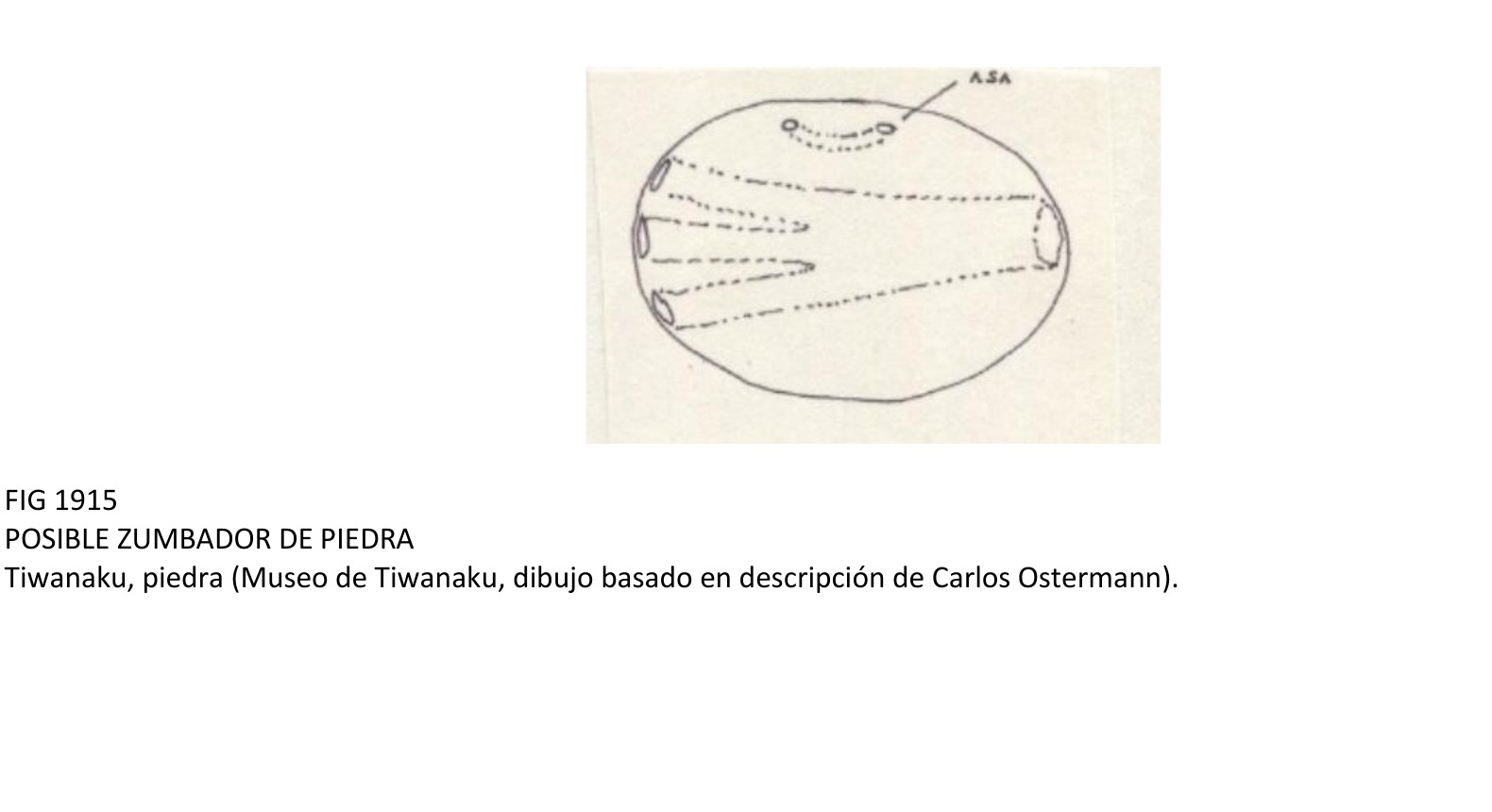
posible zumbador de piedra
Source term: POSIBLE ZUMBADOR DE PIEDRA
zumbador de piedra (Spanish): "stone bullroarer/buzzer"; asa (Spanish): "handle," the source's own label for the lateral perforation used to hold/spin the object.
A stone object reportedly turned up at Tiwanaku, on Bolivia's altiplano, and is known today only through a drawing made from another man's description of it. Carlos Ostermann, who is the source of that description, told José Pérez de Arce that he tied a cord to a hole cut through one side of the stone, used as a handle, and spun it — and that it gave off a very high-pitched sound. No photograph of the stone exists in the published record, no excavation account, no measurements, and no date beyond the name of the site it reportedly came from; the Museo de Tiwanaku is the only repository named, and no catalogue entry for it has yet turned up. What survives is the test itself, reported at one remove, of a stone whose actual shape nobody who reads this can currently check against a picture of the thing.
fue probado por Carlos Ostermann atando una cuerda a la perforación lateral, usada como asa, y haciéndolo girar. Emite un sonido muy agudo.
it was tested by Carlos Ostermann, who tied a cord to the lateral perforation, used as a handle, and spun it. It gives off a very high-pitched sound.
Pérez de Arce 2025, p. 1821
- Object
- An oval stone object with a lateral perforation described as a handle (asa); known only through a reconstruction drawing based on Carlos Ostermann's verbal description, not a photograph. The published drawing (fig. 1915) shows a schematic oval with a small paired-hole feature near one edge labelled ASA, plus several additional edge features and dotted internal lines whose meaning (perforations, grooves, damage, decoration, or a thickness indication) is not explained by the source and should not be read beyond the caption.
- Function
- Reportedly tested by Carlos Ostermann, who tied a cord to the lateral perforation, used as a handle, spun the object, and obtained a very high-pitched sound (Pérez de Arce 2025, p. 1821) — the live functional datum for this candidate; the test's date, protocol, and any witnesses beyond Ostermann's own report are not published.
- Source
- José Pérez de Arce, "Aerófonos sin resonador, aerófonos de aire a presión," in Instrumentos Sonoros Sudamericanos, Parte XXXVII (Chimuchina Récords, Valparaíso, 2025), pp. 1803-1831; discussion and fig. 1915 on printed p. 1821 (PDF p. 28). Carlos Ostermann is independently documented as a Bolivian anthropologist/cultural worker associated with the…
- Source location
Page references
pp. 1803-1831; fig. 1915 on printed p. 1821 (PDF p. 28)
- Source confidence
- low Tiwanaku archaeological complex site anchor (Wikidata/public coordinate). The object is only "reportedly found at" Tiwanaku, with no excavation locus, square, or stratigraphic record published, so this is a site-level anchor for a reported find, not a findspot coordinate.