No. SA-Z1953-026
Guarayu toy
Eastern Bolivia · South America
Play / practical
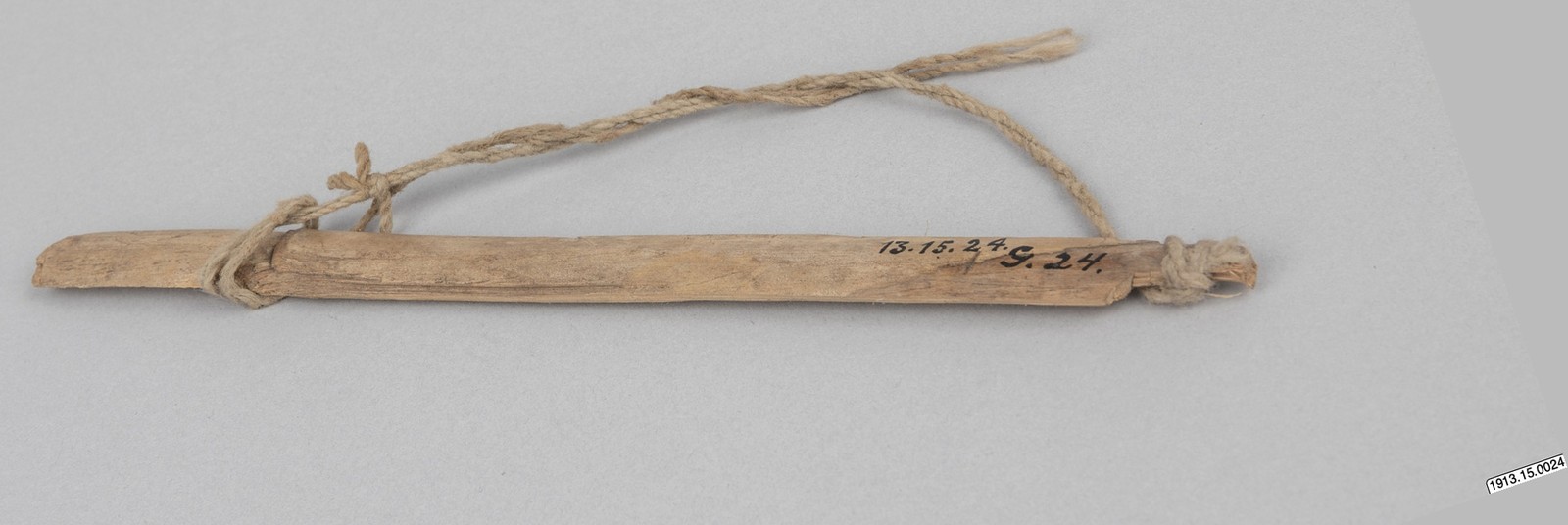
Source term: Schwirrgerät / Schwirrholz / bullroarer
Among the Guarayu of eastern Bolivia the bullroarer was a children's toy, with no recorded ritual use. Every Guarayu boy had a toy bow, Erland Nordenskiöld noted, and the smaller boys had bullroarers too — as among the Chacobo and Yuracaré of northeastern Bolivia, who likewise whirled it only in play. In his diffusion argument Otto Zerries supposed the Guarayu, a Tupí people, had taken up the bullroarer from the scattered, linguistically isolated tribes of eastern Bolivia rather than carrying it from any older Tupí stratum.
In Northeastern Bolivia the bull-roarer is used as a children's toy by the Chacobo (Nordenskiöld 1922, p. 110), Yuracaré (l.c. p. 68) and Guarayu (l.c. p. 168).
Zerries 1953:288
Particulars
- Function
- Bullroarer used as children's toy; Zerries suggests possible borrowing from isolated eastern Bolivia strata
Source
Erland Nordenskiöld, Indianer und Weisse in Nordostbolivien (Stuttgart: Strecker und Schröder, 1922), p. 168; Otto Zerries, 'The Bull-roarer among South American Indians,' Revista do Museu Paulista n.s. 7 (1953), p. 288