No. SA-Z1953-024
Chacobo toy
Eastern Bolivia · South America
Play / practical
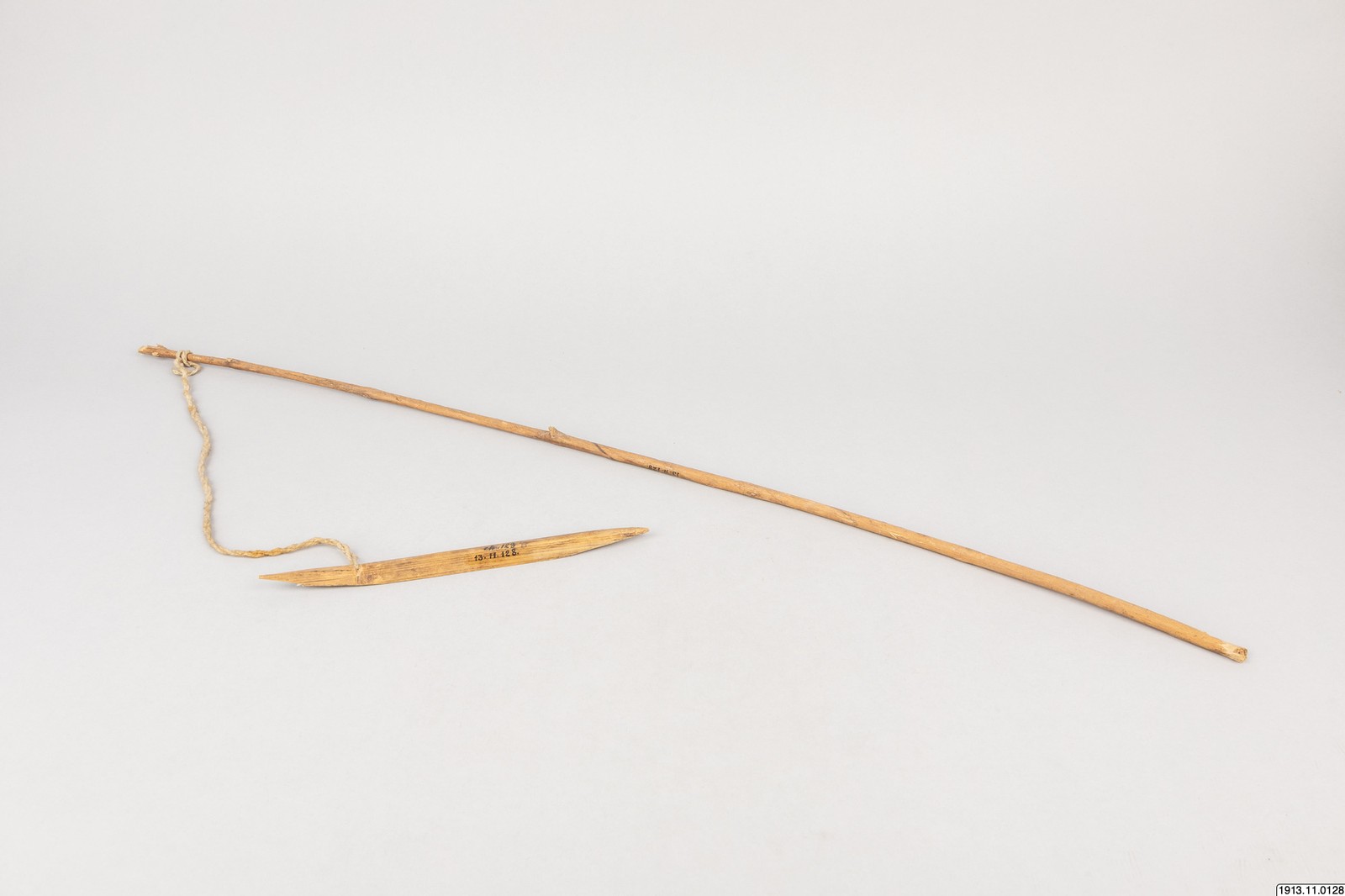
Source term: Schwirrgerät / Schwirrholz / bullroarer
Among the Chacobo, a Panoan people of northeastern Bolivia, the bull-roarer was a children's plaything. Erland Nordenskiöld found it among the children on his 1908-09 expedition. Otto Zerries set the Chacobo with their Panoan neighbors the Kashibo and Panobo in an old central-Amazonian cultural stratum where, he argued, the bull-roarer had decayed into a toy from an earlier cultic use.
In Northeastern Bolivia the bull-roarer is used as a children's toy by the Chacobo (Nordenskiöld 1922, p. 110), Yuracaré (l. e. p. 68) and Guarayu (l. e. p. 168).
Zerries 1953, "The Bull-roarer among South American Indians," Revista do Museu Paulista, N.S. VII:288
Particulars
- Function
- Bullroarer used as children's toy
Source
Erland Nordenskiöld, Indianer und Weisse in Nordostbolivien (Stuttgart: Strecker und Schröder, 1922), p. 110; Otto Zerries, 'The Bull-roarer among South American Indians,' Revista do Museu Paulista n.s. 7 (1953), pp. 288 and 302