No. SA-Z1953-027
Chiquitano / Churapa bullroarers
Santa Cruz region, eastern Bolivia · South America
Play / practical
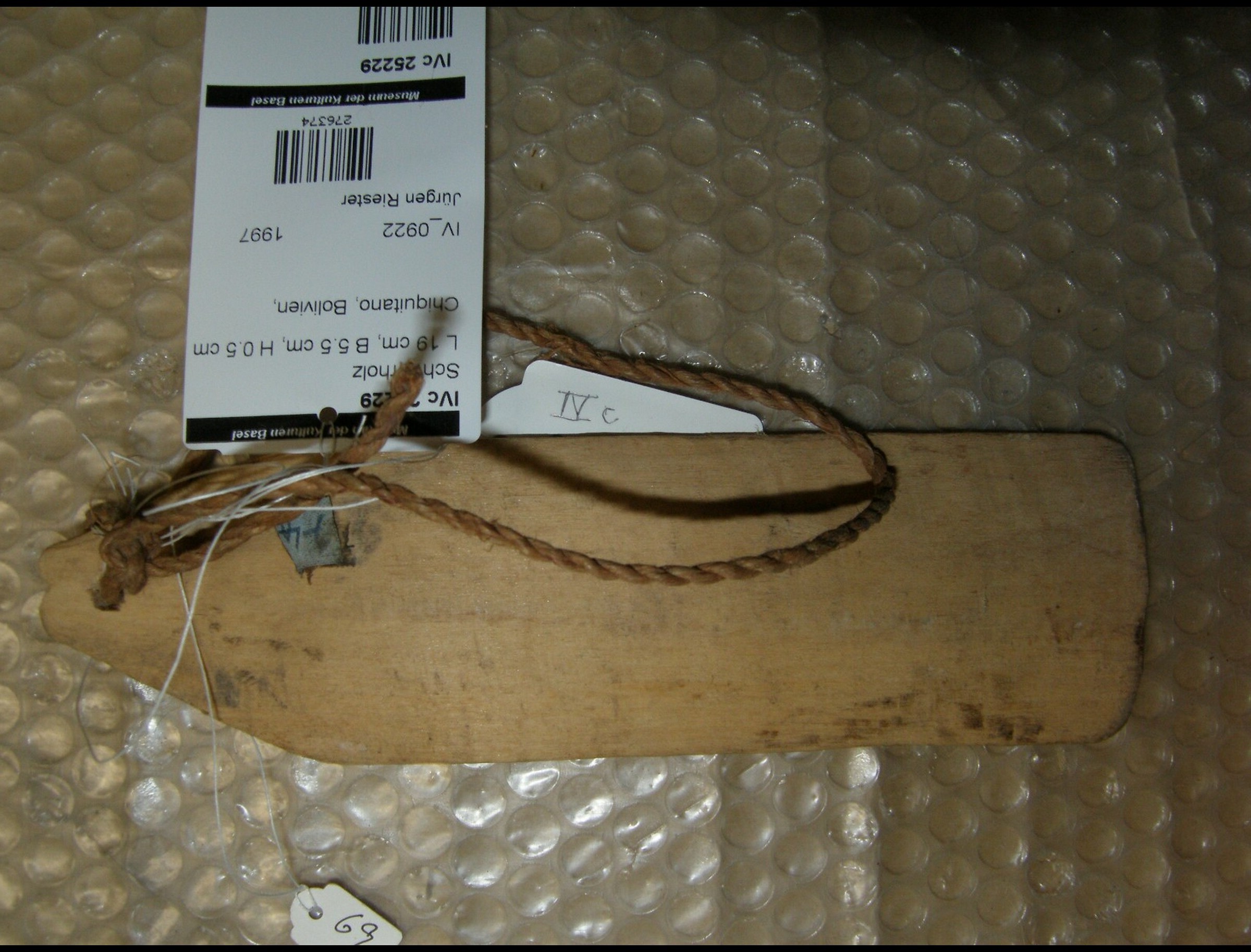
sukurush (Churapa) / upaspakiña (Chiquitano specimen)
Source term: Schwirrgerät / Schwirrholz / bullroarer
sukurush: Churapa name for the bullroarer when used as a toy (Nordenskiöld 1922:28; given as "suku-rush" in Zerries 1953:288).
The Churapa remembered the sukurush as a children's toy already slipping out of use. Two Chiquitano objects give that fading sound a physical form: one is a broad softwood blade with a braided fibre cord and the name upaspakiña; the other is a narrow slat more than half a metre long. Together they preserve both a local memory of play and the striking variety of Chiquitano roarers.
As a toy it is nowadays out of use among the Churapa; it was called suku-rush.
Zerries 1953, "The Bull-roarer among South American Indians," Revista do Museu Paulista N.S. VII:288
Particulars
- Object
- Churapa toy attestation plus two Chiquitano museum boards: a 19 cm softwood upaspakiña with braided fibre cord and a 51.3 cm narrow wooden slat with cord.
- Function
- The Churapa sukurush was formerly a children's toy; use of the broader Chiquitano museum specimens is not recorded.
Source
Erland Nordenskiöld, Indianer und Weisse in Nordostbolivien (Stuttgart: Strecker und Schröder, 1922), p. 28; Otto Zerries, 'The Bull-roarer among South American Indians,' Revista do Museu Paulista n.s. 7 (1953), pp. 288 and 302; Museum der Kulturen Basel IVc 25229 and IVc 13135