No. CROVETTO1969-001
Mapuche furfúrwe rain-whirler, Lagunita Salada, Chubut
Argentina · Lagunita Salada, Gastre Department, Chubut (northern Patagonian steppe) · South America · Southern Cone
Weather / fertility magic
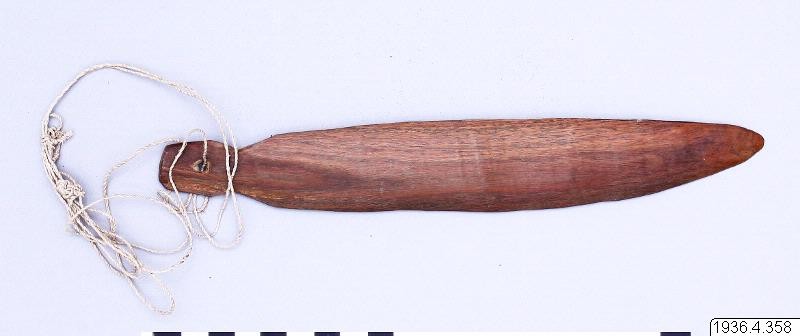
furfúrwe
Source term: palo zumbador
furfúrwe (Mapudungun, collected in Chubut) — roughly 'the whirring thing': furfür for the sound itself, with the instrument-forming suffix -we. Spanish-speakers call it the palo zumbador, the droning stick.
When storms gathered over Lagunita Salada, out on the Chubut steppe, the children used to take their droning sticks outside and whirl them to bring on the rain. The object itself was plain: a small board pierced at one end and hung on a single cord, or — up toward the cordillera — a length of colihue bamboo with two sides sliced away by parallel lengthwise cuts to leave it flat, the cord-hole burned through with a heated wire. Araucanian children all across Patagonia knew it, and Raúl Martínez-Crovetto, collecting their games in the 1960s, set it down among the spinning tops, the woollen slings and the toy bolas of an ordinary childhood; the rain-making he heard only here, and only in the past tense. He gathered the word furfúrwe in Chubut, and noted that over toward the Chilean border the same thing is the run-run. Finding it this far south, he wrote, widened the instrument's known range in South America considerably.
Antiguamente, en la región de Lagunita Salada, los niños revoleaban sus palos zumbadores durante las tormentas para hacer llover.
Formerly, in the region of Lagunita Salada, the children whirled their droning sticks during storms to make it rain.
Raúl Martínez-Crovetto, 'Juegos araucanos de la Patagonia,' Etnobiológica 13 (1969), p. 19
Particulars
- Object
- A small board perforated at one end, with a single cord passed through the hole; in the cordilleran zone a length of colihue bamboo from which two sides are taken off by two parallel longitudinal cuts, leaving it flat. The cord-hole is burned through with a heated wire.
- Function
- Ordinarily a children's toy, widespread among Araucanian children; formerly rain magic at Lagunita Salada.
Source
Raúl Martínez-Crovetto, 'Juegos araucanos de la Patagonia,' Etnobiológica 13 (1969), Universidad Nacional del Nordeste, Corrientes, section V (Juguetes), §6 Furfúrwe, p. 19