No. GENTILE2018-002South America
Four cord-whirlers at Alero de los Jinetes
Argentina · Sierras del Norte · Cerro Colorado, Cordoba Province · South America
Play / practical Candidate only
placa zumbadora / zumbador
Source term: placas zumbadoras o bolas perdidas
placa zumbadora (Spanish): 'buzzing plaque', bullroarer. bola perdida: 'lost ball', a single stone bola thrown free rather than whirled on a retained cord.
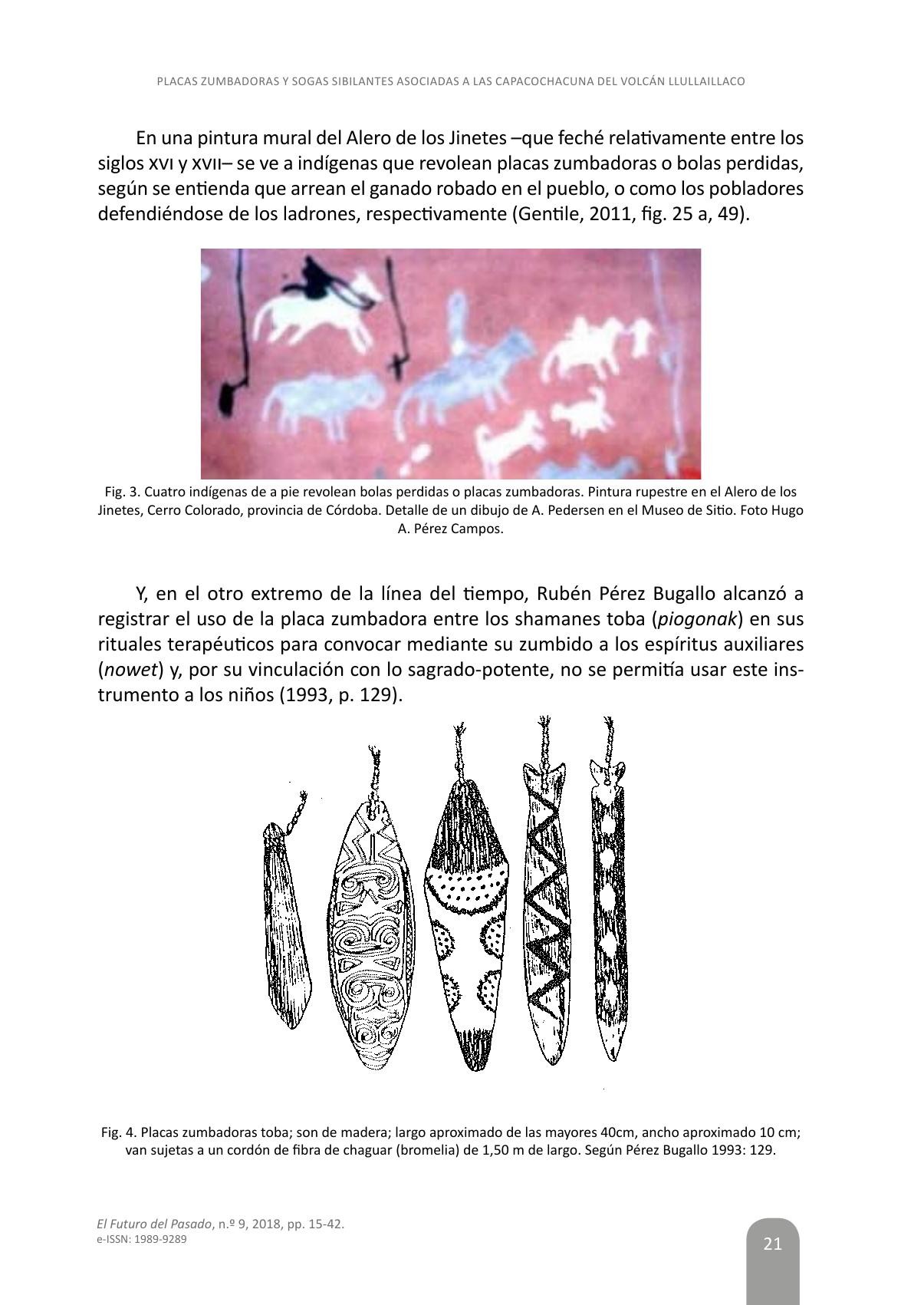
On the wall of a shelter at Cerro Colorado, in a crowded scene of horsemen and driven cattle, four men stand with their backs to the viewer. Each has an arm raised and a line running from the hand to a small dark shape swinging out at the end of it. Earlier readers called these spears, though the figures grip them uselessly by one end. Margarita Gentile suggests instead that the men are whirling something: a bola thrown to bring down an animal, or a buzzing plaque whose noise would scatter livestock and gather people. The paint went onto the rock some time after the Spanish founded Córdoba in 1573. The two readings tell two stories: raiders whirling plaques to drive off the stolen cattle, or villagers swinging bolas against the thieves.
Cuatro indígenas de a pie revolean bolas perdidas o placas zumbadoras.
Four Indigenous men on foot whirl lost-balls or buzzing plaques.
Gentile 2018, Fig. 3 caption, p. 21
Particulars
- Object
- Painted rock-shelter mural. Within a larger mounted raiding or maloca scene, four Indigenous men on foot are shown from behind, each whirling a corded object held in the right hand. No physical object is involved.
- Function
- Depicted whirled corded objects, read by Gentile as either bolas perdidas or zumbadores, whose noise could have frightened and gathered people and livestock; earlier authors called them spears.
Source
Margarita E. Gentile, 'Placas zumbadoras y sogas sibilantes asociadas a las capacochacuna del volcán Llullaillaco,' El Futuro del Pasado 9 (2018): 15-42, p. 19 n. 9 and p. 21, fig. 3; Gentile, 'El Alero de los Jinetes: iconografía e historia de sus representaciones rupestres' (2011), p. 49, fig. 25a