GENTILE2018-001 - archaeological find
Llullaillaco Spondylus buzzing plaques
Argentina - Inca Empire, Collasuyu - Puna de Atacama, Salta Province - South America
Sacred / spirit Candidate only
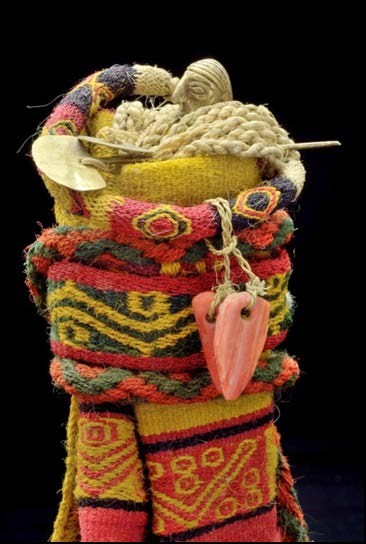
placa zumbadora
Source term: placas zumbadoras
placa zumbadora (Spanish): 'buzzing plaque', the standard South American term for a bullroarer; Gentile 2018 p. 19 n. 9 gives churinga, bullroarer, bramadera and rombo as synonyms, after Perez Bugallo 1993.
In 1999 archaeologists opened a shrine on the summit of Llullaillaco, six thousand seven hundred metres up in the Puna de Atacama, and found three Inca children and the miniature people sent up with them. One of the small figures standing at the level of the girl called La Doncella wears a bright woven band across her dress, and at each end of it, knotted onto plaited fibre cords, hangs a polished plaque of orange Spondylus shell, drilled through and still tied. Catalogues read the assembly as a sash, or as the cord holding her dress pins. Margarita Gentile reads it as an instrument in miniature: two plaques on cords which, whirled fast enough, would clack together and then fly apart into a buzzing at once high and low, called up, she suggests, to make a serpent present at the sacrifice. It is a reading of the mechanics rather than a test of them.
Dichos cordeles y las placas sujetas a sus extremos son arreos que, al girar con rapidez, producen zumbidos agudos y graves, además de intensos, con los que se podría haber acompañado la ceremonia en cuanto a evocar la presencia de un ofidio.
Those cords and the plaques fixed to their ends are gear that, spun rapidly, produce buzzing sounds high and low, and intense besides, with which the ceremony could have been accompanied so as to evoke the presence of a serpent.
Gentile 2018:33
- Object
- Two polished pierced Spondylus plaques, each still knotted through its perforation to a twisted undyed vegetal-fibre cord, probably chaguar; the cords form the two ends of the multicoloured tubular textile that wraps miniature female figurine LL-99-058, one of three figurines set at the same level as the mummy known as La Doncella. Museo de Arqueologia de Alta Montana, Salta. The plaques are miniature and no dimensions are published in the article.
- Function
- Miniature sounding gear in an Inca capacocha offering: Gentile reads the paired corded Spondylus plaques as rapidly rotated placas zumbadoras whose collision and separation produced intense high and low buzzing.
- Source
- Margarita E. Gentile, 'Placas zumbadoras y sogas sibilantes asociadas a las capacochacuna del volcan Llullaillaco', El Futuro del Pasado 9 (2018), pp. 15-42, DOI 10.14516/fdp.2018.009.001.001; terminology page gentile-p19-terminology.jpg; sounding proposal gentile-p33-mechanics.jpg; whirling model gentile-p35-whirling-model.jpg
- Source location
Page references
Gentile 2018, El Futuro del Pasado 9, pp. 15-42; Fig. 11 and caption at printed p. 28; terminology note p. 19 n. 9; sounding proposal p. 33; whirling model p. 35
- Source confidence
- high Published summit coordinate for Volcan Llullaillaco, 6,739 m, on the Argentina-Chile border in Salta Province; the capacocha deposit lies on the summit itself, but this is not a published excavation-unit coordinate.
- Snake-linked