GONZALEZBALDINI1999-001 - archaeological find
Copacabana incised stone bullroarer
Argentina - Copacabana - Tinogasta Department - Catamarca - South America
Function not recorded Candidate only
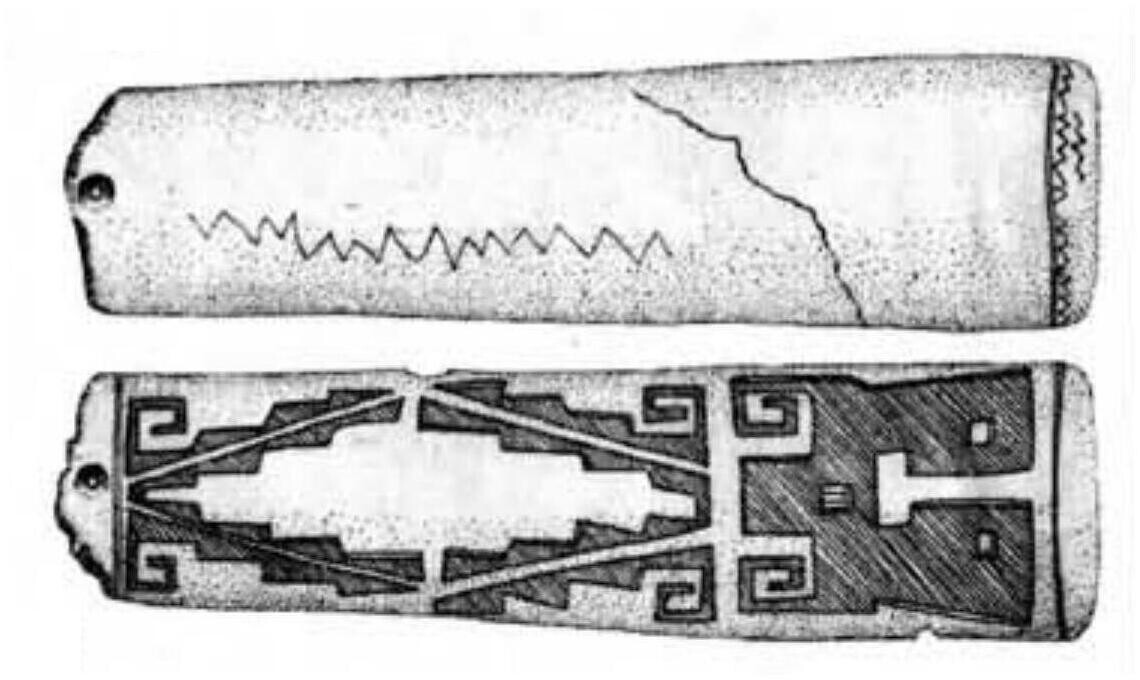
Source term: posible cetro
posible cetro (Spanish): 'possible sceptre'; related blades in the same stone tradition have also been identified as bullroarers.
A squared human face stares from one end: block eyes, a broad T-shaped nose and a mouth scored with teeth. Beneath it, paired grecas frame a great divided diamond, while the reverse is nearly bare. The surviving blade is already 34.5 centimetres long despite its broken end. Its carved world belongs to the Tinogasta Geométrico Temprano style, tentatively placed around 200 BC—a stone tradition of faces dissolving into steps, teeth and geometric doubles.
El largo total del fragmento existente es de 345 mm. Procedería de Copacabana, provincia de Catamarca. Es de forma trapezoidal muy alargada, con superficies muy pulidas. Parece haber sufrido una fractura en un extremo, el que tiene un agujero central de factura troncocónica.
The total length of the surviving fragment is 345 mm. It is said to come from Copacabana, Catamarca Province. It is a very elongated trapezoid with highly polished surfaces. It appears to have suffered a break at one end, which has a central troncoconical hole.
González and Baldini 1999, p. 36, §3.1.5
- Object
- A surviving 34.5 cm fragment of a very elongated, highly polished trapezoidal stone blade, broken at one end but retaining a central troncoconical drilled hole there. One face bears a squared anthropomorphic face with a broad T-shaped nose, paired grecas, and a large divided rhomb bordered by symmetrical stepped lines; the reverse carries only a long zigzag and a short band at the intact end.
- Function
- Possible stone bullroarer; the published alternative is a ceremonial sceptre. No cord, wear study or acoustic test is recorded.
- Source
- González and Baldini 1999, p. 36, §3.1.5
- Source location
Page references
printed pp. 35–36, §3.1.5, Plate II:1; the section heading mistakenly says Plate III:1
- Source confidence
- low to medium Official Argentine locality coordinate for Copacabana, Tinogasta Department, Catamarca (INDEC 10105050). The museum provenance is reported rather than excavated; the point represents that named locality, not a recovery locus.