No. MATHIASSEN1928-001
Palm-sized Iglulik plaything
Canada · Iglulik · Igloolik, Nunavut · North America
Play / practical
Source term: bull-roarer
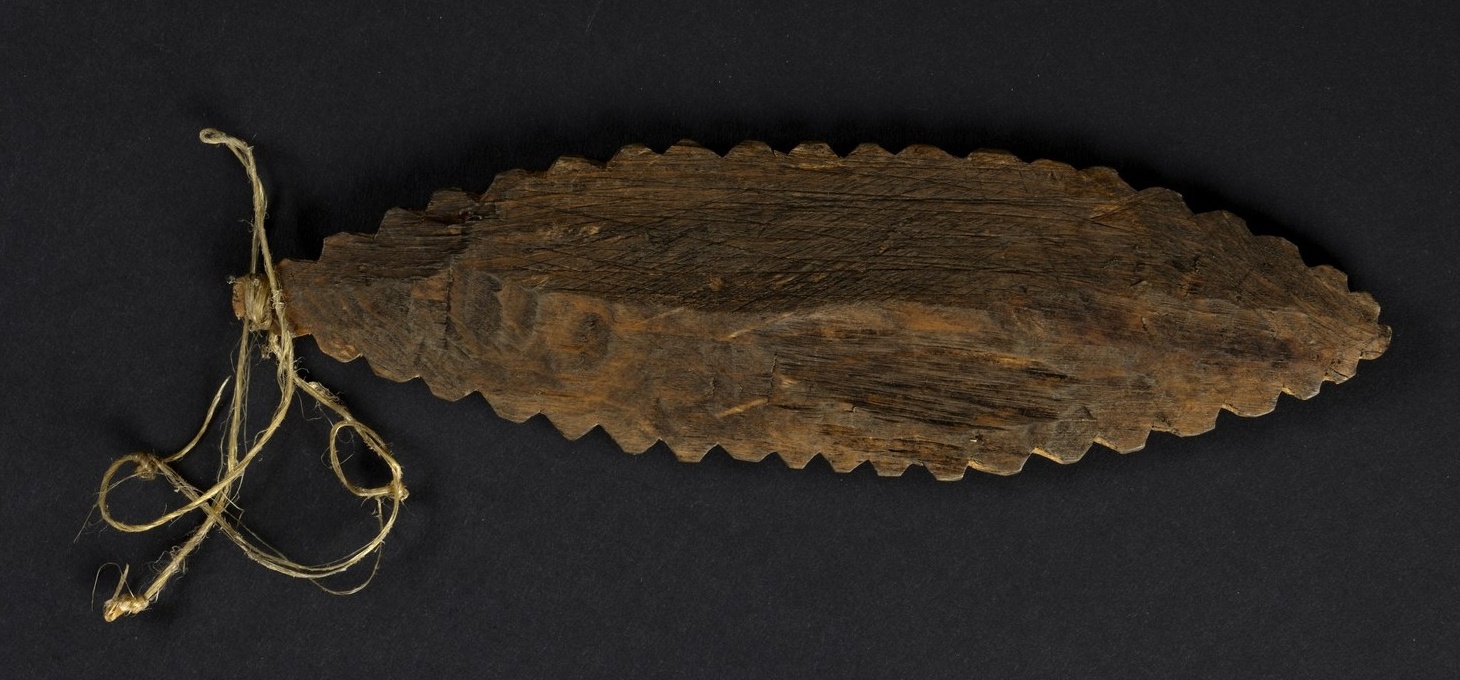
Iglulik children played at the work waiting for them: little harpoons, bows and arrows, model kayaks, small pots and lamps for a doll-sized household on the Foxe Basin coast. Among those playthings Mathiassen recorded a bullroarer barely longer than a finger — 7.8 centimetres of flat, slightly curved wood, both edges cut with deep notches, a hole at the narrow end holding seventeen centimetres of sinew thread that ends in a noose. Nearby in the same set of toys lay a spinning buzz made from a single whitefish vertebra, threaded with sinew and pulled to make it whirl.
A bull-roarer from Iglulik is of wood, 7.8 cm long, 1.8 cm wide, flat, slightly curved, with deep notches in the edges and, at the narrow end, a hole in which is fastened a piece of sinew-thread, 17 cm long, ending in a noose.
Mathiassen 1928, Material Culture of the Iglulik Eskimos, chapter 10 (playthings).
Particulars
- Object
- Small wooden blade, 7.8 by 1.8 cm, flat and slightly curved, with deep notches cut in the edges and a 17 cm sinew thread through a hole at the narrow end, ending in a noose.
- Function
- A child's plaything, recorded among Iglulik toys.
Source
Therkel Mathiassen, Material Culture of the Iglulik Eskimos (1928), chapter 10, playthings section