No. NAAIN-011
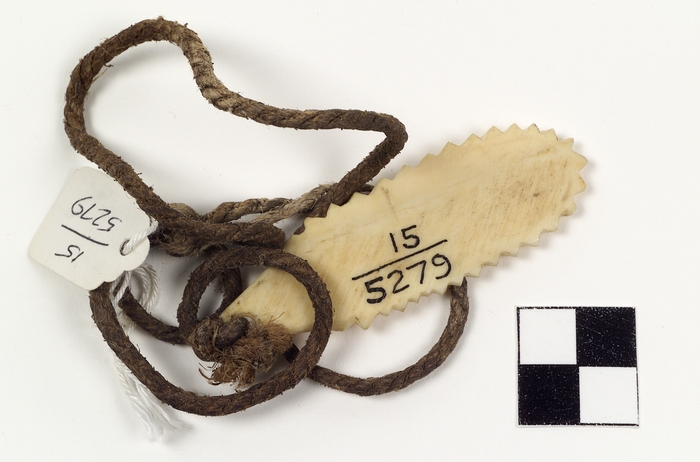
Kinngait bone-and-sinew noisemaker
Canada · Nunavut · Qikiqtaaluk Region · North America · Arctic
Play / practical
Source term: Bullroarer
A bullroarer of animal bone and sinew, collected in 1927 at Cape Dorset (Kinngait) on Dorset Island, among the Baffinland Inuit Kingarmiut and Sikosuilarmiut. In the Arctic the bullroarer was a lozenge-shaped plate of bone or wood about 15 to 20 centimetres long, pierced at one end and hung from a sinew cord that could be tied to a wooden handle; whirled overhead it threw off a loud whirring. Inuit ethnographers from Mathiassen to Jenness counted it among toys and noisemakers rather than instruments, the skin drum or qilaut being reckoned the only true Inuit instrument. This specimen reached the Museum of the American Indian, Heye Foundation, as one of the objects Donald A. Cadzow gathered while sailing the schooner Morrissey to south Baffin Island and Hudson Strait on George Palmer Putnam's 1927 expedition.
one person’s noise is another one’s music, or perhaps ritual sonority. The sound of bullroarers has certainly been ritually important for many groups worldwide…
Whitridge 2015:20 ("The Sound of Contact: Historic Inuit Music-Making in Northern Labrador," North Atlantic Archaeology 4)
Particulars
- Object
- Animal bone and sinew bullroarer collected in 1927
- Function
- Bone-and-sinew bullroarer from Cape Dorset (Kinngait); in the Inuit ethnographic literature the Arctic bullroarer is classed as a toy/noisemaker, not a musical instrument or ritual object
Sources
- Smithsonian National Museum of the American Indian, object 15/5279 (NMAI_166581) View · archived
- Smithsonian National Museum of the American Indian, object 15/5280 (NMAI_166582)
- Whitridge, "The Sound of Contact: Historic Inuit Music-Making in Northern Labrador," North Atlantic Archaeology 4 (2015), p. 20