No. MUS2026-106
Swampy Cree wind-bringer
Canada · Cross Lake, Northern Manitoba · North America
Weather / fertility magic
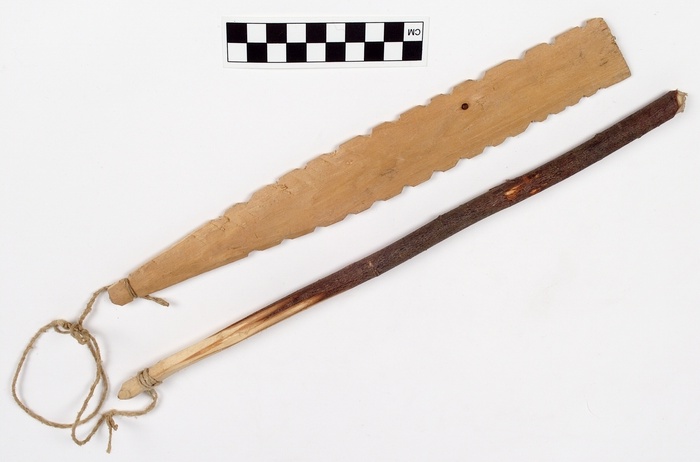
Source term: bull-roarer
Among the Swamp Cree the bull-roarer was an instrument of weather magic. Hunters and others to whom the wind mattered would whirl it 'to bring' the wind, sitting up all night working it, its power thought to lie in a noise that resembled the rush of the wind itself. This carved blade, strung on twine, was collected at Cross Lake in the Northern Region of Manitoba in 1930 by the anthropologist A. Irving Hallowell and is now in the National Museum of the American Indian. Skinner noted that such swung implements were rarely treated as children's toys.
Hunters and others to whom the wind is of importance use a bull roarer to bring it. They sit up all night manipulating this instrument. Its connection with the wind probably lies in its noise, which resembles the rush of the wind.
Alanson Skinner, Notes on the Eastern Cree and Northern Saulteaux (1911), p. 60
Particulars
- Object
- Bull-roarer of the Swampy Cree, Smithsonian (NMNH/NMAI).
- Function
- Weather magic: Swampy Cree hunters whirled it all night "to bring" the wind, its power lying in a noise like the wind's own rush.
Source
Alanson Skinner, 'Notes on the Eastern Cree and Northern Saulteaux,' Anthropological Papers of the American Museum of Natural History 9(1) (1911), p. 60; Smithsonian National Museum of the American Indian, 17/6836 (Cross Lake, Manitoba)