No. MUS2026-107
Calling the Cree wind brothers
Canada · Moose Factory, James Bay, · North America
Weather / fertility magic
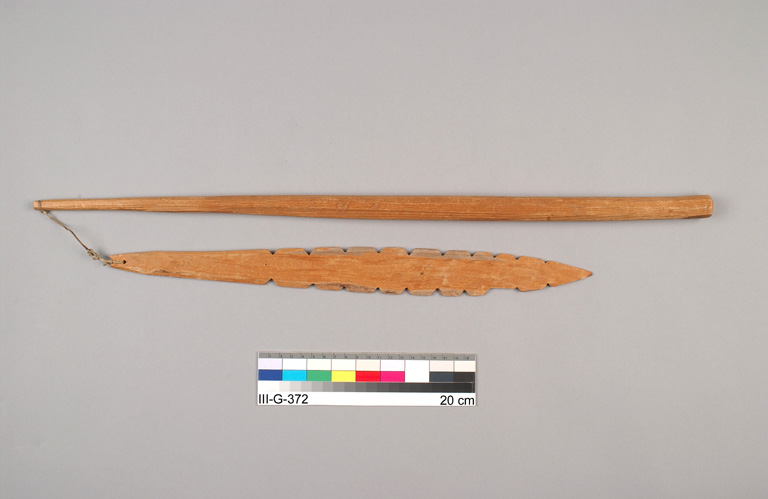
Source term: bull-roarer
Bull-roarer (Lolomikan in the Smithsonian title); the four winds named in Eastern Cree as Kiwetinung-nizeo (north), Nikapihun-nizeo (west), Wapanung-nizeo (east), Shawanung-nizeo (south).
Among the Eastern Cree of the James Bay country, the winds were four brothers, and the bull-roarer was the hunter's tool for summoning them. Skinner recorded men "to whom the wind is of importance" sitting up all night whirling a bone or serrated wooden blade on twisted sinew cords to bring the wind, its rushing buzz thought to call the real thing. Three forms were in use, and pointedly they were "rarely used as toys" — this was weather magic, not a plaything. The Smithsonian holds a Moose Cree example from the Moose and Albany bands at Moose Factory, the same people whose wind-bringing Skinner described.
Hunters and others to whom the wind is of importance use a bull roarer to bring it. They sit up all night manipulating this instrument. Its connection with the wind probably lies in its noise, which resembles the rush of the wind.
Alanson Skinner, Notes on the Eastern Cree and Northern Saulteaux (1911), p. 60
Particulars
- Object
- Bull-roarer of the Moose Cree, Smithsonian.
- Function
- Whirled all night to bring the wind.
Source
Alanson Skinner, 'Notes on the Eastern Cree and Northern Saulteaux,' Anthropological Papers of the American Museum of Natural History 9(1) (1911), pp. 60 and 141