No. JSTEWARD1941-012
Ruby Valley Shoshoni bullroarer
United States · Ruby Valley, Elko County, northeastern Nevada · North America · Great Basin
Function not recorded
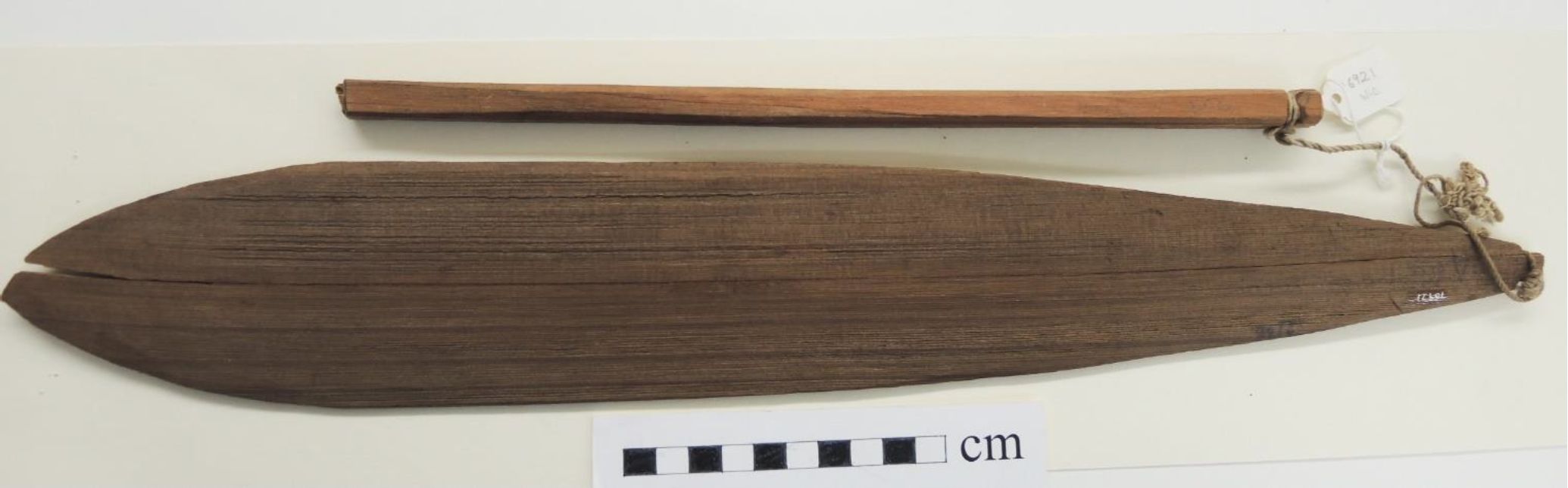
wütiŋgübü'ü
Source term: Bull-roarer
wütiŋgübü'ü: the Ruby Valley name for the bullroarer as one woman of the valley gave it — the very word Smith Creek and Snake River Shoshoni used for the sling.
The people of Ruby Valley were the Wadadüka, the 'rye-grass-seed eaters', and theirs was an exceptionally fertile, thickly settled valley in a hard country. They wintered high in the juniper belt, where there was wood against the cold, and came down in spring to gather seeds by the two lakes under the Ruby Mountains. The first few horses reached the valley about 1860, and were mostly eaten. The bullroarer was at home here; one woman of the valley called it wütiŋgübü'ü, the word Smith Creek used for the sling.
Particulars
- Object
- Not described; the Great Basin form is a flat wooden slat swung on a cord from a short handle stick.
- Function
- Not recorded.
Sources
- Julian H. Steward, 'Culture Element Distributions: XIII, Nevada Shoshoni,' Anthropological Records 4:2 (1941), pp. 213-214, 250, 307 View · archived
- Julian H. Steward, 'Culture Element Distributions: XXIII, Northern and Gosiute Shoshoni,' Anthropological Records 8:3 (1943), p. 333 View · archived
- Julian H. Steward, Basin-Plateau Aboriginal Sociopolitical Groups, Bureau of American Ethnology Bulletin 120 (1938), pp. 144-147