No. JSTEWARD1941-010
Eastern Nevada Shoshoni wunzivu
United States · Hamilton (White Pine Range), Ely (Steptoe Valley) and Spring Valley, White Pine County, eastern Nevada · North America · Great Basin
Play / practical
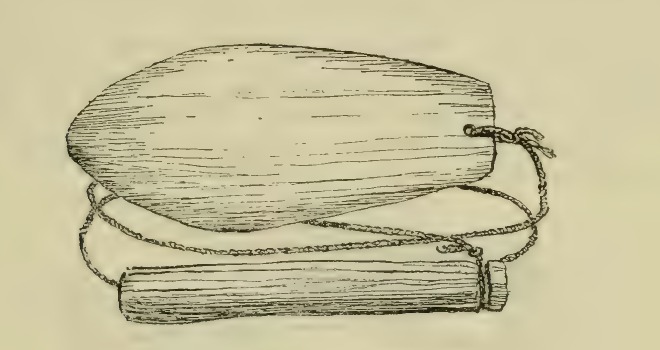
wunzivu
Source term: Bull-roarer
wunzivu: the Spring Valley Shoshoni word for the bullroarer; Elko called the roarer nui, 'play'.
At Ely, in Steptoe Valley, the bullroarer was a child's toy. Spring Valley, under the Schell Creek and Snake ranges, called it wunzivu, the word Elko used for the ring-and-dart game. That was crowded country for the Basin: at Cleveland Ranch eleven families followed six chiefs in order of rank, and only there was the water deep enough for driving mud hens. West of Ely, at Hamilton, two families wintered at Bambasa, 'water that dries up in summer', a spring on Mount Hamilton; in good pine-nut years they stayed in the mountains all winter, melting snow for water. A Hamilton man brought rain by washing his face and hair in cold water.
Particulars
- Object
- The Great Basin form: a flat wooden slat swung on a cord from a short handle stick.
- Function
- A child's toy at Ely.
Sources
- Julian H. Steward, 'Culture Element Distributions: XIII, Nevada Shoshoni,' Anthropological Records 4:2 (1941), p. 307, elements 1870 and 1873; informant notes pp. 213-214; key p. 271; name p. 250; also pp. 211, 262 View · archived
- Julian H. Steward, Basin-Plateau Aboriginal Sociopolitical Groups, Bureau of American Ethnology Bulletin 120 (1938), pp. 118 (Hamilton), 124-127 (Spring Valley) View