No. GURINA1956-001
Oleniy Ostrov slate blades
Russia · Lake Onega, Republic of Karelia; Mesolithic · Eastern Europe
Function not recorded Candidate only
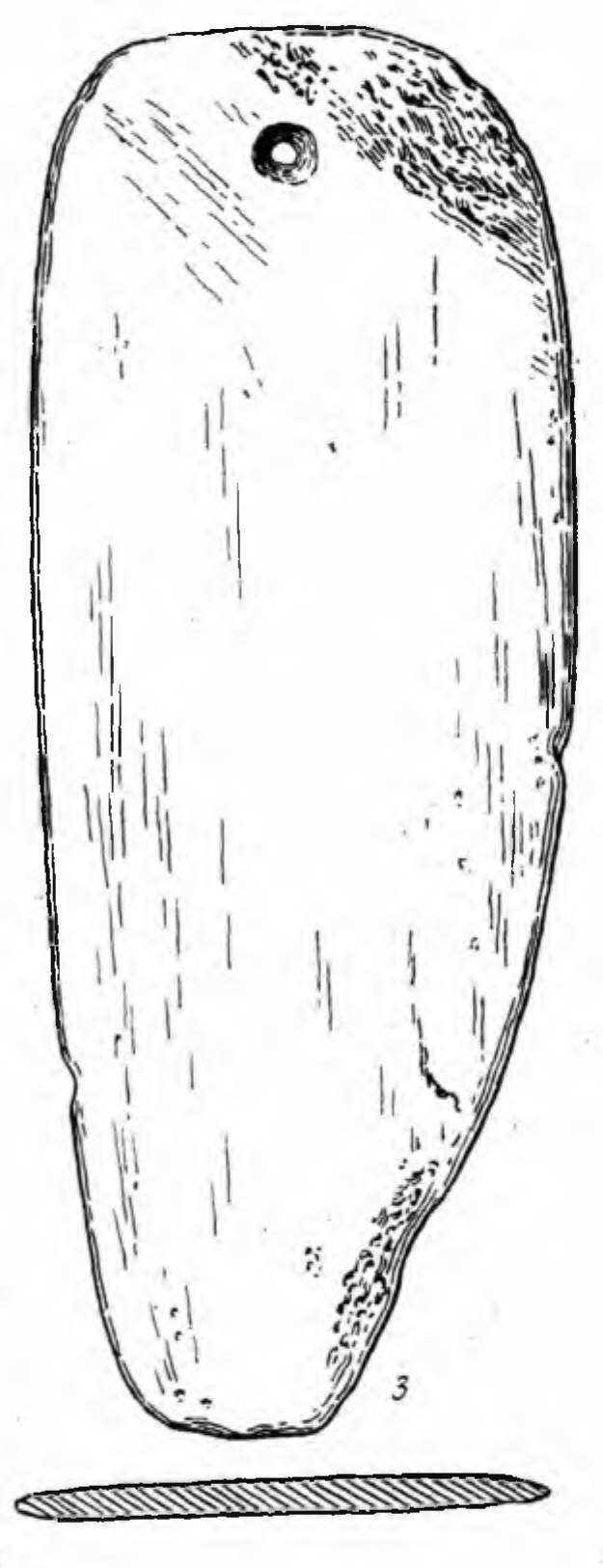
Source term: сланцевые ножи (slate knives)
On a small island in Lake Onega, Mesolithic people buried their dead in red ochre with strings of animal teeth: bear canines, elk incisors, plates cut from beaver teeth. The cemetery falls into two halves. Elk effigies go with the northern graves, effigies of snakes and of people with the southern ones. Its busiest centuries came during a sudden cold spell some 8,200 years ago. Sixty thin slate blades went into thirty of the burials, split along the stone's natural layers, ground smooth and drilled with a small hole near one end. Grave 119, in the northern group, held this one: 19 centimetres of grey slate, its broad face whole.
Particulars
- Object
- Thin plates of grey slate split along the stone's layers, ground smooth, with broad blunt edges and a small hole drilled near one end; sixty came from thirty burials. The anchor, from grave 119, is a complete oval blade 19 × 6.5 cm with a thin lens-shaped section.
- Function
- Not recorded.
Sources
- N. N. Gurina, Оленеостровский могильник (Oleneostrovskii mogil'nik), Materialy i issledovaniya po arkheologii SSSR 47 (1956), pp. 123–130, fig. 76.3, p. 356 View
- Rick J. Schulting et al., 'Radiocarbon dating from Yuzhniy Oleniy Ostrov cemetery reveals complex human responses to socio-ecological stress during the 8.2 ka cooling event', Nature Ecology & Evolution 6 (2022): 155–162 View
- R. Eckelmann et al., 'Mobility and community at Mesolithic Lake Onega, Karelia, north-west Russia: insights from strontium isotope analysis', Archaeological and Anthropological Sciences 17:17 (2025) View