No. CROVETTO1968-002
Vilela kiré ajlipié bullroarer, eastern Chaco
Argentina · Eastern Chaco · South America · Gran Chaco
Play / practical
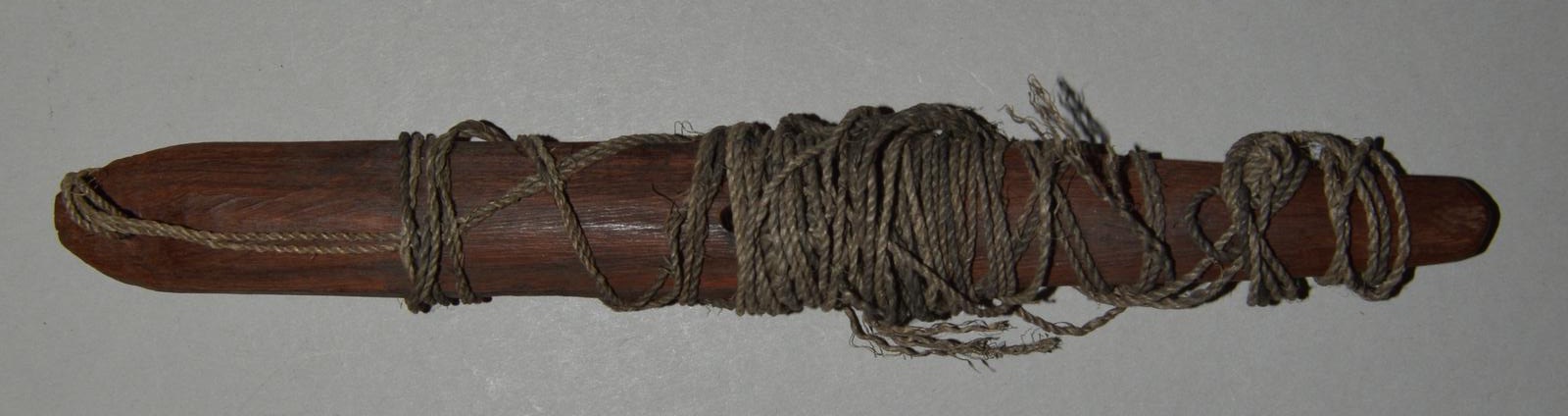
kiré ajlipié
Source term: palo zumbador
kiré ajlipié = 'el palo da vueltas' (the stick that spins).
When the botanist Raúl Martínez-Crovetto went looking for Vilela games in the 1960s, he could ask almost no one: his sources were Basilia López, 58, and her husband Juan Álvarez, 68 — two of the last speakers of a language then already dying out in the eastern Chaco. They remembered the kiré ajlipié, 'the stick that spins': a slip of guayacán wood on a metre of caraguatá-fibre cord, swung from a small perforated handle, a children's toy of the century's first years. Little else of a Vilela childhood was left to record.
Con una tablita delgada de guayacán (Caesalpinia paraguariensis), de unos 15 ó 20 cm de largo por 2 cm de ancho, de forma rectangular, construían el 'palo zumbador'. Los niños lo usaban como juguete.
With a thin rectangular board of guayacán wood, some 15 or 20 cm long by 2 cm wide, they built the palo zumbador. The children used it as a toy.
Martínez-Crovetto, 'Algunos juegos de los indios vilelas,' Etnobiológica 5 (1968), p. 11.
Particulars
- Object
- Rectangular guayacán board about 15-20 by 2 cm, pierced at one end; a one-metre caraguatá-fibre cord joins it to a small perforated handle.
- Function
- Children's toy of the early twentieth century.
Source
Raúl Martínez-Crovetto, 'Algunos juegos de los indios vilelas,' Etnobiológica 5 (1968), p. 11 (informants Basilia López and Juan Álvarez)