No. PAT-CHUR-001
Northern Patagonia engraved-plaque churinga analogue
Argentina · Northern Patagonia · Pampa · Bahia San Blas and related plaque-hacha find regions · South America · Southern Cone
Sacred / spirit
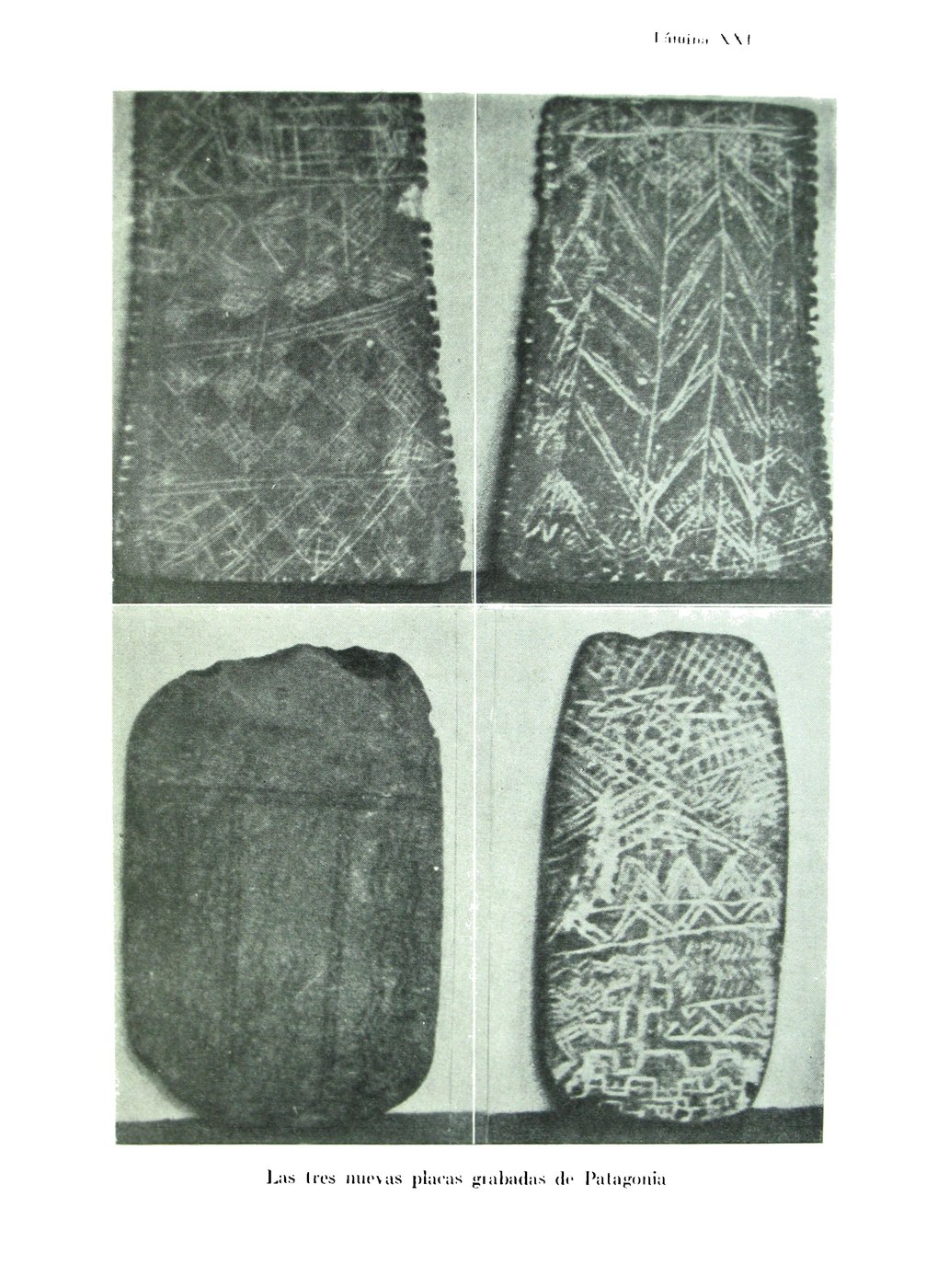
placas grabadas; hachas ceremoniales; tauk a ulungasum
Source term: churinga de piedra / stone churinga analogue
placas grabadas: Spanish, "engraved plaques" — the long-known class of decorated stone slabs from the Pampa and northern Patagonia that Bormida read as churinga analogues.
Etymology. Descriptive Spanish: 'placas grabadas' means 'engraved plaques', the archaeological label for the decorated stone slabs of the Pampa and northern Patagonia. It carries no indigenous etymology.
These are not sounded instruments but engraved stone plaques from northern Patagonia and the Pampa, which the Argentine archaeologist Marcelo Bormida read as a New World counterpart to the stone churinga of central Australia. Studying three of the plaques held at the Museo Nacional de Nahuel Huapi in Bariloche in 1952, he found one plaque's decoration rubbed faint at its center, "as a consequence of prolonged friction," and classed the engraved-plaque series as a form of stone churinga of the type so common in Australia. He went further: a huge scatter of the crudest engraved plaques that Escalada and Garces had found along the coast of Bahia San Blas approached, he wrote, the condition of churinga "treasuries," the way such objects were kept among the Aranda of central Australia. The objects themselves complicate the reading: one of the three Bariloche pieces carried a loose museum card calling it a worked stone "and silversmith's mold (sic)." No evidence was ever produced that the plaques were swung, whirled, or made to sound, and later Argentine archaeologists set the Australia comparison aside, treating the plaques and engraved axes as late-Holocene portable art exchanged within regional and long-distance networks. The churinga reading is Bormida's.
No podemos dejar de observar, sin embargo, que el panorama de la prehistoria de Patagonia, hoy en día ya bosquejado firmemente por los estudios de Menghin, concuerda más con nuestra interpretación de las placas grabadas que con cualquier otra, y que un hallazgo aún inédito nos hace esperar que el problema se encamine a su solución en el sentido sugerido por nosotros.
We cannot fail to observe, however, that the picture of Patagonian prehistory, now firmly sketched out by Menghin's studies, fits our interpretation of the engraved plaques better than any other, and that a still unpublished find leads us to hope that the problem is moving toward a solution along the lines we have suggested.
Bormida 1956:203 (Tres nuevas placas grabadas de la Patagonia Septentrional, Runa 7(2))
Particulars
- Object
- Engraved lithic plaques and ceremonial axes from northern Patagonia and the Pampa.
- Function
- Sacred objects tied to the Tehuelche spirit-force Elengasem, Walichu or Gualicho.
Sources
- Marcelo Bormida, 'Tres nuevas placas grabadas de la Patagonia Septentrional,' Runa 7(2) (1956), pp. 203-208, at pp. 203-204, note 2 View · archived
- Fisher, doctoral thesis (2009), metadata and abstract View · archived
- Belloli/Gradin, La Matemática de los Aborígenes Patagónicos View · archived
- Smithsonian National Museum of the American Indian, Bridges Hain “Snake Dance” archive record (ritual comparandum) View · archived