No. ERDALKIRAN2022-001
Barcın Höyük pierced rib blade
Turkey · Yenişehir plain, Bursa province, Marmara region; Late Neolithic · Near East · Anatolia
Function not recorded Candidate only
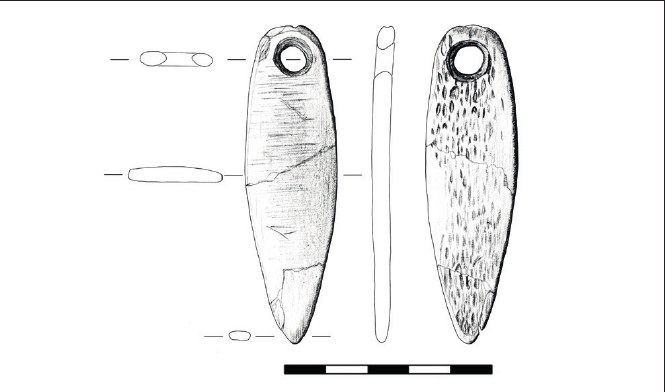
Source term: dokuma mekiği (bone shuttle)
For six centuries the farmers of Barcın Höyük rebuilt their houses side by side on one small mound in the Yenişehir plain. They grew wheat, barley and lentils, kept cattle, sheep and goats, still hunted, and, as residues in their earliest bowls show, were already processing milk. Of the more than three thousand bone tools found in the village, forty-three belong to one family: ribs split lengthwise into thin blanks, ground flat and drilled from both faces near the broad end. This one survives complete, a slim drop of bone with a clean eye at its head, tapering to a point.
Particulars
- Object
- Complete thin blade of split rib bone, drop-shaped, broad and rounded at the head and tapering to a point, with a hole drilled from both faces through the head. One of 43 such blades from the village; the complete large examples run 6–8 cm long.
- Function
- Not recorded.