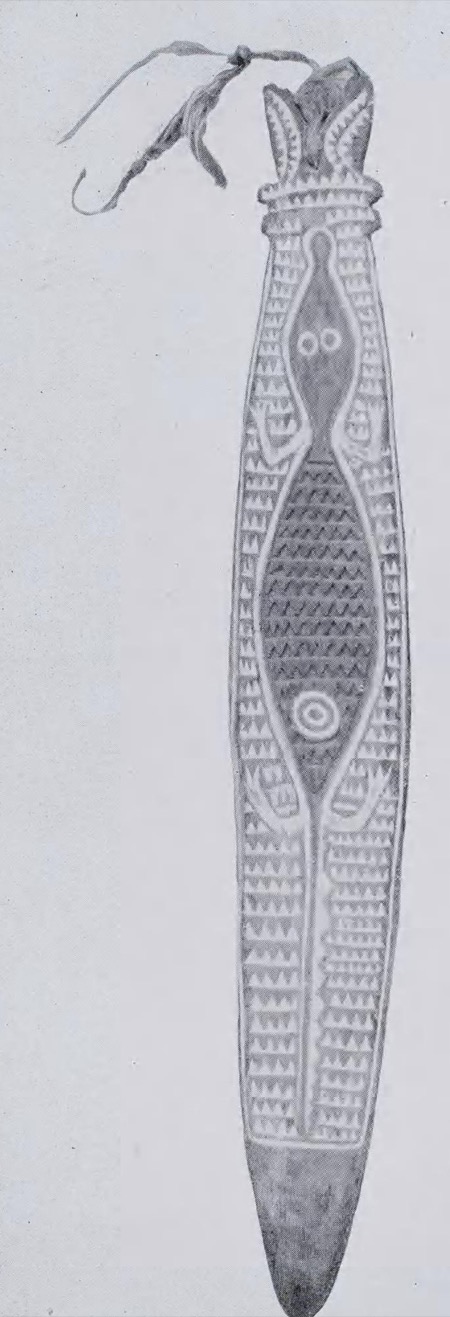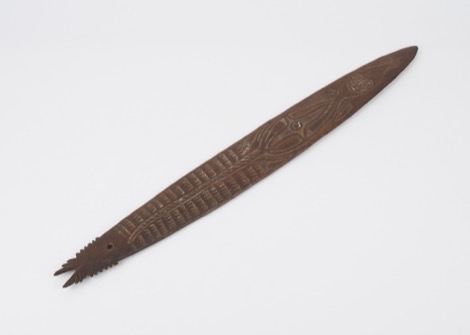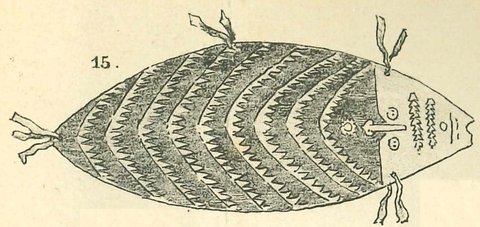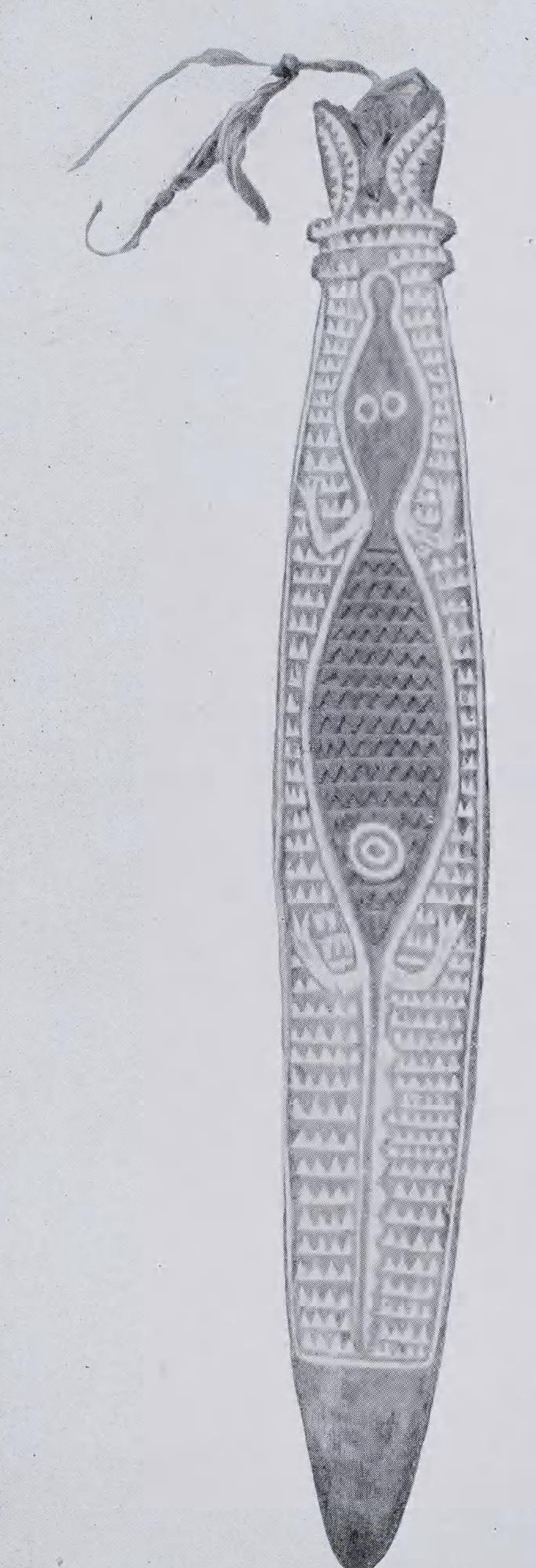
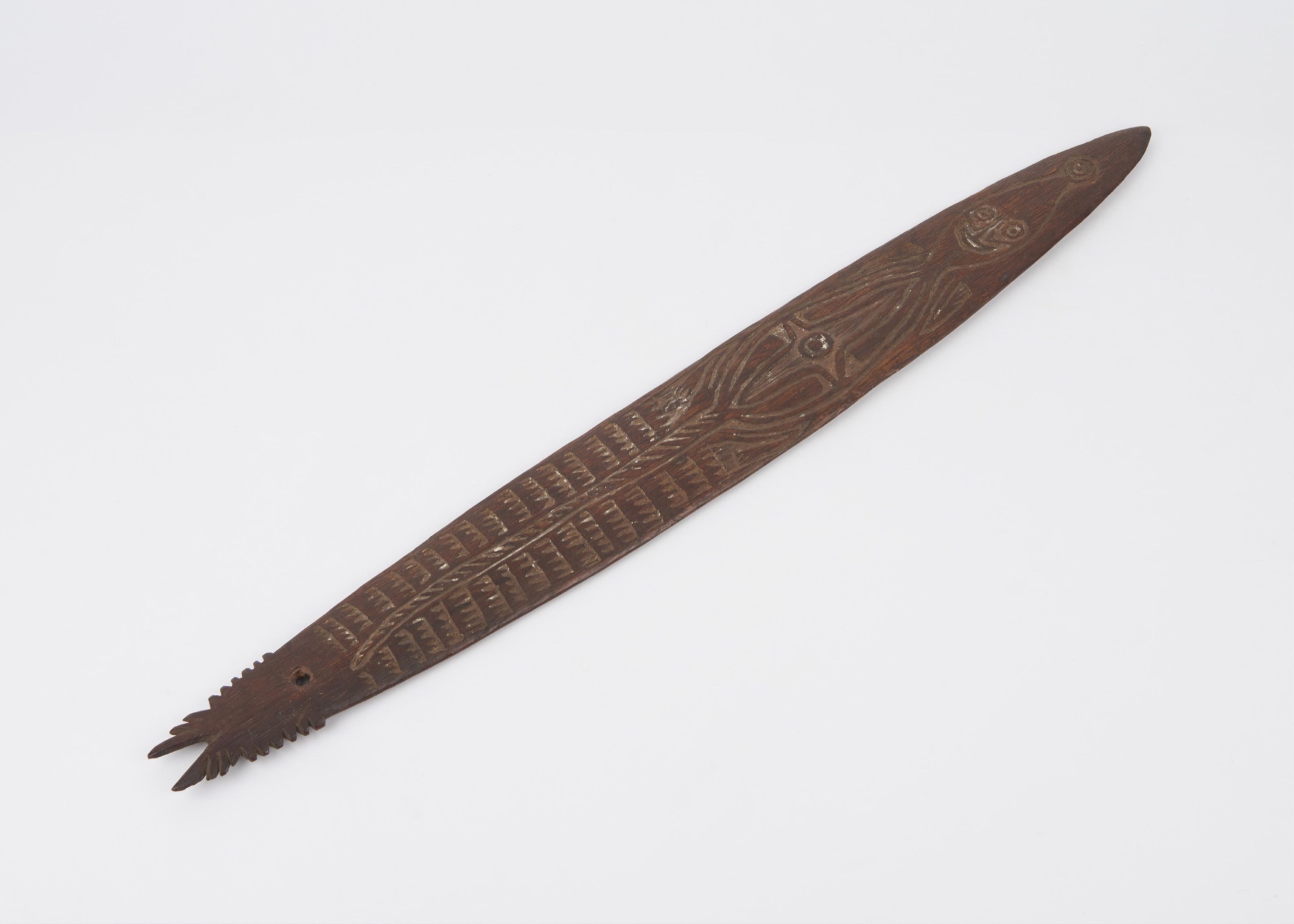
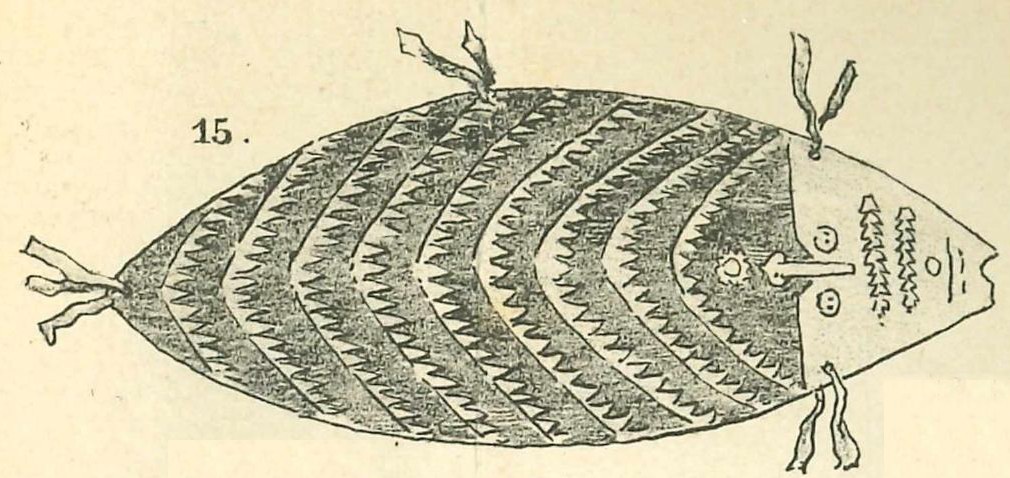
A sacred lime-pot breaks, and someone will have to find a pig. In the eastern Elema villages of Papua New Guinea’s Gulf of Papua, smashing the bullroarer chief’s gourd could bring his paired worker into action. The worker sounded the named being; the chief paid him a pig and received shell ornaments in return; the offender supplied another pig for the men of the ceremonial house. The roar made a grievance the whole village’s business. Farther west at Orokolo, the same coast’s roarers were fed, feared and revealed at initiation, and the oldest of them were said to have travelled like snakes. 1
Karama (Elema group 7) · Uaripi / Tairuma (Eastern Eleman) · Orokolo
Names along the coast
The Elema country runs east along the Gulf of Papua from the Purari delta toward Cape Possession. Hevehe, or sevese, was the usual word along much of the coast; central groups said rubu, and tiparu appeared farther east. Some of these words reached beyond the blade, into masks, beings and other sounding instruments. In the east, at Karama, Uaripi and Opau, a named roarer could be summoned to settle a quarrel, a use not found farther west. At Orokolo the roarers came out at initiation, with its visitors, pigs and pots of stew. 1
Elema: General · Orokolo · Toaripi (Motumotu) · Karama (Elema group 7) · Uaripi / Tairuma (Eastern Eleman)
A father who did not swing his own being
At Uaripi the human bukari was called rubu-papa, “father of the bullroarer.” Each major named being had an owning clan and a paired mai-karu, or worker, usually from another clan. The bukari called the being up but never swung it himself; the worker kept and sounded it. Uaripi listed nine major beings and Karama twelve named tiparu, five of them bamboo pipes or whistles and seven true bullroarers. 1
Calling the being cost something. The bukari had to give the worker a pig, and the worker returned shell ornaments, the same exchange that passed between brothers-in-law. A man could be chief of the men’s house without being a bukari, or hold both offices. One man authorized the being’s arrival; the other brought its voice into the village. 1
What a broken pot could set in motion
The chief’s bag and lime gourd were protected badges of office. If they were broken, even by accident, the worker could sound the bullroarer and set the exchanges going. One recorded quarrel began over breadfruit a son had taken: the chief stepped in, was ignored, and smashed his own lime-pot. He could use the instrument to settle other people’s disputes as well as to defend his own standing. The offenders’ pigs went to the men who took part; the chief’s pig went to the worker. 1
The chief could also use the occasion to collect ornaments or show off his pigs. Peacemaking was the most striking of his offices. If affronted, the bukari could call up the monster itself, a being able to harm the whole community. It stayed in the village until a pig placated it and wiped out the offence. 1
At Karama and Moviavi the same summons could gather people to build a house or a fence, with a feast for the helpers. Nixon, the missionary at Karama, reckoned the being was sounded two or three times a month; another observer described a single visit that lasted a month. 1
The western beings were fed and feared
At the Orokolo end of the coast, only a designated curator could open the parcel of blades. The named instruments were mythical characters, and people sought their favour by placating them. At solemn moments they were asked to favour and protect the initiates. 1
Muru kept especially dangerous old blades. Hevehe Pairapo and Kwaeva were said to have eaten a woman who intruded on them, then travelled to Muru crookedly along the ground like snakes, leaving Kiravi Creek behind them. Aihiapo, which some Orokolo men called the very first bullroarer, was kept safely wrapped there. A father with a baby would not touch it, lest his child be struck dumb. 1
Knowing the joke did not dissolve the rule
Women were told different things in different places: snakes at Muru and Keuru, crocodiles at Mei and Opau, several animals at Karama. At Orokolo the men joked that the snakes howled because their tails were tickled. A woman who knew perfectly well that the howl came from wood still feared sorcery for knowing it. 1
The Vailala upheaval exposed the instruments to women; some were thrown away or burnt. When the ceremony was revived, drums, shell trumpets and bullroarers sounded together, and women who had known the secret for about ten years hid again in their houses or the bush. Arihava and Vailala still refused to revive the great apa-hevehe masks, which meant too much work. The bullroarer was easy, and people wanted it back. 1